Fin Colleton spent the early days of the pandemic like many: alone in an empty house, isolated from anyone for months at a stretch. So he made a sign reading “How’s your day going?”, walked to a Philadelphia park and waited.
What could go wrong?
Against the odds, strangers stopped and talked. He returned again and again, each time with a new sign bearing another conversation prompt. People kept stopping.
A sign evolved into chairs; chairs evolved into a table. It became his favorite hobby, then his main source of human contact, then something closer to a calling. Colleton had become a foot soldier in the battle against what the U.S. Surgeon General has likened to smoking 15 cigarettes a day.
One out of five American adults report serious, frequent loneliness, with adults 30 to 44 reporting the highest rates, according to a 2024 Harvard Making Caring Common survey. Eighty-one percent of lonely adults also reported anxiety or depression.
Colleton, 42, says he was just looking for an unintrusive way to make real-life connections.
“I found that people could come to me,” he said. “In order to meet people, I didn’t have to walk up to people. They would walk up to me a lot.”
Colleton kept at it through community college, developing a small following as he learned what prompts worked and which fell flat.
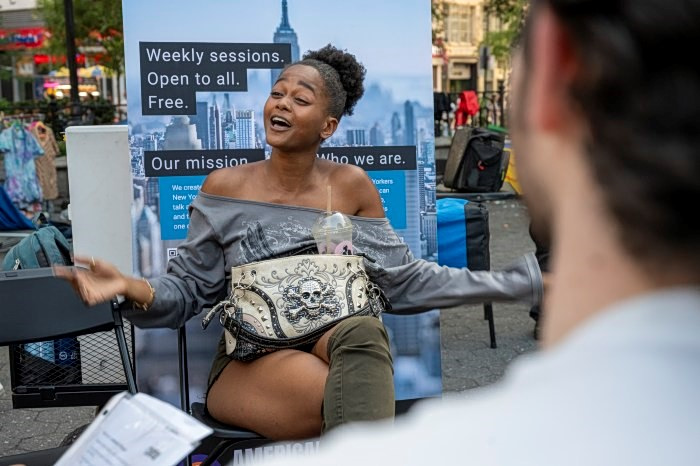
American Dialogues participants typically sit in a circle and discuss the day’s prompt. MATHYLDA DULIAN/WSJ
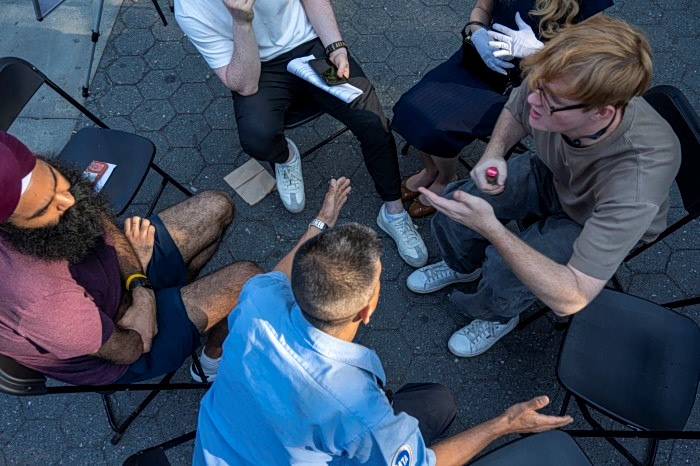
Organizers say the conversations can sometimes get heated. MATHYLDA DULIAN/WSJ
Then in 2023 he transferred to Columbia University. He began hauling chairs and a stack of conversation prompts to parks across New York, inviting commuters, dog walkers and tourists to sit down and talk. The crowd skewed younger and the conversation topics lighter, with prompts like “Come beat me in Uno.”
A month after Colleton arrived, Hamas’s attack on Israel sparked protests that left the university tense and students newly isolated. Cristian Capotescu, an associate director at Columbia’s Trust Collaboratory who studies social trust, noticed the loudest voices were drowning out a silent majority.
So Capotescu, 42, started what he called “listening tables,” moderated sit-downs where students could talk about current events without it turning into a shouting match.
A student named Zane Glassock encountered a table in Central Park. Glassock, 21, says he was struck by strangers’ willingness to sit down with college students and hand out life advice. “I don’t know any other platform that enables that so quickly,” he said.
Colleton found his way to the listening tables too, where he met Glassock and Capotescu. The three men started talking about how to combine the more academic sit-downs with the looser park sessions Colleton had been hosting.
The trio sanded the edges of Colleton’s original whimsy, borrowed some of the moderation discipline from the tables and gave the project a name: American Dialogues.

MATHYLDA DULIAN/WSJ

Cristian Capotescu (green shirt) started ‘listening tables’ in 2023 and eventually joined forces with Colleton. MATHYLDA DULIAN/WSJ
The setup is modest by design. Hosts arrive early and arrange roughly 10 folding chairs in a loose circle, then pop up a blue canopy tent that can be spotted from 50 feet away. Beside it goes a whiteboard with that day’s prompt.
“A lot of times what I write on the sign is total clickbait,” Colleton said. Recent prompts have ranged from philosophical to absurd; one read: “Do you like talking to strangers?”
From there, they wave people over or fall into step with passersby. Organizers say the more interesting recruits tend to be the ones who need no encouragement. Glassock describes the facilitator’s job as pushing a boulder: “It’s hardest when it’s yet to move,” he said. “But as soon as it starts to roll, it gets easier and easier.”
Alice Cook, 17, who has been coming to the tables for a couple of years, describes the experience as “real-life Omegle,” a service that let users video chat with strangers. “You just get a random inflow of different people.”
Cook says she was extremely socially anxious before she started coming. Now, she finds interacting with strangers considerably less scary.
Kratima Divakar, a 26-year-old lawyer from India, started attending during her first semester as a grad student. She was drawn to the opportunity to talk to people without a professional agenda, and later decided she could help the organizers attract more women.
She now runs much of the group’s outreach, and says the best conversations happen while she’s recruiting people to join the tables.
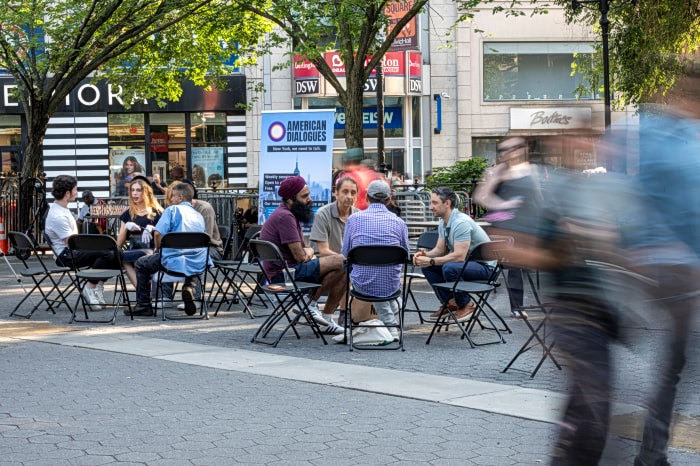
Colleton thinks the tables work in part because of the intimacy of the setup. MATHYLDA DULIAN/WSJ
Organizers say they occasionally draw people who are intoxicated, having a bad day, or simply looking for someone to vent at. At a table organized around the New York mayoral race, a participant lashed out at someone with a different opinion. Glassock, who was hosting, let it play out.
“People are holding a lot in,” he said. “That person may not have people to talk to. They just needed to be seen.”
He acknowledges not everyone can absorb that: “I’m a 21-year-old man. I felt safe receiving it. Others might not.” When things get out of hand, he’ll remind participants the table tries to focus on ideas rather than the people holding them.
Six years and thousands of strangers later, Colleton has a theory about why the tables work: There is just enough anonymity that people feel comfortable saying what they actually think, but not so much that they say things they’d be ashamed of.
Also, people sitting in small numbers facing each other, he said, is “just such a human thing, like a campfire.”