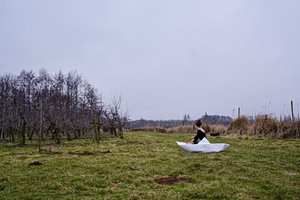
Imagine being entirely disconnected. No phone, no laptop, no smartwatch, no ring , no pings. No TV, no reading, no journaling, no music. And no talking whatsoever—not even eye contact—as you sit, eat and stroll mindfully alongside 90 or so strangers.
For five long days.
This may sound like the setting for a “White Lotus”-style murder plot. Something best suited to self-satisfied tech bros with their own private mountaintops or people who enjoy soybeans and use hashtags like #mindbodyandsoul.
“Sounds like hell,” was the most common response I got when describing my plan to head to just such a retreat last month.
And yet…that was the draw. Like many people, I spend the bulk of my life following a familiar routine. Could it hurt to pass a few days doing something altogether different? However awful, it would be over soon enough. Meanwhile, I might benefit from a spring cleaning of the brain. After years of downloading meditation apps and consistently ignoring their notifications, I might even succeed at meditating.
In my favor: though not a Buddhist, I am intellectually, if not spiritually, drawn to Buddhism’s doctrines of suffering, impermanence and nonattachment. I enjoy being alone and often wish people, myself included, would talk less.
Not in my favor: I cannot abide hippie culture, bristle at the slightest whiff of woo woo and balk reflexively at the phrase “loving kindness,” which immediately calls to mind the worst person I know.
There was the risk that in trying to achieve mindfulness, I might wind up losing my mind.
I’d heard of the Insight Meditation Society through several friends, all hardened journo types who’d come through the other side intact. IMS, they told me, was the real deal, founded in 1976 by Joseph Goldstein, Sharon Salzberg and Jack Kornfield, legendary teachers in the tradition of Vipassana, or mindfulness meditation. Located near the Berkshires, in Massachusetts, IMS has welcomed luminaries like the Dalai Lama to its grounds, which includes three dormitories and a forest retreat amid acres of well-maintained trails.
Retreatants or yogis (Pali terms are in heavy rotation in these parts) follow a strict schedule that starts with a 5:15 a.m. bell and includes three meals between alternating sets of sitting and walking meditation. Vegetarian food is served cafeteria style and in practice if not by decree, eaten slowly, putting down the fork between bites. (Takeaway: you eat less and enjoy more.)

NIKOLAI SENIN FOR WSJ
Within the niche category of meditation memoir, I’ve always appreciated narratives by dyspeptic Type As, the kind of meditators who start off by sitting in silent judgment. Here is Emmanuel Carrère in his 2020 book, “Yoga,” writing about a fellow retreatant: “Since I’m a negative sort of person, my attention focuses on him. With a pointed goatee and a wine-toned jacquard sweater, he’s annoyingly smug in the role of the smiling, benign sage, rich in insights into chakra alignment and the benefits of letting go.”
Personally, I couldn’t figure out how to size up other yogis up without getting caught in verboten eye contact, but I did notice recurring characters: a runner-up in the Philip Seymour Hoffman look-alike contest, the woman who accidentally served herself lunch before the official chime as everyone looked on in horrified silence, a couple of extroverts visibly straining not to gesticulate or emit the occasional whispered nicety.
Speaking was officially permitted during small group meetings led by the retreat’s teachers, Annie Nugent and Devin Berry. These sessions, along with daily Dharma talks, both of which I’d dreaded, turned out to be the retreat’s highlight. The teachers were wise, down-to-earth, funny and—dare I say it—enlightening. (Berry jokingly referred to himself as a “dharmaceutical rep for Big Dharma.”) I came ready to roll my eyes and found myself riveted. I could have listened for hours and may do so in future on the Dharma Seed website, which offers many of these recorded talks free.
My low point came on the second day when I set out at 9 a.m. for what I figured would be a 90-minute walk. Following the advice of a friend, who had drawn a rough map of his favorite trails before I left, I took the “longer” route. At some point I must have deviated from the path—but who knows? The map was back on my locked-away phone. Before long, I had entered a state wildlife preserve.
I spent the next three hours profoundly lost. When I finally emerged onto an unfamiliar road, I staggered up to two people standing by a lumberyard and in as few words as possible, asked how to get to IMS. It was another 5-mile walk back.
Lunch had been served hours earlier. “Cookies!” exulted the chalkboard menu, the sole dessert offered during the entire retreat. I experienced much dukkha (pain) as I spied cookie remains inside the compost bin.
The worst of it, aside from a momentary panic in the woods (bears, no water, no food, no GPS), was that it was as if it hadn’t happened. I couldn’t reassure anyone by saying “I made it!,” because no one knew who I was, never mind that I’d been missing for six hours. There was no Strava trace to show how I’d gone so astray.

NIKOLAI SENIN FOR WSJ
Apart from GPS and the weather app, I didn’t miss my phone nearly as much as I anticipated. In its absence, I recognized that I mostly turned to it out of boredom, idleness or an almost inert curiosity. For five entire days, I had no idea what Donald Trump was saying or what had happened in the Middle East.
As it turned out, I missed a lot and nothing at all.
I did miss TV and novels—narrative, fantasy, creative expression, all of which, in meditation practice, are considered distractions. Vipassana meditation involves maintaining awareness only of the current moment. When your mind wanders, whether to rehearse a future argument or ruminate over what you said Friday night, you’re meant to note it, lightly and without judgment: “thinking” or “planning.”
Actively trying to dismiss these things was exhausting. My days transformed from “Where does the time go?” to “Why won’t the time go?” Bored into slumber by 8:30 or 9, I awoke instantly to the bell at 5:15. I learned that under certain conditions, chopping vegetables—the volunteer service I signed up for—can be a source of deep engagement and satisfaction.
I don’t think I meditated particularly well, though I did sit entirely still for 45-minute long stretches, a triumph for this restless fidgeter. I learned a lot from the teachers and left eager to read more deeply into Buddhist texts. In the days that followed, I felt calmer and less reactive. I did not get anywhere close to enlightenment and likely never will. But I believe in trying.
Before You Go
Rewatch “The Matrix.” Turns out the red pill is also a metaphor for awakening.
Read Robert Wright’s “Why Buddhism is True: The Science and Philosophy of Meditation and Enlightenment” for a secular grounding in Buddhist practice
Pack good walking shoes, emergency sugar if you know you’ll miss it.
Consider cheating : You aren’t supposed to, but I packed a couple of books, albeit unexciting ones about Buddhist philosophy and nature. Only do so if you can accept that this is not the way.
Corrections & Amplifications undefined Insight Meditation Society is near the Berkshires, in Massachusetts. An earlier version of this article incorrectly said IMS was located in the Berkshires. (Corrected on June 23)