In April, the leader of Taiwan’s main opposition party traveled to mainland China for a red-carpet six-day tour, the first such visit in nearly a decade.
Officials treated Cheng Li-wun, chairwoman of the Kuomintang, or KMT, to high-level meetings and a Shanghai river cruise. The chairman of Meituan , one of China’s biggest tech companies, gave Cheng a plushy kangaroo, the corporate mascot. Capping it off, Cheng got an audience with Chinese leader Xi Jinping.
His hands were as “soft as clouds,” Cheng said later.
What hasn’t been revealed publicly: Months earlier, Chinese officials met with KMT negotiators to hammer out language Cheng would use during her trip. Cheng even shared advance copies of prepared remarks in which she made clear she opposed independence for Taiwan, to Xi’s approval, people familiar with the matter said.
The visit set off alarm bells in Taiwan, whose government is skeptical of Beijing’s intentions. It also revealed a new chapter in China’s efforts to win control of the self-ruling island democracy, which it regards as part of its own territory—without ever firing a shot.
Even as China continues to apply military pressure on the island, it is intensifying efforts to drive a wedge through Taiwanese society, courting opponents to formal Taiwanese independence such as Cheng, and sowing doubts about America’s commitment to the island.
The goal: to convince more Taiwanese that resistance to Chinese control is futile.
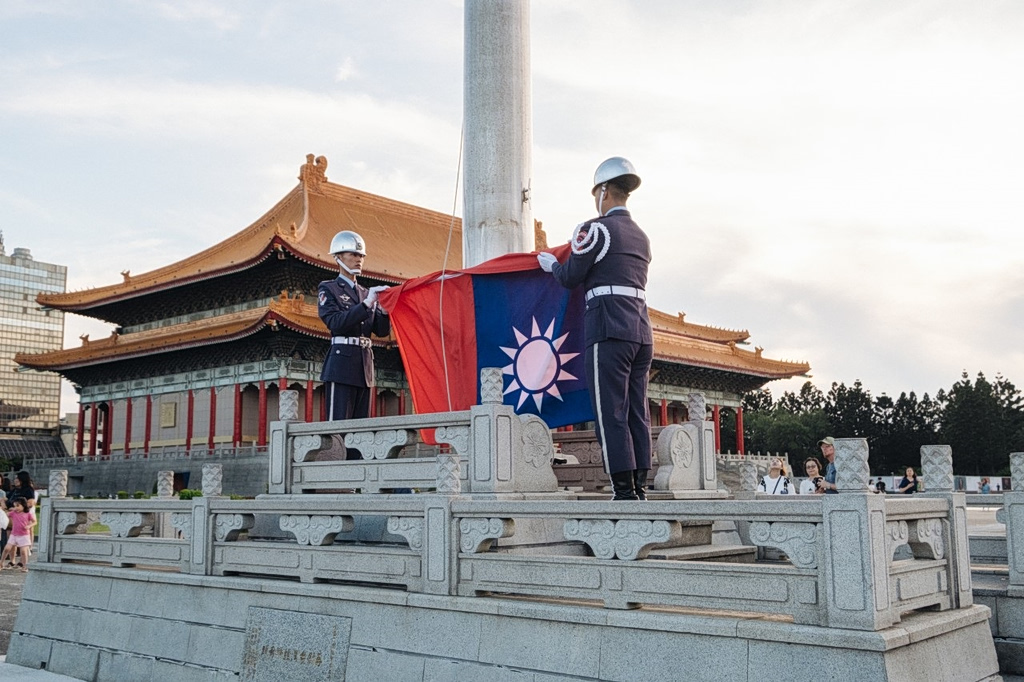
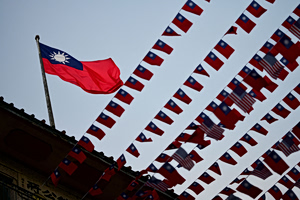
The Chiang Kai-shek memorial in Taipei in August. Sean Marc Lee for WSJ
Xi sees an opening because of rising concerns in Taiwan that President Trump might be willing to sacrifice support for the island in return for better relations with Beijing.
Trump has at times echoed Chinese talking points on Taiwan’s government, and repeatedly accused Taiwan of having stolen the U.S. semiconductor industry, a charge Taipei rejects. He has also withheld approval on a $14 billion arms sale to Taiwan, describing the package as a good bargaining chip in negotiations with China.
A recent Brookings Institution poll found that only 24% of Taiwanese voters consider the U.S. a trustworthy ally.
In some ways, U.S.-Taiwan ties have deepened. Taiwan has begun acknowledging long-concealed U.S. military training on the island, and American officials have publicly noted their cooperation with the Taiwanese coast guard—a signal to Beijing that the relationship remains solid.
Even so, Beijing views Trump’s second term as a “rare window of opportunity” to sway Taiwanese opinion in the mainland’s favor, said Chiu Chui-cheng, minister of Taiwan’s Mainland Affairs Council, the government body that oversees cross-strait policy. “They think Trump’s unpredictability on U.S. commitments gives Xi more room to operate.”
Xi is expected to keep pressing Trump on Taiwan when the two meet in Washington this week. Xi’s aim, Chinese policy advisers say, is to coax Trump into expressing clearer opposition to Taiwanese independence, further narrowing the space for Taiwan to resist. China’s Foreign Ministry, responding to questions for this article, called Taiwan “the core of China’s core interests.”
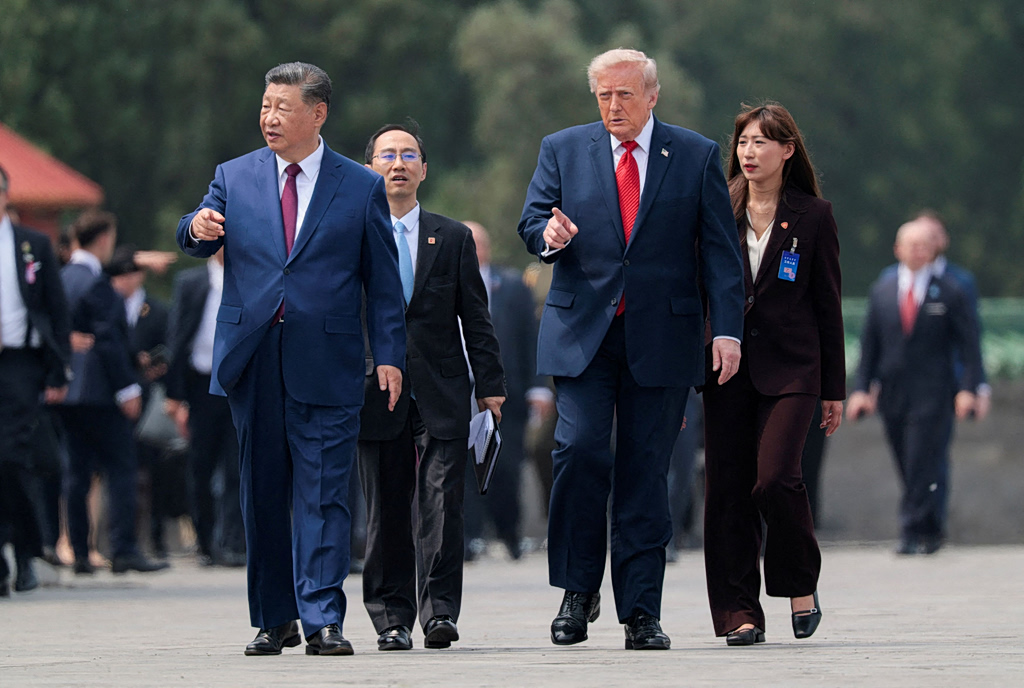
FILE PHOTO: U.S. President Donald Trump and Chinese President Xi Jinping walk together as they tour the Temple of Heaven in Beijing, China, May 14, 2026. REUTERS/Evan Vucci/File Photo
At the same time, Beijing is trying to exert more influence on the ground in Taiwan. One way it hopes to do that is by working with Cheng, a 56-year-old former legislator and TV talk-show host who emerged unexpectedly last year as the head of the opposition in Taiwan and a possible future presidential candidate.
Tall and telegenic, with smartly tailored suits, she has a delivery so forceful that organizers of a press briefing late last year stopped to re-test three microphones before concluding she simply speaks at what local journalists described as “talk-show volume.”
She has made warmer relations with Beijing a priority.
“Many friends in the international media have asked me whether I am pro-China or pro-U.S.,” Cheng said during a party meeting in Taipei. “I ask in return: Why can’t I choose both? Why must I choose a side?”
“We will never forget the friendship and generosity of the United States,” she added. “But at the same time, mainland China is our family, and we could never bring ourselves to harm our own flesh and blood.”
Cheng and her supporters say she has no plans to bend to Beijing and simply wants to promote better relations.
Cheng declined to comment.
“The KMT’s approach has consistently been guided by Taiwan’s interests, with the goal of preserving peace and stability across the Taiwan Strait while safeguarding Taiwan’s democracy and way of life,” the party said in a statement.
Impatience in Beijing
Policy advisers in Beijing said Xi, 73, feels increasing urgency to show progress on controlling Taiwan, a historical mission central to his legitimacy. Although he remains firmly in power, he faces a pivotal Communist Party congress next year in which questions of succession loom, and a new generation could press for results on Taiwan.
In addition to courting the KMT, Beijing is flooding digital spaces with content mocking the ruling Democratic Progressive Party, or DPP, and amplifying narratives that Washington will abandon the island, leaving China as the only partner Taiwan can trust.
Taiwan’s National Security Bureau said in a report earlier this year that Beijing had launched an “all-out” cognitive warfare campaign via online platforms and fake websites. It identified 45,000 suspected accounts in 2025, up from around 28,000 in 2024, the report said.
One deepfake video, which Taiwanese officials linked to China, fabricated a dialogue between Taiwan President Lai Ching-te and Vice President Hsiao Bi-khim that included the line: “The U.S. is no longer able to contain China, and may trade us away one day.”
Mainland-generated AI disinformation campaigns have also been detected supporting Cheng’s election as chairwoman of the KMT party last year, according to Taiwanese security officials. The officials ultimately determined the campaign helped tilt the election in Cheng’s favor, calling it interference by Beijing in a Taiwanese political party.
Beijing has long denied involvement in disinformation campaigns. It says Taiwan, which the Communist Party has never ruled, is an inalienable part of Chinese territory, and it will do whatever it takes to bring the island under mainland control.
Military pressure remains a major way for Xi to squeeze Taiwan. In early August, Beijing said it had imposed traffic control measures on ships passing through the strait’s southern entrance, the latest assertion of jurisdiction over waters around the island.
Still, people familiar with Xi’s thinking say he worries an invasion of Taiwan could turn into a quagmire. Persuading more Taiwanese to reconcile with Beijing could enable him to show momentum, without the dangers of a war.
Overall support for unification in Taiwan has fallen to under 8%, from 22% three decades ago, according to a long-running National Chengchi University poll.
But about 21% of under-20s held a positive view of China in a poll last year by World United Formosans for Independence, a pro-independence group in Taiwan, the highest of any age group.
Many young Taiwanese haven’t lived through decades of tensions with the mainland, and some embrace Chinese popular culture. Beijing has worked with influencers on YouTube and TikTok, offering them sponsored trips and VIP treatment in exchange for content that echoes Communist Party talking points, according to an Australian Strategic Policy Institute analysis.
Taipei restricted access to one of the most popular Chinese social-media platforms, Xiaohongshu, in December, amid fears it could be a vehicle for soft-power influence.
Taiwan is gearing up for elections in November for mayors and other local positions that could bring more politicians sympathetic to Beijing into positions of power. A bigger prize for China would be ousting the DPP, which has ruled since 2016 and is loathed by Xi, and replacing it with a Cheng-led KMT in Taiwan’s next presidential race in 2028.
Though the DPP maintains an edge in some recent polls, the KMT has a strong influence in Taiwan’s local politics and currently controls Taiwan’s legislature. It recently used that advantage to force President Lai’s administration to scale back a $40 billion special defense budget.
DPP leaders say they have already detected signs Beijing will try to sway the November vote, as it tried to do, largely without success, in the 2024 presidential election.
In June, Taiwanese authorities traced a cluster of near-identical Facebook posts, some blaring fake alerts such as “Breaking News—the national emergency alarm went off loudly,” to a military-linked content farm in China’s Hebei province. The goal, an official said, was to build a following that could be activated later to flood the campaign with disinformation.
Courting the KMT
Founded in the early 20th century, the KMT was led for decades by Chiang Kai-shek, the Nationalist military commander who fled to Taiwan in 1949 after his defeat by Mao Zedong’s Communist forces. The group ruled Taiwan under martial law before the island’s democratic transition in the late 1980s and 1990s.
While officially opposed to immediate unification, the KMT is generally seen as friendlier to Beijing than the DPP, attracting Taiwanese voters who favor calmer relations over confrontation.
When the KMT last held Taiwan’s presidency, from 2008 to 2016, it fostered closer economic and political ties with the mainland, including the start of direct cross-strait flights.
Xi’s goal is to “use a genuine believer to move pro-unification forces from the margins of Taiwanese politics into the mainstream,” said Lai I-Chung, a cross-strait analyst at Taipei’s Prospect Foundation.
Cheng, the KMT chairwoman, got her start as a student activist in pro-democracy protests against the KMT, advocating Taiwanese independence. But she left the DPP in the early 2000s and joined the KMT, the more Beijing-friendly party—though her embrace of closer ties with China would come years later.
Only when the party’s chairmanship race opened last year did she emerge as the most powerful figure in Taiwan’s opposition. Her history of shifting positions makes her more useful to Beijing, political observers say, suggesting she is driven more by personal ambition than a firm ideology.
“Xi likely sees Cheng as his best chance to move the KMT in a more overtly pro-China direction,” said David Sacks, a Taiwan analyst at the Council on Foreign Relations who has met with Cheng in Taipei and New York. Although Cheng understands much of her appeal within her party rests on her ability to engage directly with Xi, Sacks said, “in the end, that gives Xi leverage.”
Exerting influence
Ahead of last October’s chairmanship vote, Taiwan’s National Security Bureau flagged 23 suspected YouTube accounts and roughly 1,000 TikTok clips pushing content about the race, its director, Tsai Ming-yen, said. Some of the posts lampooned Cheng’s rivals. Taiwanese authorities traced some of the accounts to Chinese military units.
Cheng portrayed herself as someone who could promote peace with China through more dialogue with Beijing. In the end, only about 40% of party members voted, with Cheng getting 50% of those who showed up.
Some of Cheng’s first actions as party leader appeared calculated to please Beijing. In November, she laid flowers at a memorial for victims of the White Terror—the KMT’s own postwar political-repression campaign—where those honored included Wu Shi , a Communist Party spy who was executed by Taiwan in 1950 and is celebrated as a martyr in Beijing.
Taiwan’s ruling party accused Cheng of “failing to distinguish friend from foe,” while Beijing was delighted, people familiar with the matter said.
The KMT, in its statement to The Wall Street Journal, said Cheng’s attendance at the memorial was meant “to remember history, cherish peace, and prevent cross-strait relations from ever descending into war again.”
Cheng’s China tour in April—the first trip by a major Taiwanese party leader since a previous KMT head went in 2016—was then choreographed with Beijing’s help. Details of the trip were “all up to them,” said Alexander Huang, a former director of the KMT’s Department of International Affairs, referring to Chinese officials.
The itinerary included multiple demonstrations of Chinese technological muscle, including an automated deep-water container port in Shanghai and the assembly line of jet maker Comac. At Meituan’s headquarters, Cheng ordered pearl milk tea on her phone, delivered by drone, before the company’s chairman, Wang Xing, presented her with the kangaroo mascot.
“I must bring the doll back to Taiwan. I also want to bring Meituan back to Taiwan,” she said—a nod to importing the mainland’s tech-driven delivery services.
Cheng’s opposition to Taiwan independence was already written into her prepared remarks before the trip. Cheng has told associates she didn’t raise reunification with Xi, people familiar with the matter said.
Reshaping consensus
She did, however, use language that appeared to move the KMT closer to Beijing’s interpretation of cross-strait relations.
A crucial moment, political observers say, came when Cheng made public remarks about what is known as the ’92 Consensus, a tacit understanding reached by negotiators for Beijing and Taipei in 1992 that laid the foundation for relations between the two sides over the ensuing decades. Under that understanding, each side accepted there is “one China” while papering over what that meant.
Beijing interpreted it to mean Taiwan was a breakaway piece, awaiting return. The KMT interpreted it to mean that the Republic of China—the government that has run Taiwan since 1949—can still claim the mainland.
In 2019, Xi tied the understanding to unification and called for exploring a “one country, two systems” plan for Taiwan—the same model used to govern Hong Kong—leaving no room for a separate Taiwanese government.
In her China visit, Cheng landed on a formula closer to Xi’s reading, embracing the idea of “one China,” dropping the KMT’s traditional insistence on “respective interpretations” of the deal, and stressing opposition to independence.
Many KMT members and other Taiwanese were unsettled. Cheng rejected the criticism, framing her approach as necessary to avoid conflict rather than a capitulation to Beijing.
The risk for Beijing is that it overreaches, deepening resentment of the mainland in Taiwan. Analysts across the island’s political spectrum say public opinion hasn’t fundamentally shifted in favor of unification. Even inside the KMT, there’s worry Cheng reads as too pro-China heading into the local elections later this year.
Cheng’s position is “solid but small,” said Huang, the former senior KMT official. “Most party members, including younger ones, still regard Beijing as just communists.”
Write to Lingling Wei at Lingling.Wei@wsj.com and Joyu Wang at joyu.wang@wsj.com