Ever since President Trump’s return to office, America’s allies have been fretting about Washington’s intentions. Now, after the inconclusive war against Iran has eroded U.S. weapons stockpiles and laid bare the limits of American hard power, they also worry about American capabilities.
Can America still defend its friends, if it wants to?
The question that officials in allied—and adversary—capitals are asking themselves is whether industrial decline, strategic incoherence and political dysfunction have weakened the U.S. to the point where it would no longer wield decisive force in a multi-front conflict that may encompass Europe, the Middle East and Asia. It is a concern shared by many in Washington, too.
“If you think about deterrence, it’s about capability and credibility,” said strategist Matthew Kroenig, a senior fellow at the Atlantic Council who served in the Pentagon during the first Trump administration. “The question used to be credibility—will the United States really do it? But capability is an important part of this equation. And, with all the reporting about how the U.S. is expending munitions, it’s just logical that adversaries would assume that the U.S. is less capable now than it was several months, or several years, before.”
Trump’s decision to scale back military exercises with South Korea and to describe North Korea’s dictatorship as “unthreatening and respectful” just as Pyongyang is deploying ballistic missiles and troops to Europe as part of its alliance with Russia is the latest move that has raised doubts about American staying power.
The overture to Pyongyang came alongside a monthslong drive to accommodate China, including a freeze on $14 billion in U.S. military sales to Taiwan—a reversal of Trump’s first-term priorities. Meanwhile, crucial U.S. military assets, from missile defense batteries to the sole aircraft carrier still deployed in the Pacific, have been moved from Asia to deal with the Middle East crisis.
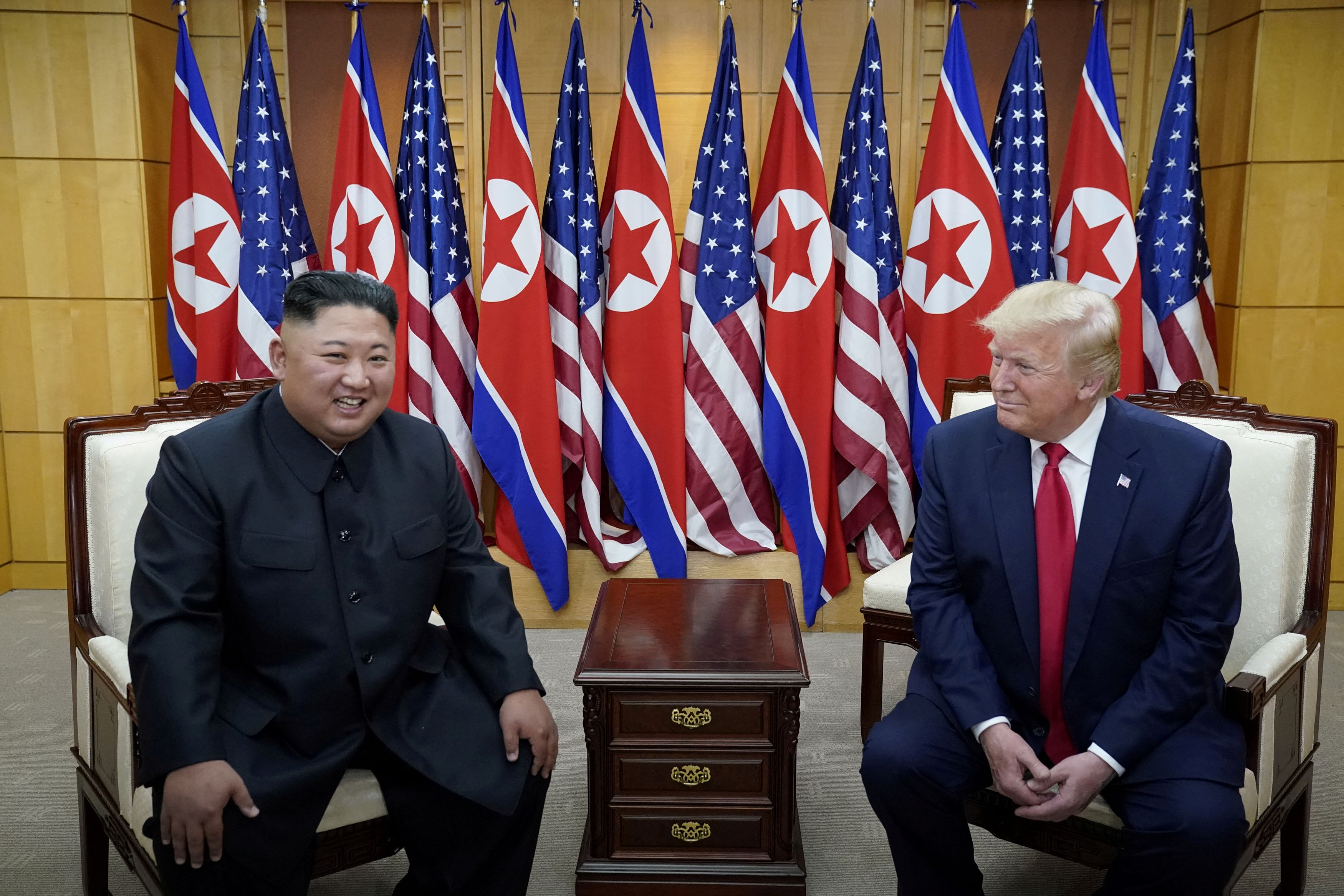
FILE PHOTO: U.S. President Donald Trump meets with North Korean leader Kim Jong Un at the demilitarized zone separating the two Koreas, in Panmunjom, South Korea, June 30, 2019. REUTERS/Kevin Lamarque/File Photo
While paying lip service to the NATO alliance in public, European officials are increasingly doubtful in private that Trump’s America will help them in case Russia attacks. “Unofficially, we all know that they won’t risk their security for the sake of the Baltic states, or for the sake of Germany,” said retired colonel Roderich Kiesewetter, a lawmaker from Germany’s ruling party. “The American nuclear umbrella is gone.”
The growing sense of American—and Western—vulnerability can tempt autocratic adversaries, particularly Russian leader Vladimir Putin , warned Nico Lange, a former senior German defense official who now runs the Iris think tank. “Iran is increasingly humiliating the United States in front of everybody, while the U.S. is creating uncertainty about their commitment to European security, and the Europeans aren’t showing any will to deter Russia,” he said. “All this creates an opportunity structure for Putin that is extremely dangerous.”
The White House has pushed back on reports of weapons shortages caused by the war in Iran. “The United States Military has more than enough munitions, ammo and stockpiles to serve all of President Trump’s strategic goals and beyond, and Operation Epic Fury has exposed what happens when you mess with the United States,” deputy press secretary Anna Kelly said. “Even still, the President has urged our defense contractors to constantly produce more made-in-America weapons, which are the best in the world.”
Military analysts, however, calculate that, in some vital categories, stocks are running dangerously low and will take many years to replenish. The Center for Strategic and International Studies has estimated that the U.S. has already burned through half of its prewar stocks of missile interceptors, such as Patriots and Thaads, and has used up one-third of the arsenal of Tomahawk and JASSM long-range missiles.
This has direct implications beyond Iran. A Council on Foreign Relations expert study released this month said that “the U.S. weapons arsenal has been depleted and no longer has the capacity to deter a Chinese attack against Taiwan.” It added that Washington needs to immediately put mass production of precision missiles on a wartime footing because “waiting until conflict begins will be too late.”
Asked about these calculations, the Pentagon replied with a statement by chief Pentagon spokesman Sean Parnell. “Claims of U.S. munitions shortages are false,” it said. “America’s military remains the most powerful fighting force on earth. We have everything required to strike at the time and place of the President’s choosing.”
Yun Sun, director of the China program at the Stimson Center in Washington, said that U.S. denials of missile shortages aren’t surprising. “America will never acknowledge that we don’t have enough ammunition. It will assert that it has the ability to walk and chew gum,” she said. “But deterrence is in the eye of the beholder. What if Taiwan perceives that you don’t have the capacity and the will to defend it, and that its best option is to be coerced by China and to start negotiations over unification?”
China and other potential adversaries would be foolish to try taking military advantage of this shortfall, said Michael Fullilove, executive director of the Lowy Institute in Australia. America, he said, remains the pre-eminent global power, with the financial, technological, cultural and demographic muscle to rebound.
“When people say America is weak, Vladimir Putin would love to be as weak as America. Xi Jinping would love for China to be as weak as America,” he said. “I don’t want to be Pollyannish, but when I squint my eyes I see American strength more than American weakness.”
Unlike in Europe, where defense officials increasingly fear the prospect of Putin taking the war beyond Ukraine, officials and analysts in Asia don’t see a full-scale war on the horizon just yet.
“People will worry, of course, but these munitions will be restocked. And in the meantime, there is really very little probability of a major conflict breaking out in East Asia,” said Singaporean political analyst Bilahari Kausikan, the island nation’s former ambassador to the United Nations. “The Chinese have a huge number of domestic problems to deal with first, and with Taiwan in particular, they are not gamblers. In all the potential flashpoints in Asia, nobody thinks that a big conflict is imminent.”
In all these actual and potential conflicts involving U.S. allies and partners worldwide, the critical shortage of ballistic-missile interceptors, particularly the Patriot PAC-3 MSE, has emerged as an Achilles’ heel for the entire free world—and its partners.
Part of the imbalance in the missile threat is that the autocracies—those actually at war, like Russia and Iran, and those not yet, like China—have already put their defense-industrial base on a war footing, achieving rapid increases.
The West lives according to peacetime rules, in which corporate calculations and shareholder interests often trump national-security needs. “This is the existential problem: our foes think they are at war, while we pretend that we are not,” said a senior European defense official.
CSIS has estimated that the U.S. now only has 800 Patriot missiles left in its arsenal. Despite the rapid consumption by Ukraine and multiyear backlogs, interceptor manufacturers have only achieved a modest boost in production so far. Lockheed Martin said it delivered 620 PAC-3 MSE interceptors last year, an increase of more than 20% from the year before. Russia’s missile production, by contrast, has surged since 2022, despite Western sanctions.
This disparity has strategic consequences. Ukraine has already been essentially left defenseless against Russian ballistic missiles salvos, as Trump declined Kyiv’s repeated requests for more Patriots. This, in turn, has added to Putin’s determination to continue the war, as Russia counts on missile strikes to destroy Ukraine’s energy infrastructure in the coming winter, forcing Kyiv to capitulate.
In the Persian Gulf, states like Saudi Arabia have opposed a resumption of a full-scale U.S. campaign against Iran because their own interceptor stocks are too low to protect vital infrastructure against renewed Iranian missile barrages. European nations, while working on their own missile-defense projects, remain years away from credible protection against Russian—or Iranian—missiles.
“There is now a risk of an acute crisis across different theaters brought about by the shortage of interceptors and missile defense,” said John Bew, who served as foreign-policy adviser to British prime ministers in 2019-2024 and is now a professor at the War Studies Department of King’s College London. “This has immediate implications for the Gulf, of course, but is increasingly understood as a major shortfall in European defense and has potentially major consequences in Asia, too.”
Russia alone now manages to produce more than 100 ballistic missiles a month, according to intelligence estimates, and a similar number of cruise missiles. The overall production of ballistic missiles by the axis of adversaries that also includes China, North Korea and Iran outmatches the manufacturing of interceptors in the West by several times. (Making the math even more alarming, shooting down one ballistic missile usually requires two or even three interceptors.)
“We in the West have made a strategic planning mistake in not calculating interceptors against ballistic missiles that are produced,” said Lange, the former German defense official. “We have a problem in ballistic missile-defense production, but they don’t have a problem in ballistic missile production—not in Russia, not in China, not in North Korea.”
Ballistic missiles have become an instrument of geopolitical coercion because of technological change. Previous generations of ballistic missiles were so costly and imprecise that they were mostly considered useful in the nuclear context, in which a deviation of hundreds of yards from a target didn’t matter because of the mass devastation caused by a nuclear device. Up until the U.S. withdrew following the Sept. 11, 2001 attacks, a Cold War-era treaty strictly limited antiballistic missile defense capabilities to maintain the equilibrium between the two superpowers.
Now, however, even middle powers like Iran have developed precision ballistic-missile capabilities. Iranian missiles managed to inflict serious damage on U.S. military bases in the Gulf and Jordan, as well as energy and industry targets in Gulf nations and Israel. Though Iran’s missile forces have been degraded by Israeli and American bombing, they have yet to be fully suppressed.
“In the environment of major interstate war, even substantially weaker adversaries have enough capability to hurt, enough capability to launch these ballistic missiles. And even the United States, with all of its financial and industrial power, is not able to keep up structurally,” said missile expert Fabian Hoffman, a senior fellow at the Norwegian Institute for Defense Studies. “Ballistic missile defense, as it was conceived, has just been exposed as something that doesn’t work that way in practice.”
Interceptors able to counter modern ballistic missiles are among the most sophisticated and expensive military systems, which is why only a handful of companies worldwide can make them. That is a huge difference with the parallel revolution in drone warfare: drones, and systems used to intercept drones, including air-defense drones, are much simpler and cheaper.
The U.S. and allies now are pumping hundreds of billions of dollars into missile defense and long-range strike programs. The Pentagon’s $59 billion deal announced with Lockheed Martin last month would triple Patriot PAC-3 production by the end of 2030. The Pentagon has also awarded Lockheed Martin a $35 billion seven-year contract to quadruple Thaad interceptor production. Both of these contracts have yet to be fully funded.
There is a certain silver lining in the fact that the shortfall in missile defense has been exposed in a war against a relatively weak foe like Iran, argued Ludovic Hood, a senior fellow at the Hudson Institute who served in senior State Department positions involving Ukraine and the Middle East until earlier this year.
“The wake-up call was necessary. It’s been very easy for Western powers in recent decades to be lulled into a sense of false security,” Hood said. “As unpleasant as it is to have to go to war, it can actually be a useful forcing function to make sure that we’ll be prepared for something much more strategically challenging in the future.”