
 Μake us preferred on Google
 The killing of the conservative activist and influencer Charlie Kirk, as he spoke Wednesday to university students on a Utah campus, is the latest evidence that political violence is now a frequent and terrifying fact of American life.
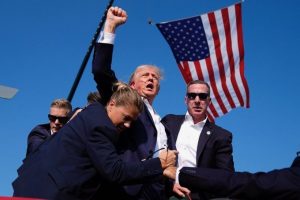
From President Trump, who was targeted in two assassination attempts last year, to lawmakers, judges and local elections officials, violence is now a continuous threat for public figures across the country. The shooting of Kirk is poised to drive a divided nation even further into its partisan silos, amplifying the animosity between the political parties.
“It’s ‘us versus them’ on steroids,” Lilliana Mason, a Johns Hopkins University professor who studies political identity, said of the American political landscape. She added: “It’s not just a matter of us having political power versus them having power. It’s us surviving versus them surviving.”
Last year, nearly 9,500 threats and concerning statements were leveled against Congress members, families and staff, and the Capitol complex, up from about 8,000 the year prior, the U.S. Capitol Police reported. In 2017, the number was less than 4,000.
Americans in recent years have had to grapple with incidents such as the killing this June of Democratic state Rep. Melissa Hortman and her husband, and the shooting of Republican Rep. Steve Scalise in 2017, which nearly killed him.
Judges and prosecutors have also been targeted. Compared with 2021, threats against federal judges doubled to 457 in the fiscal year that ended in September 2023, the U.S. Marshals Service has said.
Trump called the Kirk shooting “a dark moment for America.” While the motive and mental state of the assailant is unknown, the president revived an argument among some Republicans that the left was at fault for recent violence.
“For years, those on the radical left have compared wonderful Americans like Charlie to Nazis and the world’s worst mass murderers and criminals,” the president said in a video posted online. “This kind of rhetoric is directly responsible for the terrorism that we’re seeing in our country today, and it must stop right now.”
Trump ticked through a set of recent acts of political violence, omitting those against Democrats, and said: “Radical left political violence has hurt too many innocent people and taken too many lives.”
The Kirk shooting renewed a fight between the parties over which actions might reduce violence. Sen. Elizabeth Warren (D., Mass.), when asked about assertions that Democrats need to lower the temperature in politics, said: “Why don’t you start with the president of the United States, right? And every ugly meme he has posted and every ugly word.”
Warren, who spoke to reporters before Trump released his video, pointed to an image the president’s account posted online last week that showed helicopters over the Chicago skyline, alongside flames that seemed to come from wartime bombing. “When he’s posting things like he did a couple of days ago, trying to show an entire city on fire…then I just don’t want to hear this from Republicans,” Warren said.
In contrast to Trump, Utah Gov. Spencer Cox, a Republican, included victims on both the left and right in saying the nation is broken. “Nothing I say can unite us as a country. Nothing I can say right now can fix what is broken. Nothing I can say can bring back Charlie Kirk,” Cox said.
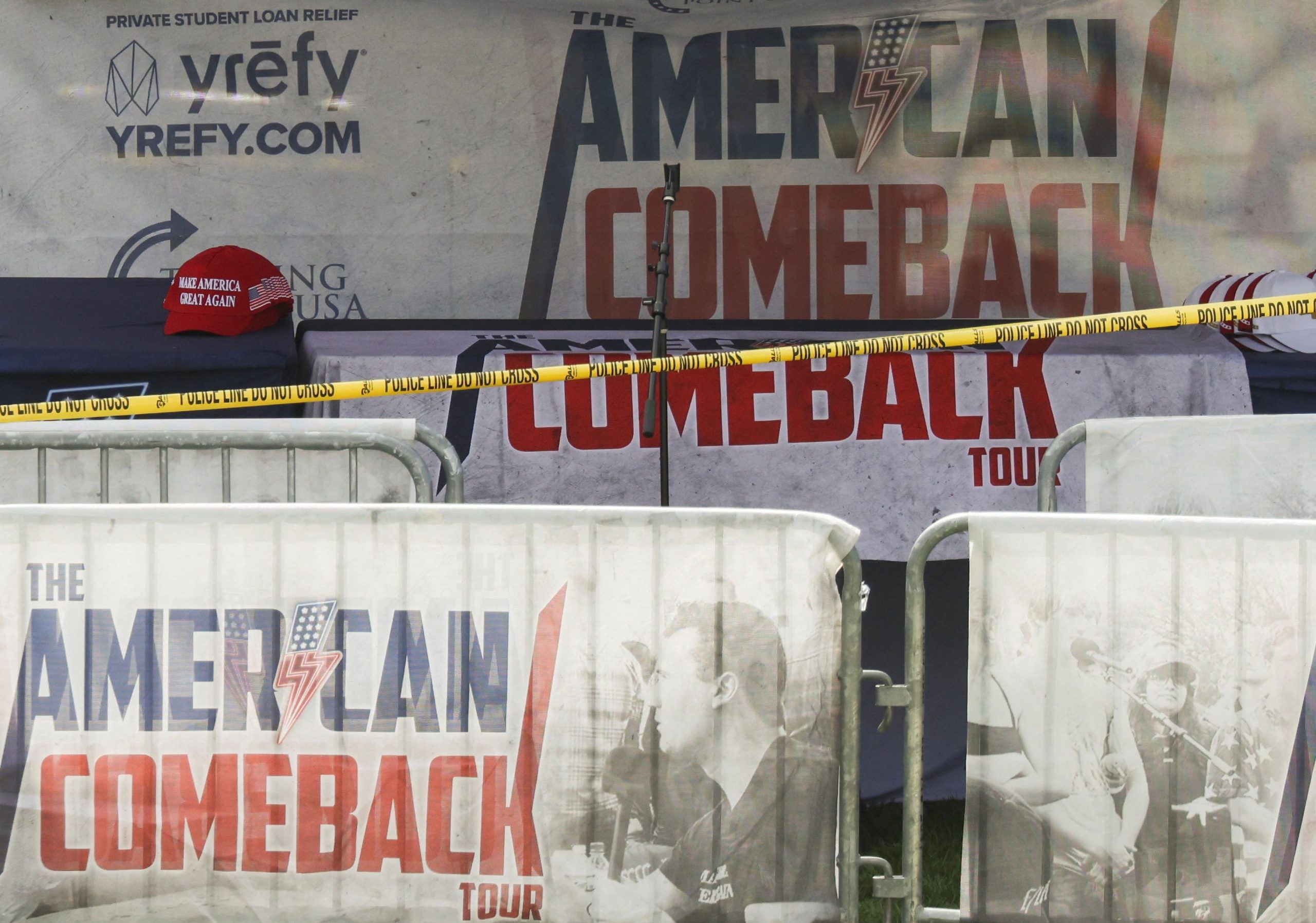
Kirk, who built his Turning Points USA organization into a powerful, pro-Trump force in media and voter mobilization, especially among young people, was shot as he spoke to a large crowd at Utah Valley University under a tent carrying his familiar “Prove Me Wrong” slogan—the challenge he offered on campuses that he would debate all comers. It was the kind of event he has held scores of times, producing videos that earned tens of millions of views and propelled his popularity. Video showed him tossing baseball caps carrying a pro-Trump slogan to the eager audience Wednesday, as he has often done lately on campuses.
Kirk was talking about mass shootings when he was shot, responding to an audience question. In a 2023 appearance, he said that there were ways to reduce gun deaths, but that they couldn’t be completely eliminated.
“I think it’s worth it to have a cost of unfortunately some gun deaths every single year so that we can have the Second Amendment to protect our other God-given rights,” he said, according to video of the 2023 event.
The shooting stands to make public figures rethink how they engage with their audiences.
“It’s going to change things. There’s no way this doesn’t change things,” said Kristan Hawkins, who leads the antiabortion group Students for Life of America and was a friend of Kirk. She was speaking at the University of Montana when she heard that Kirk had been shot, and she left the campus shortly afterward to ensure her safety.
Hawkins said she is especially concerned with how she ensures the security of members of local student chapters who conduct antiabortion outreach at some 1,600 campuses around the country. She also holds a dim view of the prospect of debate between liberals and conservatives going forward.
“It’s a new civil war, and nothing good is going to come out of it,” she said.
In Washington, many political leaders emphasized that violence has no place in politics. “Political violence has become all too common in American society, and this is not who we are,” House Speaker Mike Johnson (R., La.) told reporters at the Capitol. “We need every political figure, we need everyone who has a platform, to say this loudly and clearly.”
Gavin Newsom, the Democratic governor of California, called the shooting “disgusting, vile and reprehensible.” Newsom, who chose Kirk as the first guest on a podcast he started this year, wrote on X, “We must reject political violence in every form.”
Some others joined Trump in accusing opponents of fueling the violence. “The Left couldn’t stand 15 feet in front of Charlie and argue with his logic, so they shot him from 200 yards away, instead,” Rep. Pat Harrigan (R., N.C.) posted on X. Elon Musk, the Tesla chief executive and erstwhile Trump ally, wrote, “The Left is the party of murder.”
Animosity between the two parties has risen in recent years. More than 80% of Democrats and 80% of Republicans hold not only an unfavorable view of the opposing party but a “very unfavorable” view, The Wall Street Journal found in a survey this July.
By contrast, 50% of Republicans and 40% of Democrats held “very negative” views of the opposing party when the Journal and NBC News surveyed voters in 2010.
Political disagreements have grown to the point where each party feels that losing an election means more than losing a policy debate; it means one’s way of life is at risk. When NBC News asked in 2022 if the opposing party’s agenda would destroy America if enacted, 79% of Republicans and 81% of Democrats agreed.
Political violence has marred public life since the nation was founded. Mason, the Johns Hopkins University professor, said the current environment is particularly concerning because policy disagreements reflect the views of each party more uniformly than in the past. The civil-rights movement and anti-Vietnam War movement, for example, didn’t map cleanly onto partisan lines, as neither party uniformly backed one side in those conflicts.
“There has been political violence at other times,” Mason said. “But when it is organized and aligned along party lines, it becomes institutionalized in a way that is very dangerous.”