
 Μake us preferred on Google
 Iran is entering negotiations with the Trump administration with an eye on a big prize: tens of billions of dollars locked abroad that could help revive its crisis-hit economy.
Some of the assets have been frozen for nearly as long as the Islamic Republic, which dates to the 1979 revolution, has existed. But the blocked assets are mostly more recent payments for Iran’s oil sales to China, India, South Korea and Japan—money got stuck when President Trump withdrew from the Obama administration’s nuclear accord and reinstated sanctions on Iran in 2018.
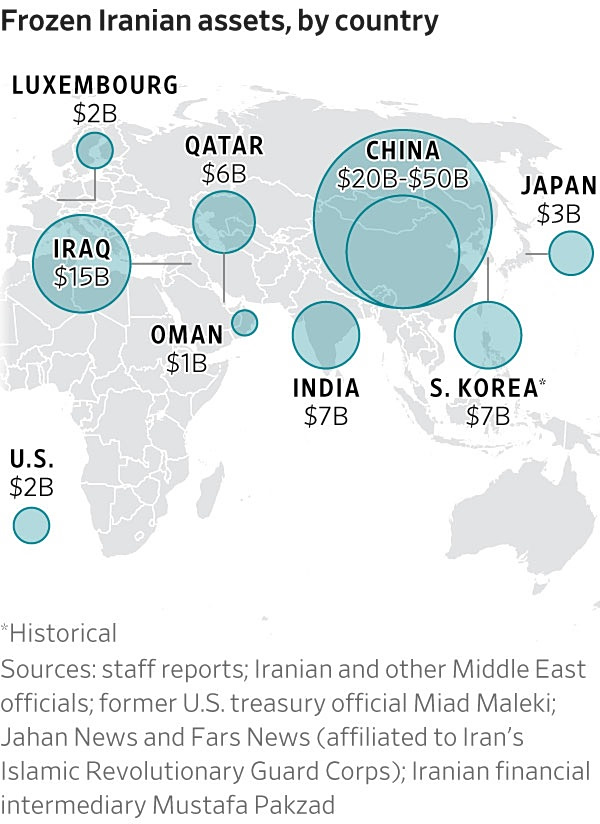
Estimates of how much Iranian assets abroad are worth vary, with Tehran saying it is at least $100 billion. Other experts put it much lower. Tehran’s priority is to unblock an initial $24 billion in phases.
Releasing some of the cash would allow Iran’s leaders to increase the value of the country’s currency and lower inflation, said Esfandyar Batmanghelidj, chief executive of the economics-focused think tank, the Bourse & Bazaar Foundation. But “Iran will still have a very strong incentive to pursue broader sanctions relief,” he said.
China has long been the biggest buyer of Iranian oil, and estimates of Tehran’s frozen assets there range from $20 billion to $50 billion.
The U.S. is able to stop countries from paying Iran for oil because almost all global oil deals are transacted in dollars. The Treasury Department can block financial institutions from the dollar system if they violate sanctions, a powerful tool used increasingly by the U.S. in the past two decades.
Even after the war started, China continued to secretly buy Iranian oil , The Wall Street Journal has reported. Iran has been able to tap some of these funds to purchase Chinese machinery and auto spare parts, among other things, the Journal has reported.
Iraq is a major buyer of electricity and natural gas from Iran, its neighbor, but U.S. restrictions have long prevented Baghdad from paying for the services. The Trump administration last stopped allowing Iraq to pay Iran for the power supplies.
Before Trump pulled out of the Obama-era nuclear deal, India was Iran’s second-largest oil buyer. The Trump administration’s sanctions forced Indian banks to withhold payments for the purchases of Iranian crude.
Like India and China, South Korea was a major oil customer of Iran’s before the first Trump administration imposed sanctions. Much of the $7 billion frozen there was later transferred to Qatar as part of a prisoner exchange with the U.S..
The U.S. reversed course after the Oct. 7, 2023, attacks on Israel by Iran-backed Hamas, a U.S.-designated terrorist organization. Washington still hasn’t allowed Qatar to transfer the funds, which were meant to be used only for humanitarian purposes. Current negotiations focus heavily on granting Iran access to these funds.
Iranian assets are also held in Japan, Luxembourg, Oman and even the U.S.
Note: All figures are estimates.
Write to Benoit Faucon at benoit.faucon@wsj.com and Emma Brown at Emma.Brown@wsj.com