TAIPEI—Taiwan is opening up about long-concealed U.S. military training while Americans note their cooperation with the island, sending a message to China that ties are strong despite comments by President Trump that appeared to put the relationship in jeopardy.
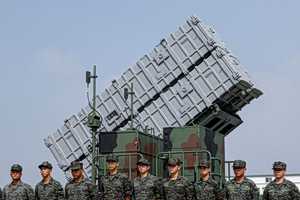
Taiwan’s military collaboration with the U.S. “is far closer than you might imagine,” Defense Minister Wellington Koo told a small group of reporters, a rare recognition of a secretive American role in helping Taiwan strengthen its defense and deter China.
Beijing claims the democratic island as its own and hasn’t ruled out the use of force to seize control. The U.S. is committed by law to provide the island with the means to defend itself, selling billions of dollars in weapons to Taiwan.
“The public sees only the arms sales, but in fact, it’s multifaceted and involves so much more,” Koo said Friday. “Through military exchanges, we have been learning so much practical combat experience from the U.S.”
The Pentagon and U.S. Pacific Command said they had no comment.
Koo added that Taiwan’s planning for potential conflict with China doesn’t include U.S. military intervention.
Training troops in Taiwan is a sensitive issue that both sides have long kept in the shadows to avoid potential retaliation from Beijing.
Even maritime cooperation in law enforcement has been a touchy subject. But the American Institute in Taiwan, the de facto U.S. Embassy in Taipei, released a photo last week of Taiwanese and U.S. Coast Guard cutters sailing in tandem.
“The United States Coast Guard and the Taiwan Coast Guard are busy coordinating on shared maritime objectives,” the post said. It added that the U.S. “appreciates Taiwan’s partnership in maritime security and safety, and supports Taiwan’s meaningful contributions on global issues including maritime law enforcement exchange and international cooperation.”
While the U.S. and Taiwan coast guards are “quite different” from their militaries, Taiwan’s government favors making their cooperation more public, said Bonnie Glaser, managing director of the Indo-Pacific Program at the German Marshall Fund of the United States, a Washington-based think tank.
Kuan Bi-ling, minister of Taiwan’s Ocean Affairs Council, which oversees the Taiwan Coast Guard, responded on her Facebook page to the AIT post: “This announcement is deeply significant and a new step by the U.S. that reflects its commitment to maintaining peace and security in the Western Pacific.”
These more open stances came after comments from Trump called U.S. support for Taiwan into question, and as Chinese pressure on Taiwan has steadily mounted .
On Friday, two Chinese coast guard ships conducted what it said were routine law enforcement patrols in waters east of Taiwan, far from the Chinese mainland. China’s coast guard has become effectively a military asset and regularly join exercises designed to practice invasion or blockade scenarios and intimidate Taiwan.
There were 85 similar coast guard sightings reported by Taiwanese authorities in May and June—a nearly 90% increase compared with the same period last year.
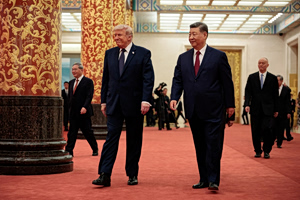
Trump’s remarks following a Beijing summit with Chinese leader Xi Jinping—specifically not wanting “to travel 9,500 miles to fight a war”—have raised concerns in Taiwan about the credibility of U.S. commitments, said David Sacks , a Council on Foreign Relations fellow for Asia studies.
“The fact is, despite talk of a detente between Washington and Beijing, Chinese coercion of Taiwan has only increased since Trump’s meeting with Xi,” said Sacks. “President Trump’s statements gave further momentum to the skepticism that has been growing in recent years among Taiwanese regarding the trustworthiness of the United States.”
In an interview that aired after Trump left Beijing, the U.S. president called a $14 billion U.S. arms package for Taiwan “a very good negotiating chip” with China. It remains unclear whether and when the White House will approve the arms sale.
“Making public some aspects of U.S.-Taiwan security cooperation such as joint coast guard patrols is likely an attempt to combat these narratives and restore faith in the United States,” said Sacks, who previously worked at the AIT on political military affairs.
The Wall Street Journal reported in 2021 that a small contingent of U.S. troops had been in Taiwan for at least a year, secretly training the Taiwanese armed forces to defend against China’s military.
U.S. military personnel in Taiwan are often referred to as “American English teachers,” a term used to avoid mentioning the American military explicitly, as their presence in Taiwan has long been an open secret.
“A lot more ‘American English teachers’ will be showing up where they need to be,” said Koo. “But you won’t be able to spot them everywhere they operate.”
As Taiwan prepares for annual military exercises that start Wednesday, other senior military officials also spoke more freely than in the past about the U.S. role.
“The ‘American English teachers’ share a lot of real combat experience with us,” said Lt. Gen. Sun Li-fang, a spokesman for the Taiwanese military, on Friday.
“If you want to know what we actually learned, you just have to look at how much our units have changed during these realistic combat training,” said Lt. Gen. Huang Wen-chi, who leads the military’s Strategic Planning Department. “But none of this is something we can talk about publicly.”
Write to Joyu Wang at joyu.wang@wsj.com