 Μake us preferred on Google
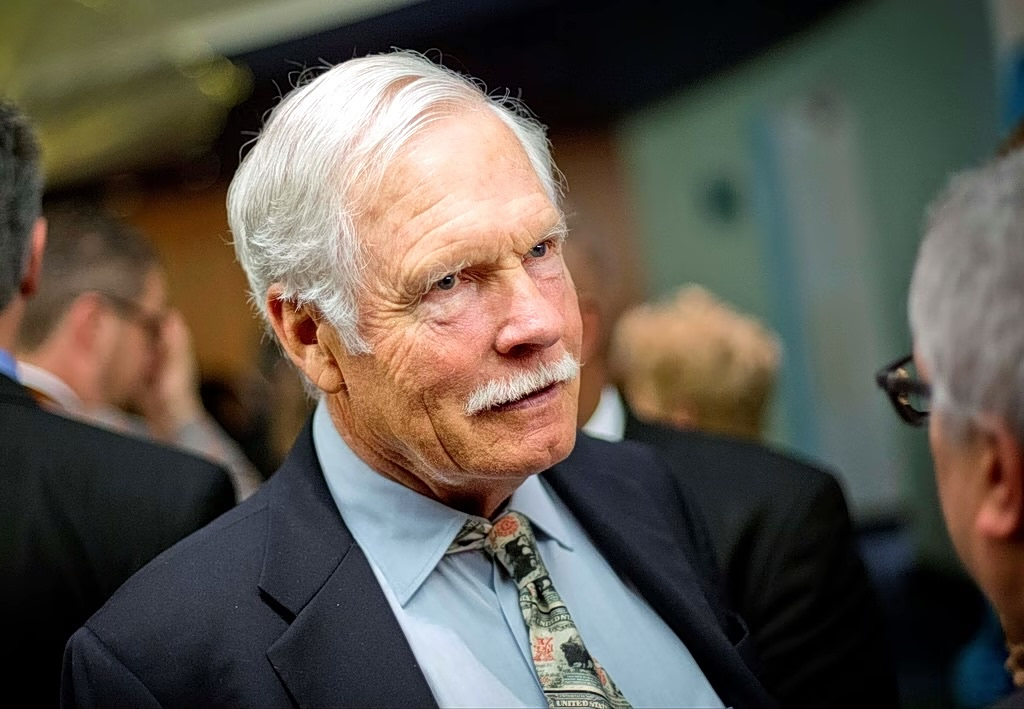
 Ted Turner , the swashbuckling media titan who helped shape the modern cable-television industry, ushering in the era of 24-hour news with CNN while building other major networks that bear his name, died Wednesday at age 87, according to a spokesman.
Adventurous and impulsive, Turner made a mark in many walks of life. He was a sailor, a conservationist who was one of the largest U.S. landowners, and a major philanthropist who helped set a model for generous giving by billionaires.
He was best known for turning the billboard-advertising company he inherited from his father into Turner Broadcasting System, an Atlanta-based television and movie giant that he eventually sold in 1995 to Time Warner. Turner joined the company and stayed with it through its ill-fated January 2000 merger with America Online before leaving in 2003.
As Turner battled rival media titans like Rupert Murdoch and Sumner Redstone in the 1980s and 1990s, they collectively brought cable TV into the mainstream, fostering an explosion of investment, new channels and consumer subscriptions.
At TBS, he seized on breakthroughs in satellite technology to turn a local Atlanta TV station into a national “superstation.” That network and TNT became cable TV counterparts to what were then the big three broadcast networks—ABC, CBS and NBC.
Starting in the 1980s, CNN redefined how breaking news is covered on television, with round-the-clock updates and live reports during major events like the first Iraq war in 1990, the O.J. Simpson murder trial and natural disasters. Programs like “Larry King Live” and “Crossfire” were early signs that talk shows and commentary would have a major role in cable TV.
Though he faded from the media scene in his later years, Turner never lost affection for the properties he created. He looked back fondly on his career despite a few major disappointments, including failed attempts to merge with broadcast networks and being pushed out after the AOL merger.
“Hardly anybody wins all the time,” he said in a 2008 interview with Charlie Rose. “I’ve won more than most.”
Among his many interests outside the media business, Turner was a conservationist—the owner of two million acres of land in nine states and in Argentina, plus 51,000 bison.
He at turns kept a bear and an alligator as pets, was adamantly anti-religion, and, as he admitted himself, had a knack for putting his foot in his mouth.
Turner said in a 2018 interview with CBS that he had Lewy body dementia, a progressive brain disorder that he said made him tired and forgetful. Turner, labeled “Captain Outrageous” for his erratic behavior, had once been thought to have bipolar disorder. He told CBS that was a misdiagnosis, and that his confusion and the “euphoric highs and dark lows” he was known for were symptoms of the dementia.
Turner said in that interview that he considered a presidential run in the 1990s, while married to actress Jane Fonda, but she had warned if he ran he’d be running alone.
As a philanthropist, Turner was best known for pledging $1 billion—one third of his wealth—to the United Nations in 1997. That led to the creation of the United Nations Foundation, which focuses on issues such as global climate change, children’s health and security.
His survivors include five children, 14 grandchildren and two great-grandchildren.
Father and son
Born in Cincinnati on Nov. 19, 1938, Robert Edward Turner III was shaped significantly by the complicated relationship he had with his father, Ed Turner. In his autobiography, “Call Me Ted,” he described his father as abusive when drinking. But he also sought his father’s affection and wanted to live up to his lofty expectations.
The family moved to Georgia, and as a young man Turner began doing odd jobs for the billboard company his father had set up, cutting weeds in front of the signs and helping the painters. Throughout his school years and into college, Turner had a reputation as a troublemaker. At Brown University, he was suspended for throwing chairs out the window of a dormitory after drinking.
His father’s disappointment with his decision to pursue classics as a major—the elder Turner didn’t think that would be useful for a career in business—left a lasting imprint.
“I just wish I could feel that the influence of those oddball professors and the ivory towers were developing you into the kind of man we can both be proud of,” Turner’s father wrote to him, according to the autobiography. He left Brown before getting his degree.
Despite those tensions, Turner joined his father’s company in 1959, helping to lease properties to use for billboard installations before taking on bigger roles as the company expanded. His father struggled with substance abuse and anxiety—partly over fear of being unable to make debt payments. In 1963, the elder Turner impulsively struck a deal to sell a chunk of the company and then, a few days later, shot himself dead in the bathtub.
Turner took over the company and put the brakes on that sale. He set out on a growth path in the ensuing years, acquiring radio and TV stations in Atlanta and Charlotte, plus a library of movies and old TV shows. In a few years, the business was profitable.
By the 1970s, satellite technology was making it possible to send a TV station’s signal to cable providers around the country to deliver to their local customers. Turner used that technological leap to make TBS available nationwide. It was a risky bet that paid off handsomely as cable TV gradually took flight.
‘Mouth of the South’
Known by the nickname “Mouth of the South” because he would speak his mind on almost any topic, Turner brought an unorthodox style to his business dealings. At one point, when he was seeking to have his channels carried on fellow media titan John Malone’s cable TV service, the nation’s largest, Turner got on all fours and asked, “Whose shoes do I have to kiss?” he recalled in his autobiography.
After acquiring the Atlanta Braves baseball team in 1976, he sent an advertising sales executive to spring training to embed with the club, in uniform, so he could learn about baseball. Once, when a player hit a home run, Turner ran on the field to congratulate him. Turner himself put on a uniform and temporarily became the manager during the 1977 season—until the league put a stop to it, citing rules against an owner taking the reins on the field.
As his career in media took off, Turner cultivated his interest in sailing. After failing to get through the 1974 America’s Cup trials, he regrouped and won the Cup in 1977. His sailing experience influenced how he thought about business.
“I ran my company the same way I ran my boat. I found the best people I could to run our businesses while I stepped back to keep an eye on our overall strategy and what our next move should be,” Turner wrote in his autobiography.
In 1980, spotting an opportunity where broadcasters weren’t developing news operations for cable, Turner launched CNN. He invested heavily despite skepticism from advertisers. Turner said in a speech at the launch that the network was meant “to create a positive force in a world where cynics abound.”
One of Turner’s biggest gambles—and most humbling moments in business—came in the mid-1980s when TBS purchased MGM from controlling owner Kirk Kerkorian . That deal gave his company access to classic titles like “Citizen Kane” and “The Wizard of Oz” that could be shown on cable, but also left it with $2 billion in debt. A string of flops by MGM left Turner in a financial crunch.
He called Malone for help shoring up his balance sheet. “You’ve got to do something!” he said in a 6 a.m. phone call with his fellow titan, according to “Cable Cowboy,” a biography of Malone. Malone persuaded several cable operators to join him in investing. They took a significant ownership stake and several board seats.
Tensions ensued as the new investors sought to rein in what they viewed as Turner’s habit of making big decisions on a whim. “The question is: Is Ted a one-man band?” Malone told The Wall Street Journal at the time.
Bought by Time Warner
For years, Turner explored potential mergers with the big broadcasters, but couldn’t consummate a deal. Instead, Turner Broadcasting became an acquisition target for Time Warner, which owned HBO, Warner Bros. and the Time Inc. publishing stable, in addition to the Time Warner Cable distribution arm. Turner signed off on an $8 billion sale to Time Warner in 1995 that left him as a major shareholder.
Turner took on a high-profile role when Time Warner Cable failed to carry CNN rival Fox News at the news channel’s launch. He feuded with Fox’s then-boss Rupert Murdoch, with Murdoch’s New York Post running a front-page headline asking, “Is Ted Turner Nuts? You Decide.” Turner at one point challenged his rival to a boxing match and said he was “looking forward to squashing Rupert like a bug.”
After a yearlong legal dispute, the two sides ultimately reached a carriage agreement. (The Murdoch family is a significant shareholder in both Fox Corp. and Wall Street Journal parent News Corp.)
By 1999, Time Warner was under pressure from investors to deepen its exposure to the burgeoning internet economy, and CEO Gerald Levin was hunting for a big deal. AOL, with its fast growth and steady subscription business, was attractive. The companies announced a $156.1 billion merger in 2000.
The deal went down as one of the most disastrous corporate mergers, as the cultures clashed and AOL’s online-ad business deteriorated, a harbinger of the dot-com bust. As vice chairman of Time Warner, Turner, had expressed some reservations about the merger to the board but didn’t move to stop it. “I smelled it a little bit, but I didn’t smell it enough to try and block it,” he said in the 2008 interview with Charlie Rose.
Turner, who had been running the cable programming division of Time Warner, was unhappy at being sidelined from a significant role after the merger, as AOL took the plum positions. Levin felt Turner was a liability as a manager who was injecting his personal, liberal views into CNN, according to “Stealing Time,” a book about the merger.
As AOL weakened, the company took write-downs in the tens of billions of dollars while making big accounting restatements related to improperly booked revenue from ad deals. Turner, whose personal fortune was reduced as the company struggled, left AOL-Time Warner in 2003.
In pursuit of Jane Fonda
After splitting from his second wife, Jane Shirley Smith, Turner read in the paper that the actress Jane Fonda was getting divorced, and he decided to pursue her. When she said she needed space after her divorce, he obliged, then called her a few months later and asked, “Will you go out with me now?” according to his autobiography. That began a romance that led to marriage in 1991.
Turner’s marriage to Fonda broke down around the time the AOL-Time Warner deal was coming together, and they divorced in 2001.
In a 2012 interview, Piers Morgan asked Turner how he got away with having four girlfriends at once after the divorce. “With great difficulty,” Turner said with a smile, adding that marriage was harder than having multiple casual relationships while juggling the demands of his work.
He often spoke of missing Fonda, but told the Hollywood Reporter in 2012, “I’ve been married three times, and with my background in baseball, I remember the first rule of the game is, three strikes and you’re out. I regret that I wasn’t more successful with my marriages, but it is what it is.” Asked if he was lonely, he said, “Maybe a little.”
After his career in media, Turner opened a restaurant business, Ted’s Montana Grill. In 2015, he launched Ted Turner Reserves, which sells luxury ecotourism packages in New Mexico.
Considering his own mortality, while consumed by daily news of death and destruction on the network he founded, Turner mused about what one day might be inscribed on his gravestone.
“You Can’t Interview Me Here” was an early contender during the days of his young celebrity, he wrote in his memoir. “In the middle of my career I considered ‘Here Lies Ted Turner. He Never Owned A Broadcast Network.’ These days, I’m leaning toward ‘I Have Nothing More to Say.’ ”
Write to Amol Sharma at Amol.Sharma@wsj.com and Anne Steele at anne.steele@wsj.com