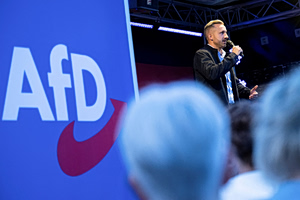
BERLIN—After Alternative for Germany’s big state-election win in eastern Germany on Sunday, the party is as close as it has ever been to actually governing. If it succeeds, it intends to launch one of the most ambitious far-right policy experiments in Europe this century.
The party, known by its initials, AfD, sees the state of Saxony-Anhalt as a showcase for its ideas on immigration, education, culture and demographics, which in some cases would represent a sharp departure from the approach of mainstream political parties.
AfD leaders have pledged to crack down on migrants and rework school curricula to focus less on Germany’s Nazi-era past. They also want to create a volunteer militia to help police maintain order and say they will cut funding to museums and arts groups with “anti-German goals.”
“We won’t bend and we will not water down our fundamental positions,” said Ulrich Siegmund , the AfD’s candidate to become premier of the state. Proposals on immigration, security, energy policy and the economy were “nonnegotiable,” he added.
The former salesman needs to find three additional votes to secure a stable majority in the state parliament and form a government. Negotiations with other politicians could take weeks or even months. If he succeeds—which would take cajoling some lawmakers to cross the aisle or persuading a smaller far-left party to back his government —some of his proposals would likely face financial, legal and constitutional obstacles.
Some of the AfD’s marquee ideas, such as taking Germany out of the European Union, abandoning the euro as a currency, canceling sanctions on Russia and ending support for Ukraine, are beyond the reach of a state government.
Yet Germany’s federal system gives states substantial powers over education, cultural policy and security—including control over the police and the regional branch of the Office for the Protection of the Constitution, Germany’s domestic intelligence agency.
Should the AfD take control of the agency, it would raise concern about the state’s determination to fight far-right extremism and antisemitism, said Remko Leemhuis , director of the Berlin office of the American Jewish Committee.
Saxony-Anhalt had the second-highest number of far-right motivated criminal acts per inhabitant last year, according to police statistics. In 2019, on Yom Kippur, a neo-Nazi gunman tried to attack the synagogue in Halle, the state’s largest city, killing two people.
“In countries like France and Italy, the far right has moderated as it has moved closer to power,” said Leemhuis. “Here it is the opposite. The party has become more and more radical over time, to the point where others in Europe don’t want anything to do with it.”
The AfD rejects this accusation, saying it is advocating conservative ideas that were mainstream in the 1990s and early 2000s. It says centrist parties have drifted too far to the left in the past two decades.
The AfD program for Saxony-Anhalt calls for “remigration.” The concept, popularized by the ethno-nationalist identitarian movement in France in the early 2000s, describes the forceful removal of nonnationals, including some naturalized citizens, from Europe.
Siegmund insists that he won’t target German citizens or anyone residing in Germany legally and that his government would abide by all constitutional requirements. On Sunday, he said the party welcomed hardworking foreigners who came to support the people of Saxony-Anhalt.
His program, however, calls on employers not to hire “culture-distant” migrants, whom it says are often poorly qualified and can put German lives at risk. Skill shortages, it says, should be filled by returning German expatriates, automation and artificial intelligence.
EU migrants who receive benefits, meanwhile, should leave, according to the document. Criminals with dual citizenship should lose their German nationality and all Ukrainians should be stripped of refugee status and benefits. The AfD wants to house all asylum seekers in a small number of centers away from urban areas, seize their assets and compel them to work.
Beyond making life difficult for asylum seekers, the party could struggle to implement much of its immigration agenda since most of it would require backing from the federal government.
That isn’t the case for education. There, the AfD wants to create separate classrooms for children of migrants it deems to have low prospects of staying in Germany. It also wants children with serious disabilities to be removed from ordinary classrooms and taught separately.
The party thinks patriotism should play a bigger role in shaping the curriculum. History classes should focus less on the Nazi era and the Holocaust and more on 19th-century history, the founding of the second Reich and Bismarck. Teachers should have to swear an oath to the German people and the homeland.
The AfD has targeted one of Saxony-Anhalt’s biggest tourist draws , the Bauhaus Foundation in the town of Dessau. Now a museum, the former school of design closed by the Nazis in the 1930s promoted a style of architecture devoid of regional roots, according to the party.
“The AfD favors buildings that convey to people a sense of the homeland and of identity,” Laurens Nothdurft , the party’s general counsel and a close adviser to Siegmund, told The Wall Street Journal shortly before the election.
Museums, theaters, orchestras and nongovernmental organizations that follow “anti-German goals” may see their funding cut, according to the program.
This could clash with the freedom of the arts and of education enshrined in the constitution, which protects civil society from excessive state interference, according to David Begrich, a researcher at Miteinander, an NGO that studies far-right extremism.
“An AfD government would without doubt mark a break in the traditions and political culture of the Federal Republic as a liberal state ruled by the rule of law,” Begrich wrote in an assessment of the AfD’s program for Saxony-Anhalt for the American Jewish Committee in June.
The Saxony-Anhalt program includes a number of new positions for the party as a whole, including more money for Russian-language education and cuts in state funding to the officially recognized Catholic and Lutheran churches.
Among the party’s lesser-known proposals is the creation of a volunteer militia under the authority of the municipal police to help authorities patrol smaller communities.
“This is among the strangest proposals,” said Benjamin Höhne, political scientist at Chemnitz University. “This could raise concerns about the creation of a political shock troop for the party.”
Write to Bertrand Benoit at bertrand.benoit@wsj.com