Over the past two years, Israel has systematically killed off or hobbled the leaders of its most-powerful enemies: Hamas, Hezbollah and Iran. Yet it hasn’t been able to neutralize one, whose unrelenting resistance has made him, in the eyes of supporters, the last militant leader still fighting in the Middle East.
Diminutive and soft-spoken, Abdulmalik Al-Houthi has survived relentless attacks by Israel, the U.S. and other regional powers by hiding out in caves and never appearing in public while counting on Iran’s support to help keep his rebel movement in power in Yemen. For more than a decade as commander of Houthi forces, his playbook has been to keep challenging more formidable opponents with brazen missile attacks, gambling they have more to lose than he does.
Israeli officials say they believe Al-Houthi intends to keep doing that, especially now that the war in Gaza has helped raise his profile in the Arab world, where he is seen by many as the last and most credible defender of the Palestinian cause.
While Israel and the Arab world were expressing support at the end of September for President Trump’s plan to end the war in Gaza, the Houthis were hitting a Dutch-flagged ship with a cruise missile, leaving it in danger of sinking. That extended a campaign that had crimped a vital sea lane for two years and drew the U.S. into pitched naval battles.
Al-Houthi has said he’ll respect any truce signed by his Palestinian allies Hamas. But whatever the outcome, the Houthis are expected to continue their religious war against Israel and the U.S. over time. The group’s slogan, chanted at rallies, is “God is Great, Death to America, Death to Israel, Curse the Jews, Victory to Islam.”
In private meetings, officials from Egypt, Qatar and Saudi Arabia have tried repeatedly in recent months to convince Houthi leaders to stop attacking Israel and ships in the Red Sea, and go back to being a relatively small-time player in the region’s conflicts. But the group always refused, people familiar with the meetings said.
“They genuinely believe in this jihad to remove Israel from that land,” said April Longley Alley, a former United Nations diplomat who has engaged with the Houthi leadership. “And they’re going to keep pushing.”
The global spotlight has emboldened Al-Houthi, who in almost-weekly speeches by video from an undisclosed location has positioned himself as the most prominent Arab and Muslim leader standing up for Palestinians.
“If the Muslim world remains silent as Palestinians face extermination,” he said in a speech in March, “it will only embolden America and Israel to commit further atrocities.”
In a new poll released last week by the Palestinian Center for Policy and Survey Research, support among Palestinians for the the Houthis was much higher than for any regional militias or governments. Al-Houthi’s face has adorned posters in Istanbul, Tunis and Tehran since the war began. In Western capitals, young people have demonstrated against the war in Gaza with chants supporting the Houthis.
According to the United Nations, recruitment for the group has increased dramatically in recent years, with an estimated 350,000 fighters by late 2024, compared with 30,000 in 2015.
Inside Yemen, an impoverished nation of 40 million, Al-Houthi rules through a combination of religious inspiration and repression of those who don’t follow his radical creed.
Although the Houthis only control around a third of Yemen’s territory, the area includes ports, state companies and other economic assets that yield the group as much as $2 billion in annual revenue, according to researchers who track them. Their vast arsenal, much of which is supplied by Iran, includes drones, cruise missiles, sea mines and speed boats.
For hardened followers, Al-Houthi, who is believed to be in his mid-40s, is a father figure who claims to have descended from the Prophet Muhammad. The Houthis have recruited child soldiers, according to human rights groups, and have run “cultural courses” in the Yemeni capital of San’a for teenagers, who are shown speeches and writings calling for Muslims to dispel Western influences and support the Palestinian cause.
“We truly believe in Abdulmalik,” a young man who attended a course a few years ago told the Journal. “We are ready to follow his orders because we believe they are God’s commands.”
The attendee, who later became a Houthi member and asked to remain unnamed, said he felt empowered joining the group.
“You carry a gun, you lead, you make decisions,” he said. “Sometimes, you even get paid or offered a job—what could be better in a country like Yemen?”
Detainees in Houthi prisons are subjected to torture, routinely mock-executed, beaten in the genitals or given electric shocks, according to the U.N. The Houthis’ security headquarters features jail cells known as “squeezers” that are three feet long and under two feet wide, and hold prisoners incommunicado as loudspeakers broadcast speeches by Al-Houthi, the U.N. says.
A Houthi court last year sentenced nine people accused of homosexuality to death—some by stoning, the others by crucifixion, according to Amnesty International. The executions took place in a public square.
Until a decade ago, Al-Houthi and his group were an insignificant force even in Yemen, so were not seriously on the radar of Israel intelligence.
In late August Israel appeared to achieve a major intelligence breakthrough by picking up signals the Houthi government was going to meet. Hours later, Israeli jet fighters struck a conference hall in San’a, killing at least 12 government officials, including the prime minister and foreign minister, and severely injuring others, according to the Houthis.
Israel has since said the attack also killed the group’s military chief of staff.
But the strike failed to deter the group, or noticeably impair their ability to attack Israel.
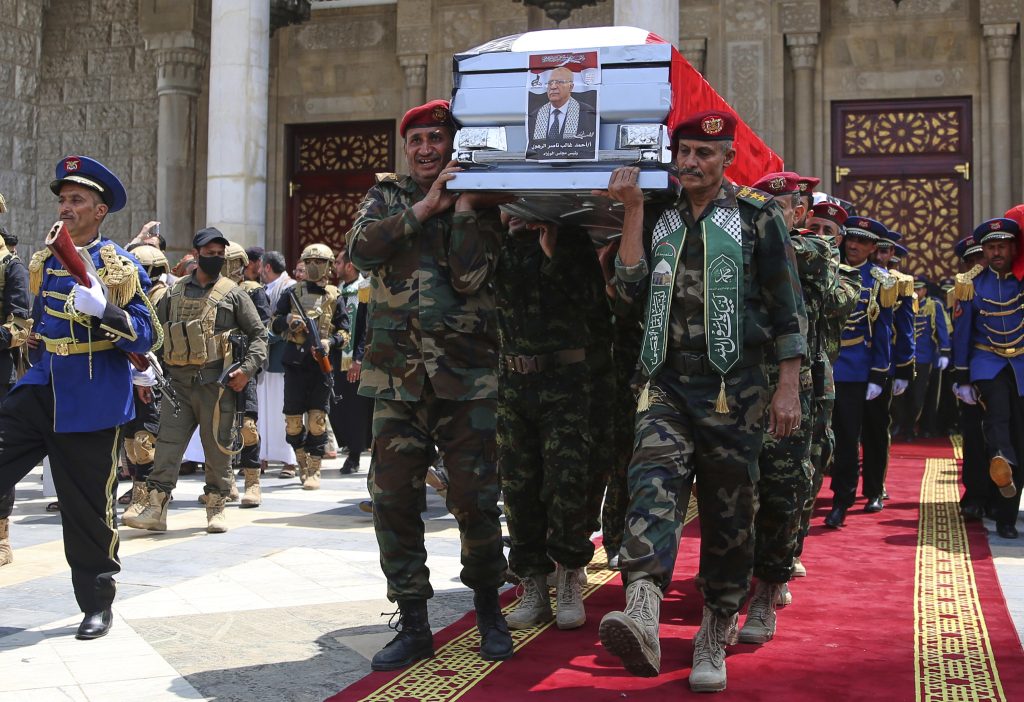
Houthi officers carry the coffin of Houthi Prime Minister Ahmed al-Rahawi, who was killed along with others in Israeli airstrikes on Thursday, out of the Shaab Mosque during his funeral in Sanaa, Yemen, Monday, Sept. 1, 2025. (AP Photo/Osamah Abdulrahman)
Al-Houthi is obsessive about keeping his location secret and only takes meetings in safehouses—by video. Former diplomats who have met with Houthis had to give up their phones and were taken in vehicles around twisty streets only to be ushered into a room with a computer screen and Al-Houthi on videoconference with live translation, according to people familiar with the arrangements.
Israel’s prime minister’s office didn’t comment on Al-Houthi. The White House said it was coordinating with regional partners to secure shipping lanes, degrade Houthi capabilities and disrupt the flow of Iranian weapons to his group. The Houthi office in Muscat, Oman, declined to comment.
‘Chosen by god’
The Houthis first emerged as significant players in Yemen, on the Arabian peninsula’s southern tip, in the 1990s.
Their Zaidi sect, an offshoot of Shia Islam, had ruled northern Yemen for about a 1,000 years until a military coup in 1962 pushed them from power. Many Zaidis, who made up about a third of Yemen’s population, felt marginalized.

A Houthi military wears a vest showing a drawing of the leader of the Houthi movement Abdul Malik al-Houthi as he directs traffic during an anti-U.S. and anti-Israel rally in Sanaa, Yemen, Monday, March 17, 2025. (AP Photo/Osamah Abdulrahman)
Tapping that frustration, Al-Houthi’s older brother, Hussein, launched a revivalist movement that called for driving out Western influences and supporting Palestinians. The movement caught on with young people who didn’t like Yemen’s government, which was aligned with rival Sunni Muslim groups, and cooperated with Washington in its war on terrorism.
Hussein also promoted a new idea among Zaidis of a singular leader, known as the “Guiding Eminence,” who was chosen by God to rule. Previously, Zaidi imams had earned leadership via their standing as scholars. Hussein imported the idea from Iran, where Ayatollah Ruhollah Khomeini led a revolution in 1979 and became both the country’s leader and its religious figurehead.
In 2004, Hussein was killed in clashes with government forces. Abdulmalik, then in his early 20s, was thin and quiet, so lacked some of the superficial masculine traits required for leadership in Yemen’s tribal society, according to Ali al-Bukhaiti, a former Houthi spokesman who left the group in 2015 after becoming disillusioned with its actions and now lives in the U.K.
But Al-Houthi distinguished himself by regrouping Hussein’s followers in caves around their northern Yemen stronghold of Sa’dah and leading guerrilla warfare against the government’s more powerful forces. He also embraced the idea that he was a successor to the Prophet, designated by God.
“He would just lead the battles in person,” said Bukhaiti, who wasn’t a member at the time but heard stories about Al-Houthi’s rise. “This is the moment people believed, like, ‘Hey, this guy was chosen by God.’”
A few years later, during the chaos of the Arab Spring, the Houthis established full control of Sa’dah province.
Around that time, Jamal Benomar, the U.N. special envoy to Yemen between 2011 and 2014, became one of the only foreign diplomats ever to meet Al-Houthi in person. The first time was in a barebones safehouse in Sa’dah, which had been bombarded by Yemeni government forces, leaving it destitute, with an unusual number of amputees, Benomar said. Houthi fighters wore sandals and carried aging Kalashnikov rifles, Benomar added.
Although Al–Houthi hadn’t traveled extensively overseas—or even in Yemen—he was mature for his age and unusually courteous, said Benomar, who now chairs the New York-based International Centre for Dialogue Initiatives.
“He was the head of a hardened militia, yet he was very affable with a gentle manner,” he said.
Iranian support
Al-Houthi’s outward demeanor, however, belied a more strategic—and ruthless—streak that led him to link up more closely with backers that could facilitate the group’s rise.
Iran at the time was building a regional network of allies and initially supported the Houthis with arms and cash transfers, according to Bukhaiti, the former spokesman. Over the next decade, Iran would spend hundreds of millions of dollars in supporting Al-Houthi’s militants with arms, fuel and cash, according to the State Department.
In 2014, they took over San’a, Yemen’s capital. Fearful of an Iranian Shiite ally on the Arabian peninsula, a coalition of Sunni Arab countries led by Saudi Arabia and the United Arab Emirates intervened, launching airstrikes seeking to restore the government Al-Houthi had helped to overthrow.
Backed by Iran, Al-Houthi withstood the pressure, while returning fire on Saudi Arabia and U.A.E. using cheap drone and missile technology. While largely intercepted, his projectiles threatened oil facilities, his opponents’ main funding sources. They also jeopardized the perception that Saudi and U.A.E. cities were safe places to live and work, threatening reforms meant to diversify their economies from oil.
Saudi officials say they launched more than 145,000 combat and reconnaissance missions over Yemen over three years, and still couldn’t flush Al-Houthi out of his caves. The U.N. eventually brokered a Saudi-backed truce that was supposed to evolve into a broader power-sharing agreement between the Houthis and other Yemeni factions. But talks have stalled.
Trump’s frustration
When the conflict in Gaza began, Al-Houthi redirected his attacks to start hitting commercial ships in the Red Sea and Tel Aviv, demonstrating the group’s solidarity with Hamas and the Palestinians. The Houthis’ profile suddenly rose worldwide.
Almost immediately, Arab mediators seeking a ceasefire in Gaza engaged diplomatically with the Houthis, who they feared were encouraging Hamas to avoid making concessions towards a truce. Egypt, hurting from a fall in income as fewer ships traversed the Red Sea and Suez Canal, also had another reason to engage the militants.
Egyptian officials repeatedly hosted the Houthis in Cairo, asking them to stop attacking cargo and offering to help the group gain diplomatic favor with the U.S. But the message from Al-Houthi was always the same: He would only de-escalate if Israel stopped its war in Gaza.
Increasingly frustrated with the Houthi attacks, President Trump sent an armada to confront the group this spring. But after the loss of three U.S. warplanes in mishaps, Trump cut a deal where the two sides agreed not to attack each other.
According to Omani officials involved in brokering that truce, the Houthis were keen to engage in talks as the U.S. strikes had targeted Houthi-controlled areas day and night, badly damaging infrastructure. But the U.S. also saw the Houthis as resilient enough to keep fighting, so it sought a deal.
Al-Houthi quickly went back to disrupting commercial shipping, though staying away from U.S. ships. Soon after the cease-fire, armed Houthis in small boats attacked two ships not far from their coastline, sinking both and killing several crewmembers in one of their most violent and complex attacks on Red Sea shipping.
When Israel began a campaign of airstrikes against Iran in June, Al-Houthi was the only one of Tehran’s once-extensive group of regional allies that fought back. Lebanon’s Hezbollah told Arab diplomats it would stand aside after its own confrontation last fall with Israel. Hamas, decimated by the conflict in Gaza, could offer little serious help.
Al-Houthi not only fired missiles at Israel, he vowed to escalate the conflict with Arab states should they assist Israel’s military, according to Arab mediators who received the message.
Israeli officials say that even once the Gaza war comes to end, the Houthis are expected to remain a significant challenge and a new focus for the country’s vaunted intelligence apparatus.
For Al-Houthi, the fighting against the U.S. and Israel has put his movement on a level with the bigger powers that seemed unimaginable when his brother first articulated the group’s principles, according to people who study the group.
“Abdulmalik al-Houthi sees himself as a divinely chosen leader,” said Mohammed al-Basha, a U.S.-based analyst focused on Yemen. “The Houthis’ string of battlefield victories has only reinforced this perception.”
Write to Rory Jones at Rory.Jones@wsj.com and Summer Said at summer.said@wsj.com