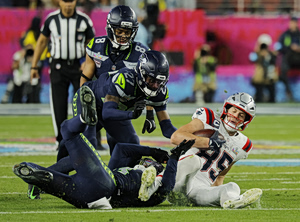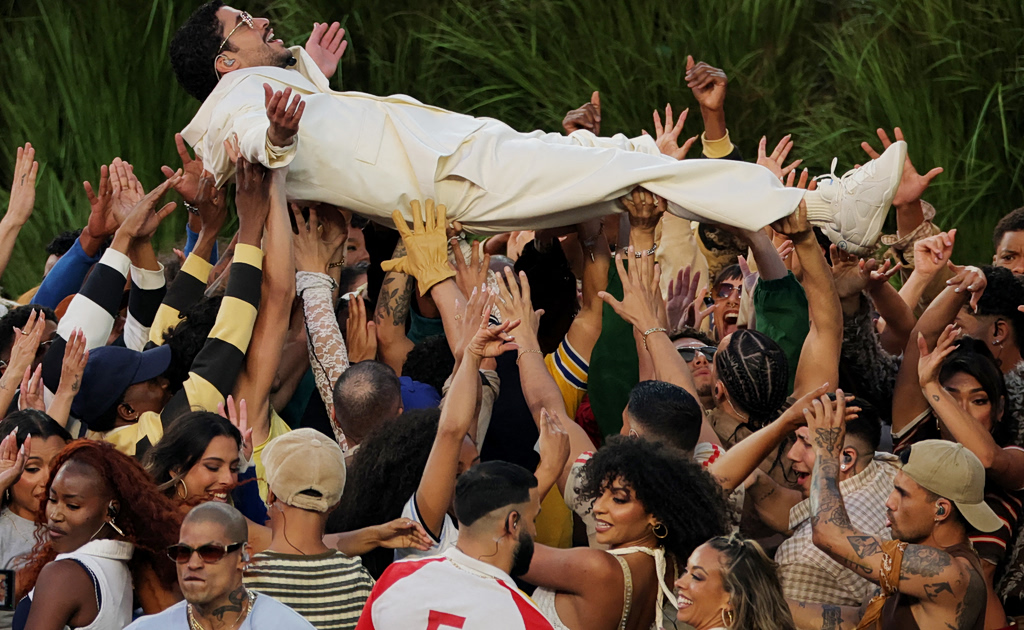

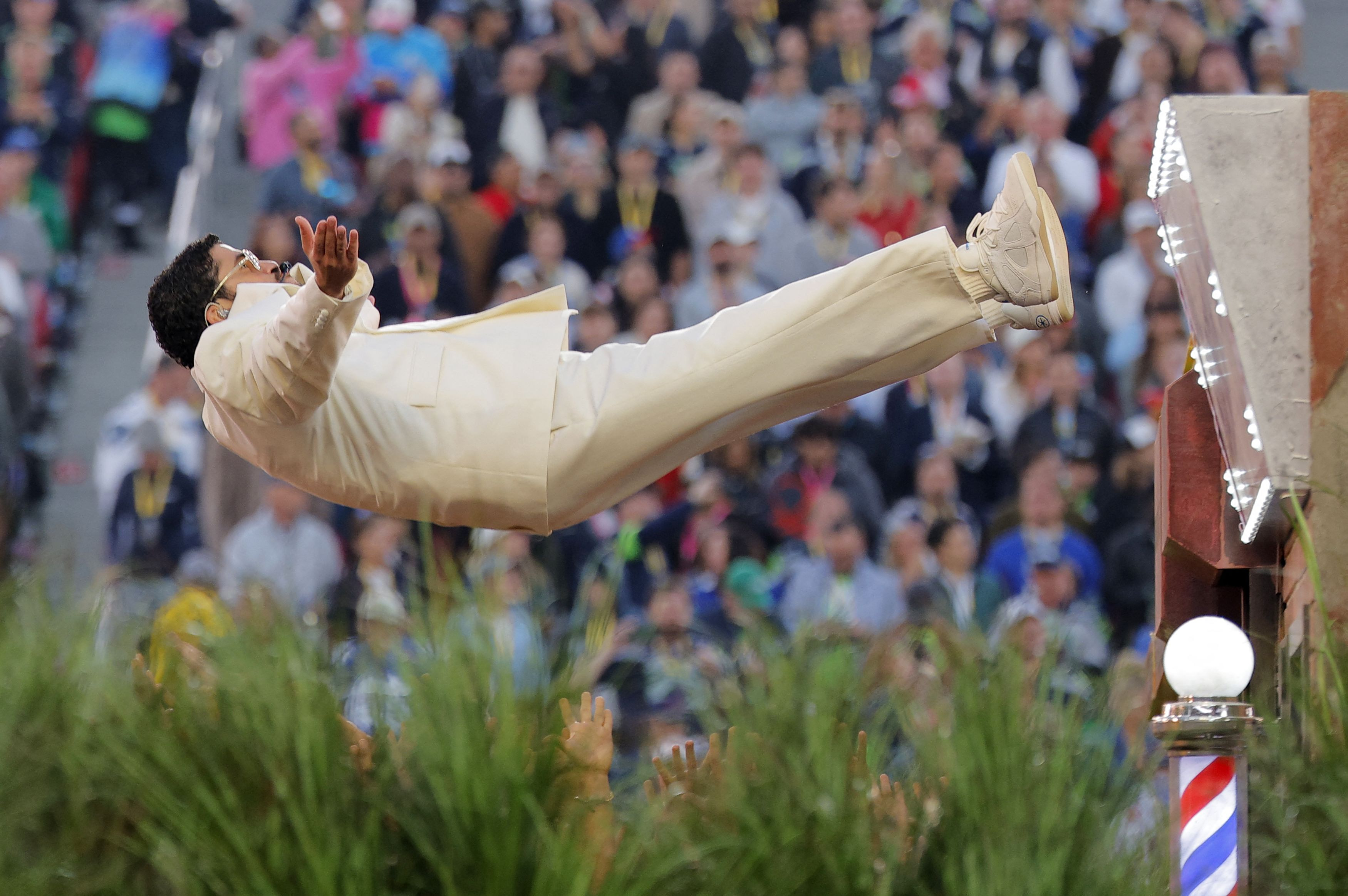
There was plenty of on-field action during the Seattle Seahawks’ Super Bowl LX rout of the New England Patriots. But pop culture dominated the night, with social media and watch parties focusing on Bad Bunny’s halftime performance, as well as buzzy—and sometimes head-scratching—ads.
Here’s what people are talking about:
Bad Bunny’s Joyous Romp
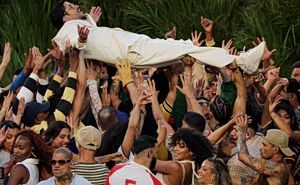
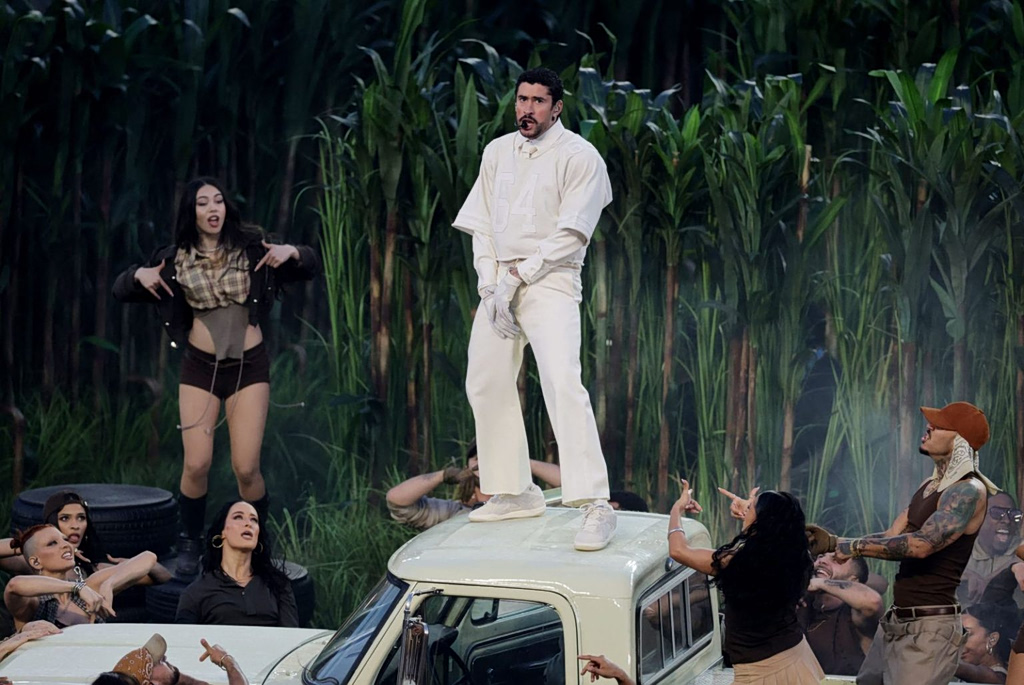
Bad Bunny delivered a buoyant celebration of Latino culture during his halftime show, blitzing through reggaeton, Latin trap and salsa. A stream of celebrities showed up to party behind him, including Jessica Alba, Pedro Pascal, Cardi B, Karol G and Young Miko. Lady Gaga sang a salsa version of her hit “Die With a Smile,” originally a duet with Bruno Mars, while Ricky Martin contributed a dramatic rendition of Bad Bunny’s song “Lo Que le Pasó a Hawaii.”
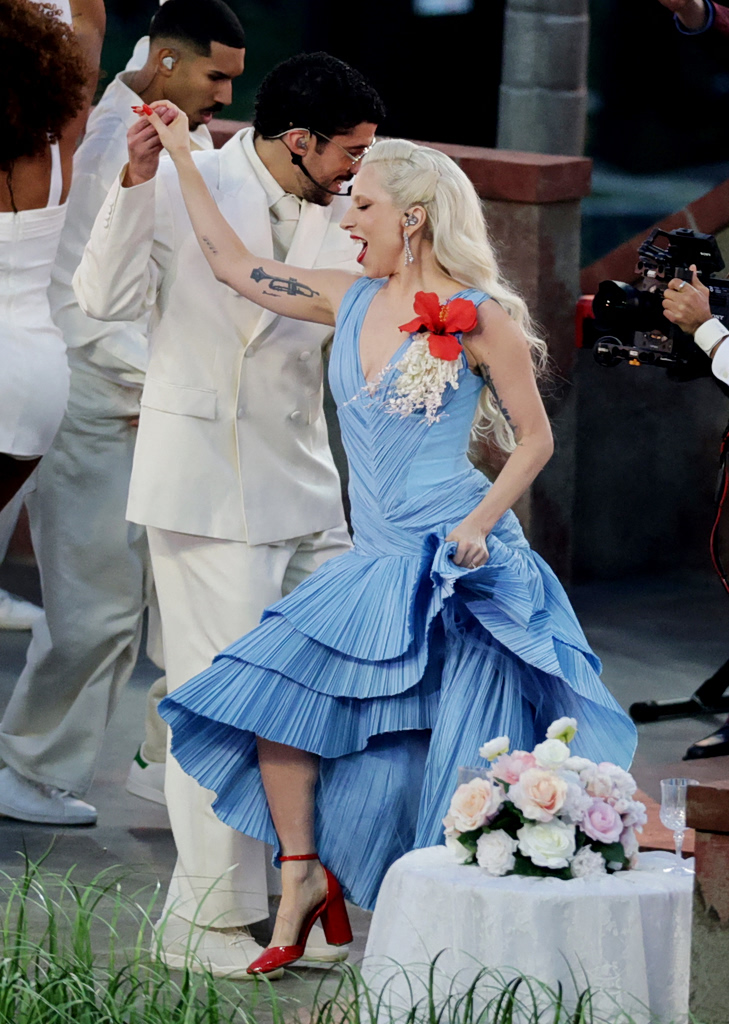
Super Bowl LX – Half-Time Show – New England Patriots v Seattle Seahawks – Levi’s Stadium, Santa Clara, California, United States – February 8, 2026 Lady Gaga and Bad Bunny perform during the halftime show REUTERS/Jeenah Moon
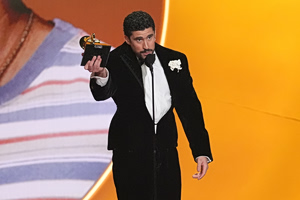
A week ago, Bad Bunny denounced Immigration and Customs Enforcement while accepting a Grammy award, drawing the ire of conservatives ahead of the Super Bowl. On Sunday, he took a different approach, finishing his set by spiking a football that read “Together, We Are America.” “We’re still here,” he said in Spanish.
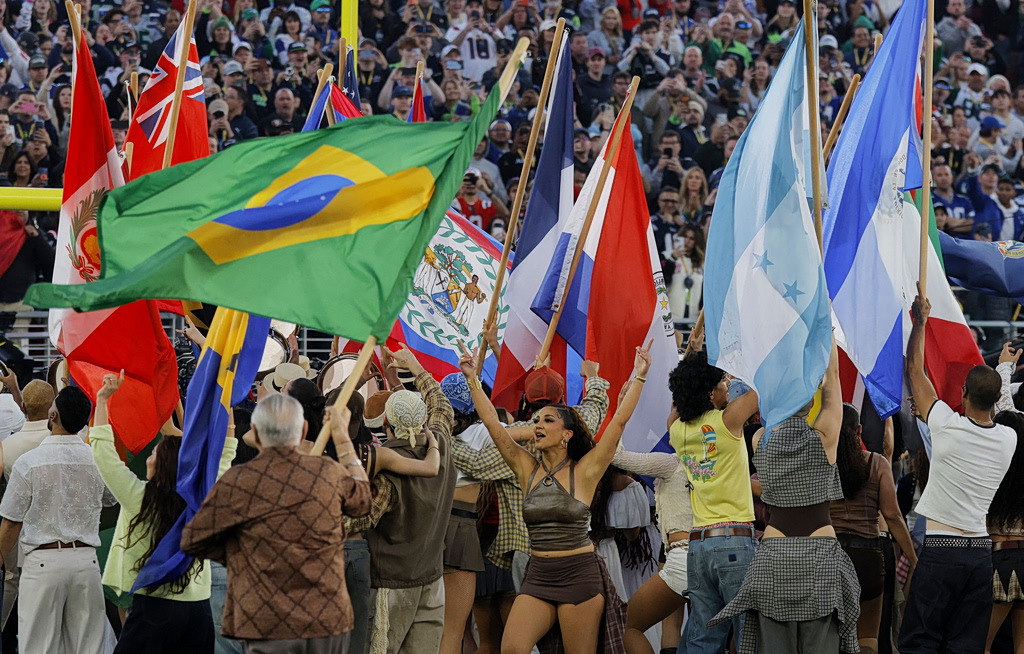
Super Bowl LX – Half-Time Show – New England Patriots v Seattle Seahawks – Levi’s Stadium, Santa Clara, California, United States – February 8, 2026 Bad Bunny performs during the halftime show REUTERS/Mike Blake
President Trump criticized the performance, saying on Truth Social that it was “an affront to the Greatness of America.”
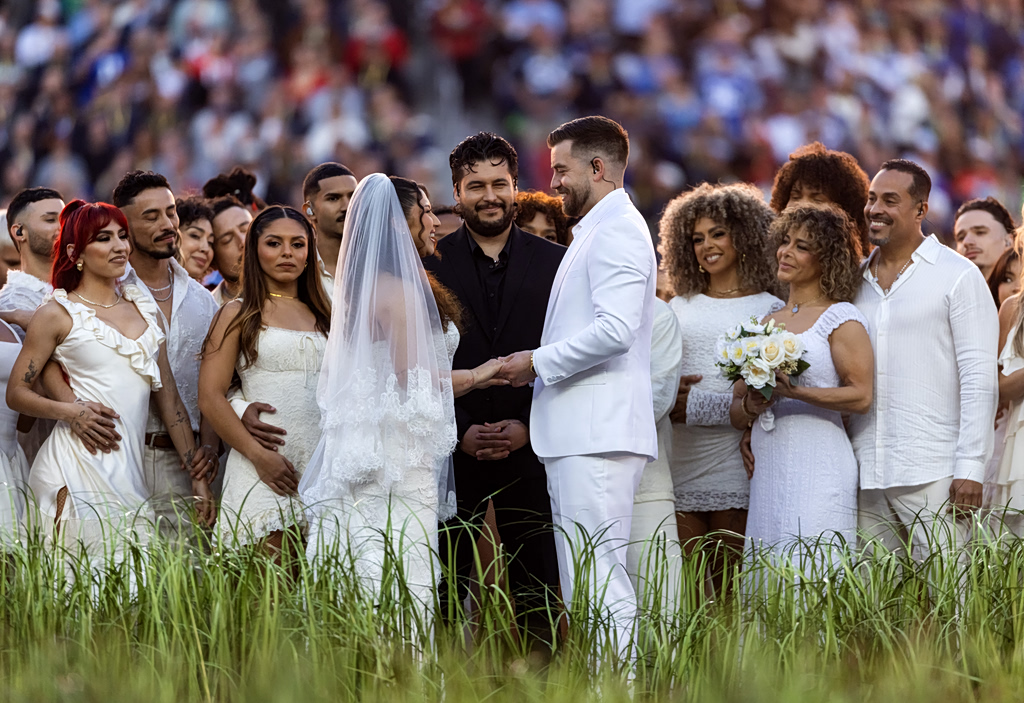
Feb 8, 2026; Santa Clara, CA, USA; A couple gets married on the stage during the Bad Bunny halftime show in Super Bowl LX between the Seattle Seahawks and the New England Patriots at Levi’s Stadium. Mandatory Credit: Mark J. Rebilas-Imagn Images
Kid Rock’s Counterprogramming
While Bad Bunny performed on the field, more than five million viewers tuned in on YouTube to stream “The All-American Halftime Show,” an alternative performance backed by the conservative activist group Turning Point USA.
Kid Rock headlined in a furry white vest, cutoff shorts and a fedora, singing his late-1990s hit “Bawitdaba” to a modest crowd indoors. He was then introduced back on stage under his name Robert Ritchie for a ballad about love and Jesus Christ.
“There’s a book that’s sitting in your house somewhere that could use some dusting off,” he sang while playing an acoustic guitar.
Country singer Lee Brice said Turning Point’s founder, the late Charlie Kirk, “gave people microphones so they could say what’s on their mind.” He continued, “This is what’s on mine,” before belting out a song about how “it ain’t easy being country in this country nowadays.”
The AI Bowl
Dot-com companies dominated ad time for the Super Bowl in 2000. Erectile-dysfunction drugs drove the conversation during the 2004 game. Cryptocurrency exchanges did so in 2022.
This year artificial intelligence stole the show, with OpenAI, Anthropic, Microsoft, Google and Amazon trying to win over viewers.
Anthropic went for laughs with its Super Bowl spot highlighting just how awkward things can get when ads enter the chat—AI chatbots, specifically. Meanwhile, OpenAI struck a more earnest tone by encouraging people to use Codex, the app that can develop software.
Amazon enlisted actor Chris Hemsworth, who becomes convinced that the AI-enhanced Alexa+ is plotting to kill him, while Google’s spot featured a mom using Gemini to show her young son what their new home will look like.
A Win for ’90s Nostalgia
Coffee chain Dunkin’ brought together stars from yesteryear sitcoms including “Friends,” “The Fresh Prince of Bel-Air,” “Cheers” and more in a sendup of Ben Affleck’s breakout 1997 film, “Good Will Hunting.”
The ad, titled “Good Will Dunkin’,” featured Affleck as the original brainy Boston math whiz, who happens to work at Dunkin’ and arranges a display of Munchkins in a Fibonacci sequence. Jennifer Aniston, Matt LeBlanc, Jaleel White and others fired off iconic lines from their respective shows.
Dunkin’ worked with former NFL offensive lineman—and current Massachusetts Institute of Technology math professor—John Urschel to post a chalkboard math problem online to extend buzz about the ad. One person who solves the problem wins a year’s supply of the chain’s coffee.
The Year of the Rear
Denim-clad backsides filled the screen for Levi’s, which aimed to augment the attention it was already getting for naming rights of the Santa Clara, Calif., football stadium. Meanwhile Novartis enlisted a group of NFL tight ends including Rob Gronkowski and George Kittle to encourage men to unclench their derrières and check out blood testing for prostate cancer. (The pharma company last year focused on breast cancer awareness.)
Then there were the toilets: Literal, singing ones for hydration brand Liquid IV’s Super Bowl debut, urging viewers to check what color their urine was. And in some markets actor William Shatner riffed on the first part of his last name in a commercial for the fibrous cereal Raisin Bran, the culmination of a weekslong PR campaign that first saw the 94-year-old photographed tucking into a bowl of the cereal in his car.
Backlash on Backstreet Boys
Some Super Bowl watch parties morphed into singalongs for the 1997 Backstreet Boys hit “Everybody (Backstreet’s Back),” thanks to a low-fi ad that featured the song’s lyrics against a plain blue screen akin to an old-school karaoke kit.
Then, audiences turned once the advertiser was revealed to be cryptocurrency company Coinbase. Some viewers took to social media to complain about what they saw as a bait-and-switch, or to relay that their fellow partygoers had let out collective groans and boos at the end of the ad.
“I was vibing and doing Backstreet Boys karaoke and then CRYPTO. How dare you,” one X user wrote alongside a popular meme of a screaming woman.
In a statement, Coinbase said its ad “draws viewers in to be part of a greater movement, leveraging the perennial appeal of karaoke in creating special shared moments and forging community connection.”