Chicago
The Obama Presidential Center confronts us with a four-sided, faceted tower, clad in gray granite and rising 225 feet to its flat top. Here and there, angular chips seem to have been chiseled away, as if struck by some giant mallet. There is no question about its monumentality. It is at once colossal, haughty and ultimately inscrutable—as a great monument should be. The question is whether it should have been a monument in the first place.
It did not begin as one. The original idea was that it would be a presidential library, different in form but not function than its peers—some combination of archive, study center and museum. It did not remain so.
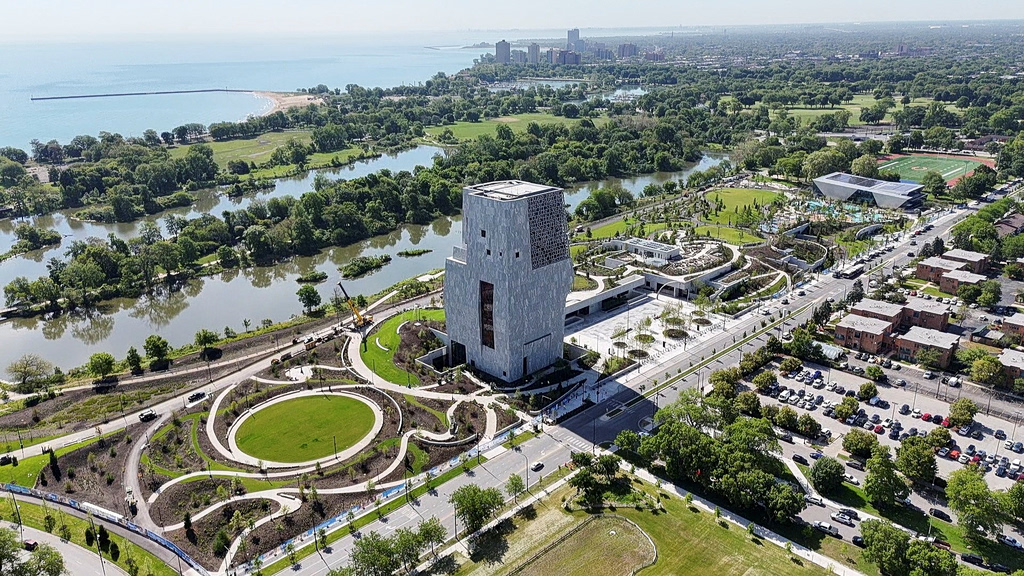
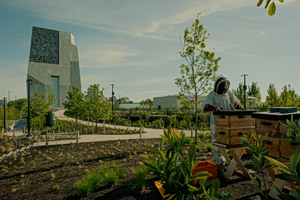
A drone image of the Obama Presidential Center weeks before it opens to the public in Chicago, Illinois, U.S., June 3, 2026. REUTERS/Eric Cox
In June 2016, Tod Williams Billie Tsien Architects was appointed to design the building in Jackson Park on Chicago’s South Side, where Barack Obama began his political career as a community organizer. Under the impression that they were designing a library, the architects first sketched one that was embedded in a hillside, preserving the natural character of the landscape.
But in a digital age, most presidential papers are not of the 8½-by-11 or 8½-by-14 variety. The National Archives took over the responsibility of acting as repository, freeing Mr. Obama and his architects to try something without precedent.
Their first innovation was to dispense with the idea of making a single object. Four separate buildings would straddle the site: a museum; a forum with an auditorium and restaurants; a branch of the public library; and a “Home Court,” a 60,000-square-foot athletic and events space—a community of buildings that expressed what Billie Tsien told me were “multiple aspirations.” These would be arranged as a continuous progression from the natural landscape at the lower end of the site to civic formality at the north, culminating in the museum tower.
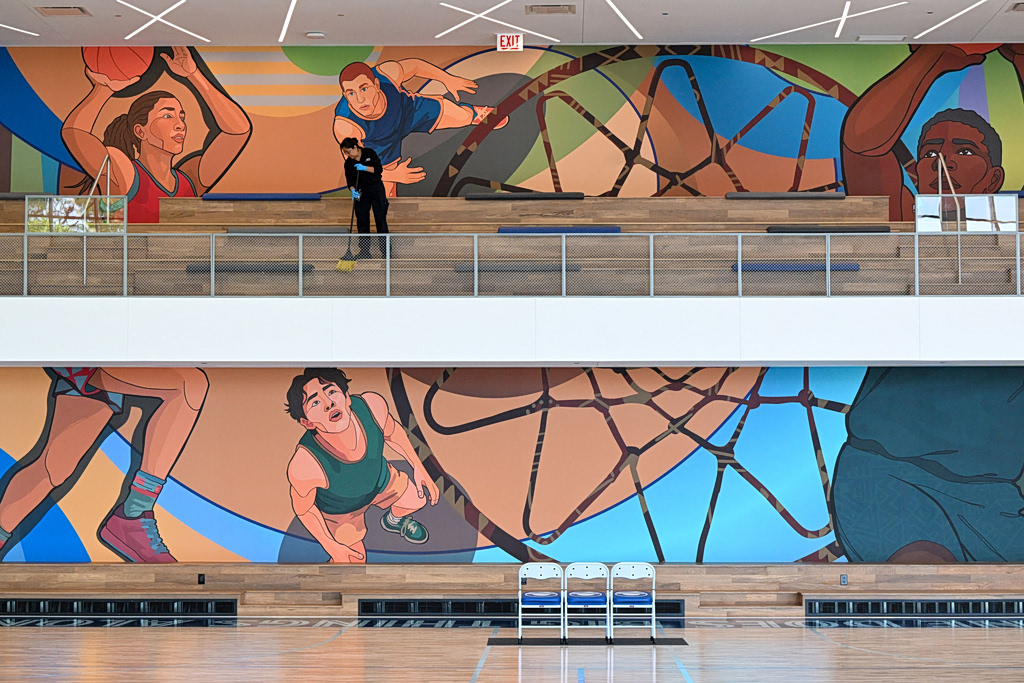
A staff member works against a backdrop of a basketball mural at the Home Court building next to the Main Court basketball court at the Obama Presidential Center during a media preview day ahead of its June 19 opening to the public, in Chicago, Illinois, U.S. June 3, 2026. REUTERS/Joshua Lott
The original version was a blunt and stubby thing, more pedestal than tower. Their client was not impressed and told them to “up their game”; he suggested they look at the exquisitely shaped sculptures of Constantin Brancusi . The architects were sympathetic. “His presidency was iconic,” Tod Williams told me; “he deserves an iconic building.” He and Ms. Tsien showed him some 25 variations of their tapered wedge, variously canting inward and outward. In the process it grew taller and thinner, with a kind of taut, poised alertness—and in the process invested with something of Mr. Obama’s own angular physiognomy and build.
But nothing about its mute, laconic form suggests museum, a building type that fits uncomfortably in a tower. Stairs and elevators take up a greater percentage of the footprint than in a horizontal building. The two elevators were overcrowded on the day I visited, and not everyone is up to the alternative: a 200-foot climb if you want to see all the exhibitions. They were designed by Ralph Appelbaum Associates—the world’s leading firm for such things—and they have a refined elegance, if the ratio of graphics to physical objects is disappointingly high. The mood is intentionally reverent, the dim lighting suggesting that you speak in hushed tones. In the end, however, it is the simulacrum of the Oval Office, where visitors can have themselves photographed, that is the real crowd-pleaser.
There is one very lovely space, the eighth-floor Sky Room. There you can peer through the enormous letters of the inscription that straddles the building’s southwest corner, an excerpt from Mr. Obama’s speech commemorating the Selma civil-rights march of 1965 (which is almost impossible to read). Above you is Idris Khan’s “Sky of Hope,” one of about 30 site-specific works in the museum. Here the artist, in order to depict continuous ascension into a bright future, stamped lines from the same Obama speech in vibrant blue ink onto the Sky Room’s pyramidal ceiling. They converge as they approach the oculus above, forming a thickening cloud of words (affectionately teasing, perhaps, the famously talkative president?).
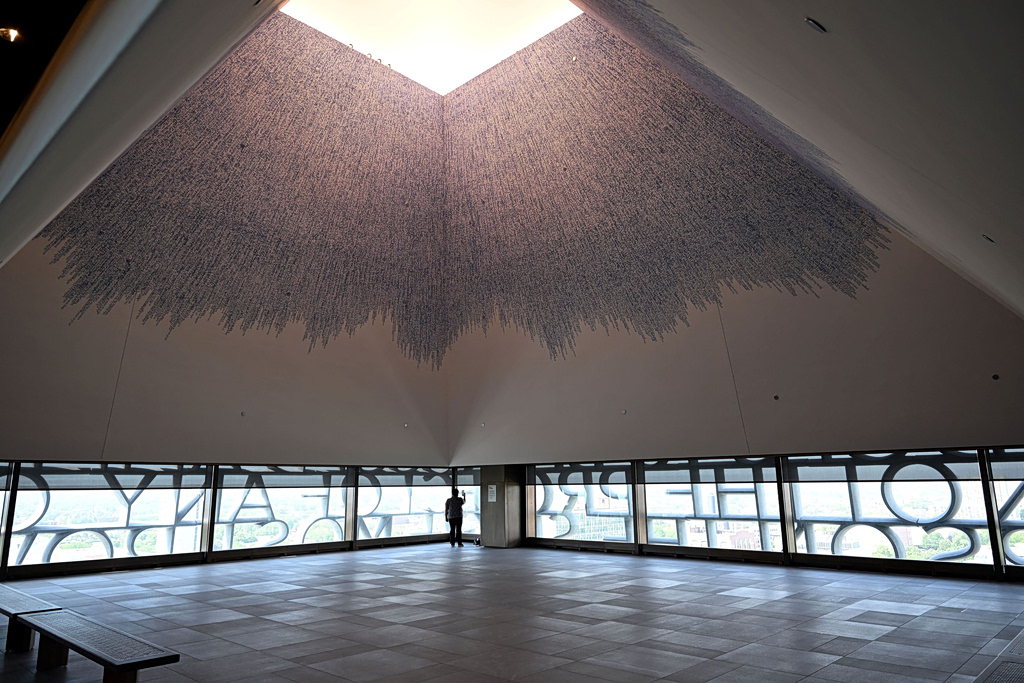
The “Sky of Hope” by Idris Khan is displayed in the Sky Room at the Obama Presidential Center Museum during a media preview day ahead of its June 19 opening to the public, in Chicago, Illinois, U.S. June 3, 2026. REUTERS/Joshua Lott
The other buildings of the $850 million complex, if not as memorable, are of a high order. Scarcely a detail does not show careful study and a poetic feeling for materials and color, from the heavy bronze doors to the floors in quarter-sawn oak to the panels of New Hampshire granite that clad the concrete superstructure. Mr. Obama chose his architects well. In almost every respect, the Obama Presidential Center is an exemplar of permanence and dignity; it is an ensemble of buildings that will not be timebound, forever stamped with the passing fads of its birthdate.
Yet there is a lingering uneasiness engendered by that upright slab. It is, after all, the most ancient of monumental forms—whether stele, totem, obelisk or pylon—the universal form for commemorating a man or god. For some types of rulers it is fitting and proper, even part of the job description—say, for an Egyptian pharaoh, Roman emperor, or one of the world’s many “presidents for life.” But is it something that an American citizen-president, even one out of office, should build to himself?
Mr. Williams told me that he wanted his design to be embraced by living Americans. “This is their Washington Monument,” he said. But that sublime monument was raised by a grateful nation, decades after that president’s death, as were those to Lincoln and Jefferson. This is a vanity project, and although it slipped in under the radar in the guise of that most innocuous of architectural objects, the “Presidential (yawn) Library,” it turned into something that would be recognized by Cheops, Trajan and even Ozymandias himself.