
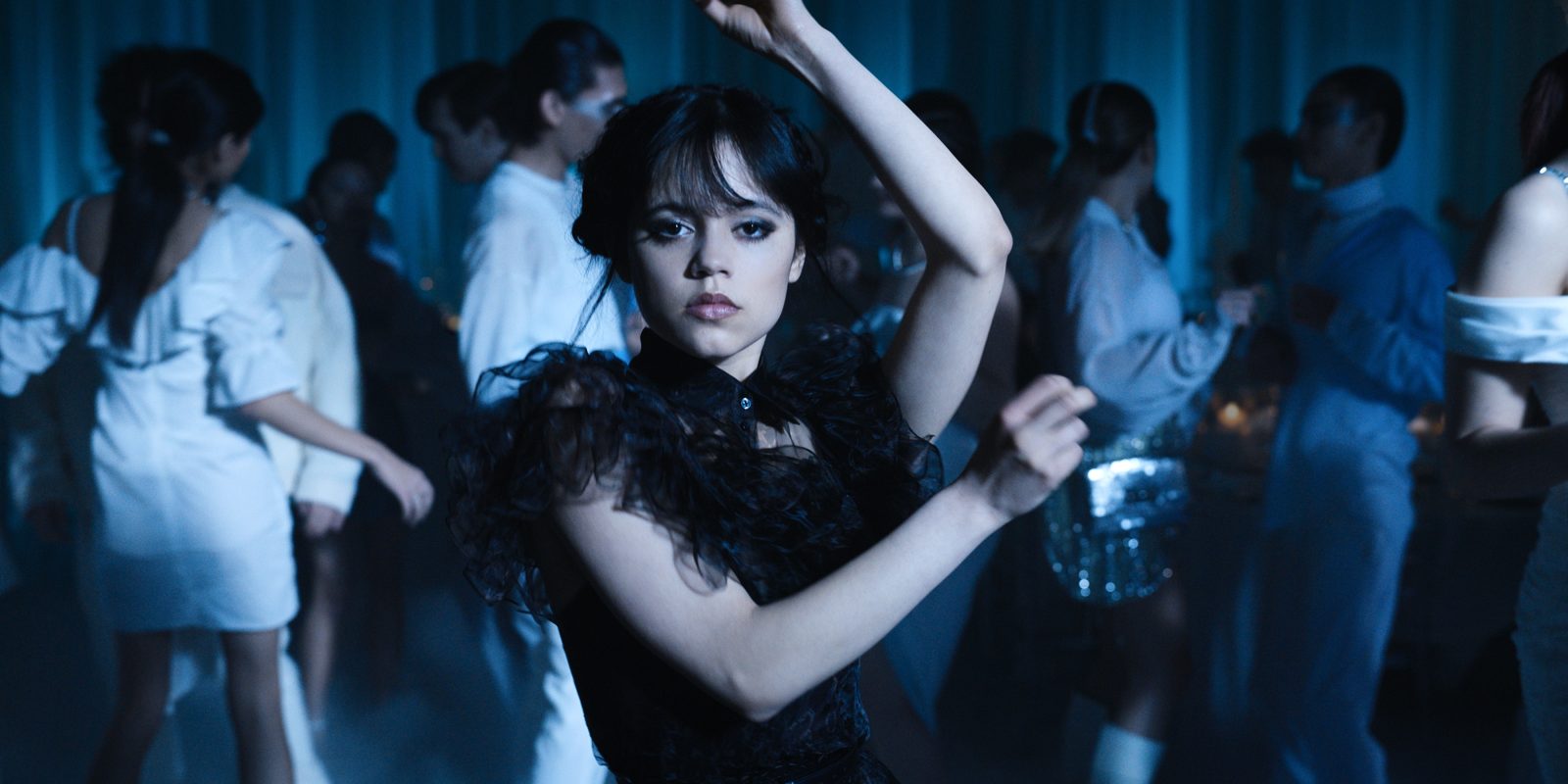
When Charles Addams was first drawing the Addams Family for the New Yorker, the characters didn’t even have names. Then they got a network TV show. Feature films. Transmogrification into a multimedia franchise. And, somewhere in the process, supernatural powers.
More is decidedly less, to judge by “Wednesday,” but less is antithetical to the American pop-cultural process—something we didn’t need this show to tell us, though it’s a prime example of excess as a governing aesthetic. The saucer-eyed Jenna Ortega returns for a new season as the acerbic Addams daughter, which is great, but the character’s misanthropic self is supported by an overload of the repulsive, the gruesome, the homicidal and the disgusting—or am I, like the series, being redundant? There’s also a negative side, which is the lack of much storytelling craft in a production that seems to be making stuff up as it goes along. At the risk of waxing very nostalgic, the Addams Family were funnier when they were pouring boiling oil on Christmas carolers.
Tim Burton , who is an executive producer and directed several episodes this time around, is at the stage where he should be referred to as a national treasure. Apropos of that, the one graceful sequence in what Netflix has dubbed “Part 1” of season 2 (meaning only four of eight episodes were offered up for review) is a stop-motion sequence about the Skull Tree and the sickly boy with the clockwork heart. This sets up the zombie portion of the program to come; the telling of the traditional start-of-school tale helps further establish Nevermore Academy as a demented Hogwarts for “Outcasts” (werewolves, telepaths, maniacs). But it also serves as a homage to the work of Mr. Burton and director Henry Selick on “The Nightmare Before Christmas” and Mr. Selick’s own “Coraline.” It is a bit of magic in a season that is, ironically enough, charm-free.
Part of the problem faced by “Wednesday” is Wednesday. Ms. Ortega is certainly a presence; to call her an actor would be jumping to conclusions. But the character is a one-joke device, the joke being her darkly cynical worldview, her antisocial, even antihumanist response to anything trite, vapid or otherwise teenaged. “If you can’t kill them with kindness,” she says at one point, “try lethal injection.” This is funny, for a while; Wednesday is the extreme version of the alienated adolescent. But the series’ creators, Alfred Gough and Miles Millar , likely know the limitations of their material, which is why they lard the story with so many backstories, useless digressions and subplots.
These include the reanimation of the aforementioned clockwork zombie by Wednesday’s brother, Pugsley ( Isaac Ordonez ), and the color war between a troop of overheated Boy Scout-adjacent “jarheads” (not my term) and the gifted contestants of Nevermore. It’s classic wheel-spinning, but it is also hard to determine what the series’ central narrative is: The contest between Wednesday and her mom, Morticia ( Catherine Zeta-Jones ), over the family book of spells? The imprisoned maniac whose spree in season 1 led to so much drama? The worshiping of Wednesday by the student body for having saved the school last term? There are more major plotlines than Thing has fingers.
Thing, the Addams Family retainer played so amusingly by Victor Dorobantu , gets an inordinate amount of screen time, but it is mostly well spent. Likewise, any attention paid to Enid Sinclair ( Emma Myers ), Wednesday’s roommate and a refreshingly “normal” kid despite her teeth, claws and aversion to full moons. The full-fledged adults are another story. Everyone loves Steve Buscemi , but as Nevermore’s new principal, Dort, he’s miscast, his part is underwritten and his wig is an atrocity. (I hope it’s a wig.) Luis Guzmán , as Gomez Addams , is no Raul Julia , or even John Astin . One bright spot is Fred Armisen’s Uncle Fester, who is delightfully deranged, though his contribution seems to exist, like much of what is best about “Wednesday,” on its own lunatic fringe.
Wednesday, Season 2, Netflix