NEW YORK—One island. 32 miles. 3,500 masochists.
The first Saturday in May is a cherished tradition for New York’s die-hard walkers, who gather to circumnavigate Manhattan in one very long day. But lately the event has been almost unrecognizable to veterans of the 40-year-old stroll.
A surge of interest from young people has made just gaining entry a chore. As recently as 2013, fewer than 1,000 people registered for the event. Organizers capped this year’s Saunter at 3,500 walkers, and another 3,000 landed on the wait list.
The start of the event was moved from a tavern to a pavilion. Some walkers carried jingling shells to mark their previous participation in another very long walk: the Camino de Santiago. A few sported hiking poles. Others wore jeans and carried tote bags .
Unregistered stragglers joined the line throughout the day while others peeled away. Crowds winded through greenways and walking trails, processing through thin paths in single-file lines and dodging annoyed runners and whizzing bikers.
There were 30-minute lines for park bathrooms along the route.
“The Great Saunter was never intended to be a mass participation event, like a marathon or a race. It’s a walk,” said Christine Summerson, a board member of Shorewalkers, the nonprofit that organizes the walk.
Shorewalkers attributes the recent spike in interest to…what else? Social media.
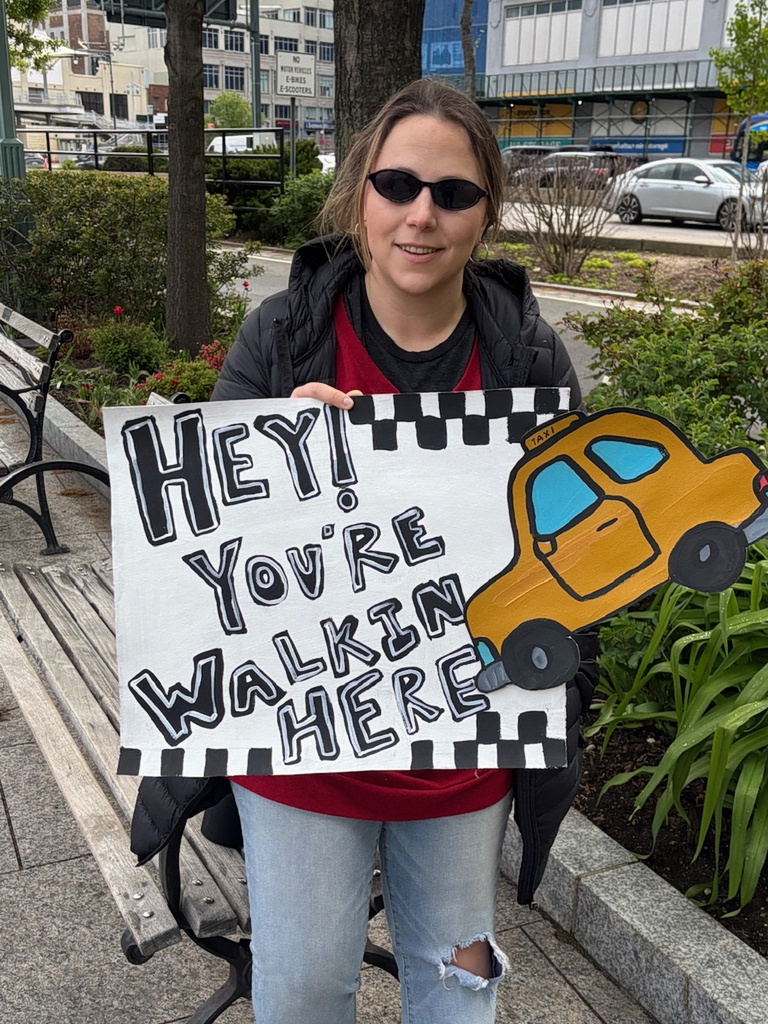
Liz Macro came to cheer on a friend. Annabelle Williams/WSJ
“There were a couple TikToks and all of a sudden we just started getting slammed and selling out in a few hours,” said Shorewalkers President Pam Cress.
Organizers estimate more than one-third of this year’s walkers were between the ages of 18 and 34, compared with 19% in 2022.
Sarah Milstein first Sauntered in 1996 and has participated at least a dozen times. “For a long time,” she said, “it was more of a middle-aged scene.”
The 57-year-old writer and leadership coach seemed more philosophical than annoyed about the influx of 20-somethings. Milstein said the Saunter is now part of New York’s “line culture,” where young people flock to bakeries and other spots that are hyped on social media and expect to encounter endless queues.
Gen Z and millennial walkers said they’re seeking in-person connection and community after the pandemic.
Amy Xiang, who Sauntered last year, was a college freshman in 2020 and spent much of her undergraduate career socially distancing. She heard about the event on Reddit.
People her age, she said, “crave something real.” Xiang joked that she was following the first commandment of going analog: “Touch grass.”
Some newcomers are finding out the hard way that the Great Saunter is no leisurely stroll. The event starts between 7 a.m. and 8 a.m. and it takes most walkers between 10 and 12 hours to complete.
Rachel Morris, 27, entered last year’s Saunter after moving to Brooklyn from Albany. Eight hours into the walk, she started to succumb to an electrolyte deficit.
“Every step kind of became torture,” said Morris, who finished at around 7:30 p.m. “It was the worst pain I think I’ve experienced.”
But enough time passed to convince her to try again. This year, she took more breaks, finishing in 14 hours.
Matthew Barouch and Kate Berg, both 32, also did their maiden Saunter in 2024. As they passed the little red lighthouse under the George Washington Bridge, Barouch proposed.
Hoping to make it a tradition, they signed up again this year, only to land on the wait list. Barouch said he added the proposal to the “notes” field. They got in, and did their first walk as a married couple.
Organizers said they try to find a balance between longtime walkers and new registrants.
Cress reminds repeat Saunterers that unlike in years past, they need to act fast to get a bib. They’re competing with Gen Zers who are used to the blink-and-you’ll-miss-it fervor of Ticketmaster queues.
Cress said the increased interest helps advance the nonprofit’s mission of expanding public access to the shoreline.
There are other upsides. Traveling south on Manhattan’s east side requires twists and turns to avoid construction around the shoreway, and more walkers means it’s harder to get lost when crowds thin. Organizers said the finish rate has gone up to around 62%, compared with about 50% in years past.
John Mulligan, 76, walked this year for the first time along with teammates from his Rhode Island rowing club. The group of four, with ages ranging from 59 to 76, finished in about 13 hours.
Mulligan considered the aches, pains and blisters a small price for the “mingled sensations of camaraderie, achievement and wonder at Manhattan’s astonishing array of sights.”