 Μake us preferred on Google
 Is it laziness, illiteracy or the ultimate flex?
Missives from titans of business and politics show a striking disregard for spelling, punctuation and proper grammar.
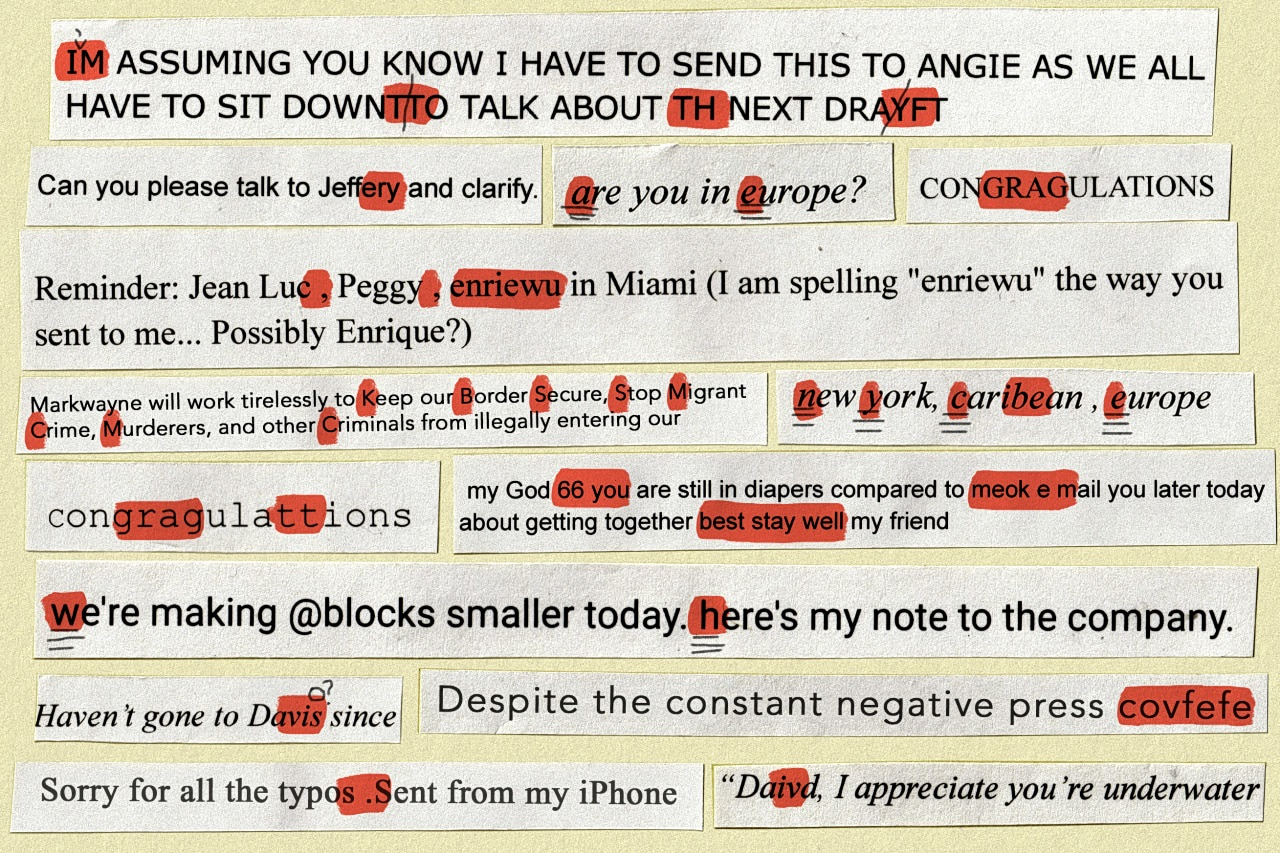
Jack Dorsey’s memo last month laying off nearly half of Block’s staff was almost entirely in lowercase. Paramount Skydance Chief David Ellison addressed Warner Bros. Discovery’s David Zaslav as “Daivd” over text last year while trying to strike a deal. The famous hack at Sony Pictures revealed executives sending messages like “WE ALL HAVE TO SIT DOWNTTO TALK ABOUT TH NEXT DRAYFT.”
Then there are the Epstein files, which are riddled with egregious misspellings and lackluster punctuation by not just convicted sex offender Jeffrey Epstein , a college dropout, but also his Ivy League connections and wealthy friends.
The literary breaches, while trivial, highlight a reality that has become all too clear: There’s an inverse correlation between power and proper punctuation.
Before the digital era, executives, lawmakers and other important people often communicated via secretaries and press releases. Now they fire off messages from their phones and computers day and night. Voice-to-text and autocorrect functions can make things worse.
Disregarding spelling and grammar in a written conversation can be a power move or a sign of friendliness, or perhaps both at the same time, said Deborah Tannen, a linguistics professor at Georgetown University.
It conveys: “I’m important, you’re not so I don’t have to bother,” or “We’re so friendly, I don’t have to worry, we don’t stand on ceremony,” she said.
There was a time when a certain level of written formality was expected of people in power. In the 1950s, a CEO sending a letter would most likely speak into a Dictaphone, and the recording would be painstakingly transcribed by a secretary, said Thomas Farley, an etiquette and communications expert who goes by Mister Manners.
“If she made a mistake, she yanked the page out of the typewriter and she started over,” he said.
Politicians were held to similar standards. In 1992, Vice President Dan Quayle corrected a 12-year-old spelling bee contestant on camera, incorrectly instructing him to add the letter “e” onto the end of the word “potato.” The gaffe became a defining moment of Quayle’s term.
Texting and the internet mean people are communicating in writing far more often. Society as a whole is also less formal, with people ditching customs like addressing someone as Mr. or Mrs.
“We’re using speech and writing so interchangeably,” said Naomi Baron, a linguistics professor emerita at American University. “We move on so quickly from message to message, conversation to conversation.”
President Trump’s social-media posts feature random capitalization and periodic misspellings. In 2017, he famously tweeted about “negative press covfefe” at 12:06 a.m. (Trump sometimes dictates his social-media posts to aides and sometimes writes them himself.)
“President Trump is the greatest and most authentic communicator in the history of American politics,” a White House spokeswoman said.
Epstein’s disregard for grammar and spelling was on another level. He sent notes of “congragulations.” He told his assistant about someone named “enriewu,” prompting her to ask if the person is “possibly Enrique?”
Epstein’s emails sometimes included a footer that read “Sorry for all the typos .Sent from my iPhone.” Hotel magnate Thomas Pritzker once replied to him saying “Please excuse my lack of typos.” Pritzker retired as executive chairman of Hyatt Hotels after the documents emerged and said he “exercised terrible judgment in maintaining contact with” Epstein.
When Seattle-based professor Daniel Bessner was scrolling through excerpts of the messages on X from his couch, he thought of how his own students put much more effort into their spelling. “It was nihilistic almost in its total disinterest in communicating,” Bessner said.
When Bessner asked others on X what they made of the writing style, some chalked it up to Epstein being a baby boomer who may have learned how to message on BlackBerry’s error-prone keyboard. Others theorized that Epstein was spelling incorrectly on purpose.
The emails show Epstein wasn’t the only one who wrote this way. When the World Economic Forum was occurring in Davos, Switzerland, in 2019, Epstein asked investor Peter Thiel: “are you in europe?” Thiel replied: “Haven’t gone to Davis since 2013… the era of globalization is just over.” Later in the exchange, Epstein tells Thiel that the following month he’ll be in “new york, caribean , europe.”
Representatives for Thiel didn’t respond to requests for comment.
Jonathan Farkas, heir to a department-store fortune, often sent Epstein emails with minimal punctuation. “my God 66 you are still in diapers compared to meok e mail you later today about getting together best stay well my friend,” Farkas said to Epstein in an exchange about their birthdays. Farkas didn’t respond to a request for comment.
Boris Nikolic, Bill Gates’s longtime scientific adviser, repeatedly addressed Epstein as “Jeffery.” Nikolic previously said “Epstein was a master manipulator, and I deeply regret associating with him.”
Epstein doesn’t appear to correct Nikolic when he misspells his first name. But in another instance, Epstein was critical of misspelling. A contact forwarded the sex offender his daughter’s college application in 2013.
“I wish you had let me review before sending…the grammatical errors and spelling mistakes will make it at least harder for early admission,” Epstein wrote.
Write to Rachel Louise Ensign at Rachel.Ensign@wsj.com and Alexandra Wexler at alexandra.wexler@wsj.com