When we talk with friends or discuss current events at school, topics like war, geopolitical tensions and global crises suddenly appear more and more often. Not long ago, Europe felt stable and secure. For many of us who grew up here, peace, cooperation and open borders seemed almost natural.
But recently, a new question has quietly entered many conversations. While we as young people want to prepare ourselves for the future ahead – finishing school, thinking about university, planning travels and careers – we also begin to wonder:
Will Europe still be the same place in which we grew up?
Europe once felt stable and predictable. But in a world shaped by everything that worries us today, we are starting to ask ourselves: What will Europe look like in the future – and what role will our generation play in shaping it?
The feeling that Europe has become more uncertain is not just a perception among young people. Across the European Union, many citizens share similar concerns. A recent Eurobarometer survey showed that 72% of Europeans are worried about active conflicts, while 52% feel pessimistic about the future of the world. These numbers reveal something important: the sense of fear is widespread. And when as we look at global developments, these worries are not surprising.
For the first time in decades, war has returned to Europe with Russia’s invasion of Ukraine. At the same time, geopolitical tensions are rising worldwide. The global balance of power is shifting as countries like the United States and China compete for influence.
But that’s only one part of the picture: migration, climate change, economic uncertainty and debates about Europe’s role in the world all add to the pressure – and sometimes it feels as if challenges are piling up faster than solutions can be found.
Yet while these challenges test Europe’s unity, they also remind us how interdependent we truly are.
In such a situation, we begin to question whether Europe is strong enough to deal with these crises. This leads us to another question: Can Europe respond to global challenges if cooperation within Europe itself is not always easy?
Europe has always been a continent of diversity. Different languages, cultures, and traditions shape the everyday lives of millions of people. This diversity makes Europe unique – but it can also make cooperation even more complicated.
At times, countries focus primarily on national interests instead of common European solutions disagreements between member states emerge. Cultural differences can create tensions. Communication barriers, misunderstandings or the development of parallel communities can make integration more difficult.
But diversity is not just a challenge – it’s one of Europe’s greatest strengths. Different perspectives encourage innovation, creativity, and cultural richness. They protect minority identities and allow societies to learn from each other.
Because of this, Europe’s future cannot be built on everyone becoming the same. Instead, cooperation must be based on something deeper than culture: shared democratic values, dialogue between cultures, mutual respect, and integration. When diversity is combined with common principles, differences no longer weaken Europe. They are essential – they strengthen it. And if Europe succeeds in working together internally, it can become much stronger on the global stage.
Europe has already shown that cooperation is possible.
A clear example is Europe’s response to Russia’s war against Ukraine. The European Union imposed sanctions on Russia, restricted exports and imports and welcomed millions of Ukrainian refugees. European countries managed to coordinate their actions when democratic values were under threat. This demonstrates something important for us: when it truly matters, Europe can act together.
But Europe’s future is not only defined by reacting to crises – it is also about shaping its own path.
The search for a new European vision does not only involve governments – it also involves its people. Our generation is growing up in a Europe where borders are easy to cross, where cultural exchange is common and where cooperation between countries is part of everyday life. Programs such as Erasmus or youth exchanges allow students to study abroad, meet people from other cultures, and experience Europe beyond their national perspective. These experiences create something powerful: a sense of shared European identity.
Perhaps the future of Europe will not come from one grand political plan. Instead, it may emerge from millions of small connections – friendships – collaborations, and – shared ideas across borders. In the end, Europe’s strength may lie exactly here. Not in homogeneity, but in cooperation.
Europe feels different today. The crises we face have made the future feel less predictable than before. But uncertainty does not necessarily mean weakness. Europe has often grown strongest in its most difficult moments. The lesson that emerges again and again is simple: cooperation matters.
In a changing world, Europe may still be searching for a new vision. But perhaps the answer has always been there.
Europe’s greatest strength is not that we are the same. It is that we choose to stand together. This is our vision.
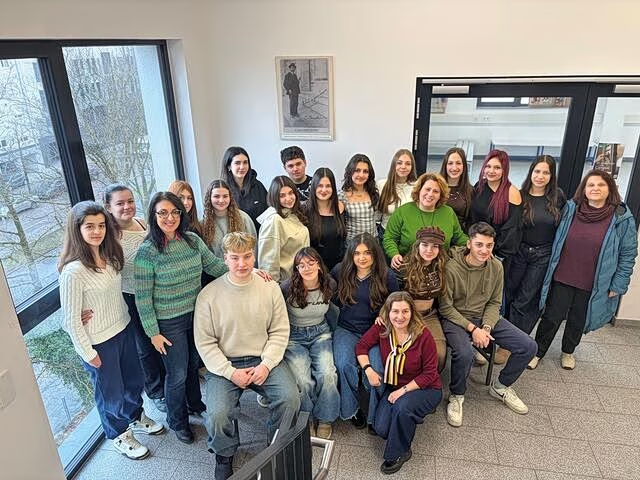
The junior ambassadors of the
Friedrich-List-Schule Ulm
Author
Carolin Wurm
Research
Paula Ehrenbeck
Victoria Korn
Vlad Nicoara
Jonathan Park
Jacqueline Scharl