 Μake us preferred on Google
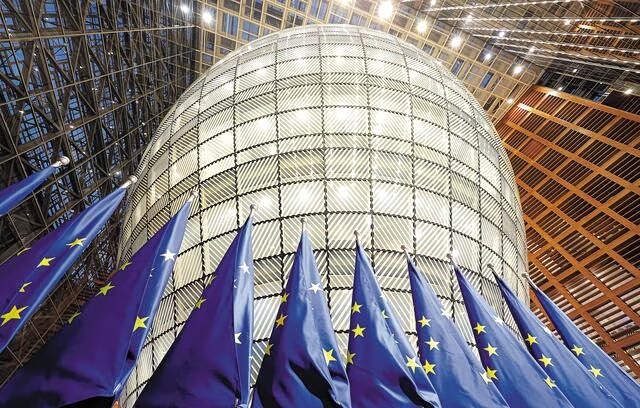
 When we think of Europe, we often imagine treaties, institutions, and meetings of political leaders, but for many young people of my generation, Europe is something much more everyday and familiar. Europe is the possibility of traveling without borders, studying languages, getting to know people and cultures from other countries, and feeling that we are part of a common space. However, as we grow up and begin to follow international news, we realize that the world is changing and that Europe is at a point of great uncertainty.
For decades, Europe has enjoyed relative political and economic stability, protected by strong alliances and an international system that seemed fairly predictable. But today that balance is changing.
One of the most important factors is the change in US foreign policy. After World War II, the US was Europe’s main ally, especially on security issues. For many years, NATO was the guarantee that the continent would be protected from potential threats. This transatlantic relationship gave Europe a sense of security that we perhaps took for granted.
However, in recent years we have seen how US policy can change very quickly depending on the government in power. Some US leaders have questioned the commitment to Europe, raising doubts about the extent to which the continent can continue to depend on the US for its security and stability.
For our generation, this discussion may seem very technical, but in reality it affects us directly. If Europe wants to have a voice of its own in the future, it will have to learn to act with greater unity and responsibility. This does not mean abandoning alliances, but rather strengthening Europe’s capacity to make strategic decisions.
At the same time, the war in Ukraine has profoundly marked European politics in recent years. Russia’s role in this conflict has radically changed relations between Moscow and most European countries. For a long time, Russia was seen by some European governments as an important economic partner, especially in the energy sector. But the invasion of Ukraine has shattered this perception and caused a deep diplomatic and economic crisis.
This war has also caused many Europeans to rethink issues that seemed to be taken for granted. Security, defense, and energy independence have once again taken center stage in political debate. For young people, seeing a war on the European continent is a worrying reminder that peace is not permanent. Many students our age have grown up thinking that armed conflicts only happened far away, but the current reality shows us that history can repeat itself.
Another phenomenon that is transforming the European political landscape is the rise of far-right parties in several countries. These movements have gained support by using rhetoric based on rejecting immigration and defending a more radical form of nationalism.
In some cases, they also question democratic institutions or rights that have been considered fundamental for decades.
This growth of the far right cannot be understood without taking into account the social and economic context of recent years. Economic crises, inequalities, migration flows, and mistrust of institutions have generated frustration among part of the population. Some parties take advantage of this unrest to propose simple solutions to very complex problems.
As young Europeans, we are particularly concerned about this phenomenon. Europe has a history marked by the devastating consequences of extreme nationalism and authoritarian regimes. That is why we believe it is important for our generation to be well informed about the past and to understand the value of democracy, human rights, and international cooperation.
At the same time, Europe also faces other major global challenges. Climate change is probably the most urgent. Our generation is the first to grow up knowing that the decisions made today will have direct consequences for the planet for decades to come. Europe has tried to position itself as a leader in environmental policy, but there is still a long way to go.
Despite all these difficulties, we believe that Europe also has many strengths. It is a continent with great cultural diversity, with important universities and research centers, with an active society and a long tradition of international cooperation. In addition, many young Europeans today are growing up with a more open and global mindset than in the past.
Perhaps the new vision for Europe will not be to create a completely new structure, but to reinforce existing values: democracy, solidarity between countries, respect for human rights, and the willingness to resolve conflicts through dialogue. But it will also be necessary to adapt these ideas to a rapidly changing world.
The answer, in part, will depend on our generation. We are the European citizens of the future, and the decisions made today will influence the society in which we will live tomorrow. We may not yet have all the political power, but we already have something very important: the ability to think critically, to participate in public debate, and to imagine a better Europe. And perhaps the new vision of Europe will begin with that willingness to rethink our place in a world that is constantly changing.