“For years, our work has focused primarily on physically removing abandoned aquaculture infrastructure from the sea,” says Veronika Mikos, Director of the NGO Healthy Seas Foundation. “What makes this case significant is that it demonstrates another possible pathway.”
Instead of Healthy Seas cleaning up an abandoned fish farm itself, sustained public pressure, informal letters to authorities, and a Coast Guard investigation ended with an operator removing its own abandoned structures from Greek waters.
For Greece, where ghost farms have accumulated across the Ionian and beyond for years with no indication of accountability from former operators, that distinction matters.
When a Ghost Farm Enters a Ferry Lane
In February 2026, a large fish farm ring was found drifting through the Ionian Sea- loose, unmoored, and crossing an active shipping lane used by passenger ferries. The Coast Guard intercepted it near Ithaca and brought it ashore.
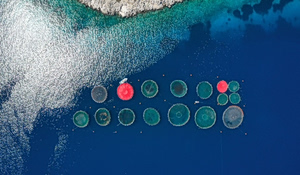
Healthy Seas moved quickly. Drawing on earlier underwater surveys of abandoned fish farms conducted with Ghost Diving Greece and the Greek NGO OZON, the foundation identified a possible connection with a site near Modi in western Greece, where four aquaculture rings had been documented as abandoned in practice for years. The ring type was distinctive, so the connection was hard to ignore.
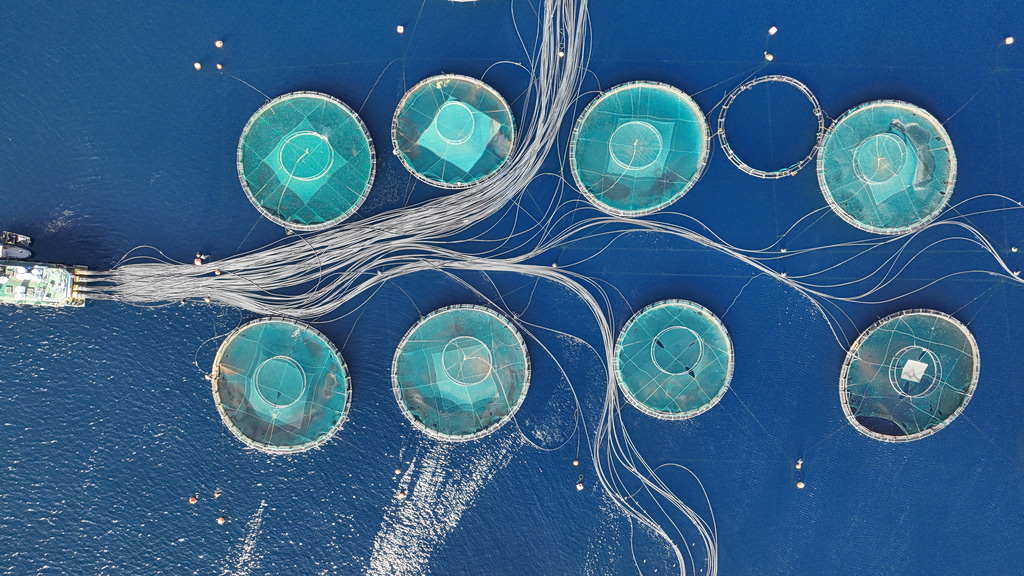
Rather than treating the recovery as a one-off cleanup, Healthy Seas escalated. Formal correspondence went to every competent authority leading to the recovered ring being recycled. A media campaign about the issue helped ensure that public attention around ghost farms intensified.
Shortly afterwards, the Coast Guard went to Modi to survey the remaining fish farm structures that had been previously documented as abandoned, only to discover that the structures were gone.
The former operator of the abandoned farm informed authorities the rings had been transferred to a recycling company, but it did not accept the notion that the drifting ring, which initially caught the attention of the public to begin with, had originated from its facility.
The Safety Argument Greece Can’t Ignore
Ghost farms are usually framed as an environmental problem. The Modi incident reframed them as something else: a maritime hazard in some of the busiest waters in the country.
“The drifting ring near Ithaca demonstrated that abandoned aquaculture infrastructure can also become a maritime safety issue in heavily trafficked seas such as those around Greece,” Mikos says. “Preventing these situations requires monitoring, accountability, and timely decommissioning before structures break loose.”
It is a pattern increasingly familiar across the Mediterranean- infrastructure inactive in practice, still on paper, deteriorating quietly until it breaks loose and becomes someone else’s emergency.
A Different Way to Count Progress
Over the past five years, Healthy Seas- with support from partners including Hyundai Motor Europe- has worked with local authorities, divers, fishers, researchers, and recycling companies to address abandoned aquaculture sites across Greece, including Ithaca, Patras, Menidi, and Methana. Since 2013, the foundation has collected over 1,309 tons of marine litter with more than 550 volunteers and 150 partners.
The Modi outcome adds something new to that record. The structures were never touched by an NGO crew because public pressure reached the operator first and resulted in the removal and recycling of the equipment.
“Strategic engagement, institutional pressure, and coordinated action,” Mikos says, “may encourage operators to take responsibility themselves before these structures become even larger environmental or maritime hazards.”