 Μake us preferred on Google
 Wednesday’s total solar eclipse will be visible along a narrow path stretching from the Arctic Ocean across the North Pole, Greenland and Iceland to northern Spain and northeastern Portugal, being the first visible from mainland Spain since 1905.
In northern Spain totality will last only about 20 seconds because the eclipse will occur close to sunset. Besides astronomers, meteorologists will also be closely studying the phenomenon on Wednesday, as a total solar eclipse does more than transform the appearance of the sky.
For a few extraordinary minutes, it can also turn Earth’s atmosphere into a natural laboratory, as the sudden loss of sunlight alters temperature and the circulation of air near the surface.
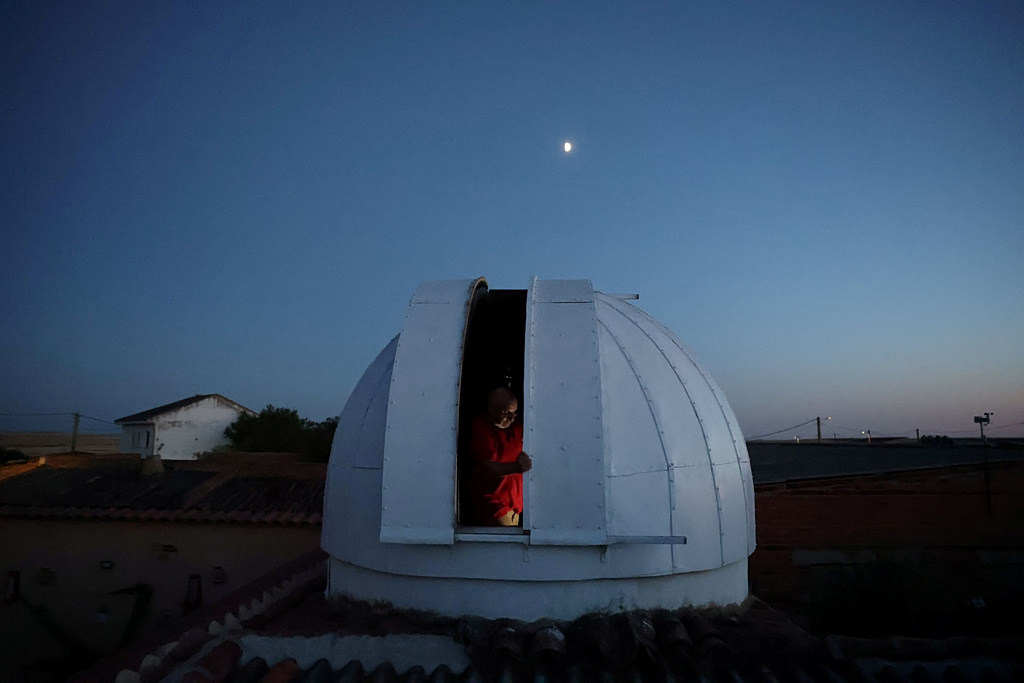
The moon shines over the domed observatory that retired shepherd and self-taught astronomer Joaquin Tapioles built with his own hands at his home in the farming village of San Agustin del Pozo, Spain, July 22, 2026. REUTERS/Violeta Santos Moura
Beyond the spectacle of the moon completely covering the sun, the eclipse will briefly interrupt the normal cycle of solar heating that drives much of the atmosphere’s daytime behavior.
The most immediate effect is a drop in temperature, as solar radiation reaching the ground drops sharply, with the result being that the surface begins to cool.
During the 2017 total solar eclipse over the United States, temperatures fell by about 4.5C in Kentucky and by 2 to 3 degrees at some locations in Oklahoma. The lowest temperature does not necessarily occur at the precise moment of totality, with the atmospheric response sometimes lagging by 10 to 15 minutes.
Winds can also change as solar heating is abruptly interrupted, atmospheric turbulence weakens and wind speeds can temporarily decline. During the 2017 eclipse, researchers recorded reductions of about 1 to 2 meters per second in Oklahoma, with larger decreases recorded at some locations in Kentucky.
Clouds may respond to the sudden cooling as well. Research has found that shallow cumulus clouds can dissipate rapidly as the land surface cools and rising air currents weaken, although the effect depends on local atmospheric conditions.
Relative humidity can also rise temporarily as temperatures fall. This does not necessarily mean more water vapor has entered the atmosphere; cooler air simply reaches saturation more easily.
The changes are short-lived and depend on factors including the time of day, season, cloud cover and degree of solar obscuration. Yet the eclipse provides a rare natural experiment: within minutes, solar heating is sharply reduced and then restored.
For those beneath the moon’s shadow, a celestial event will therefore be felt not only in the sudden transformation of daylight into darkness, but also in the air around them — through changes in temperature, wind, humidity and, in some cases, the clouds overhead.