 Μake us preferred on Google
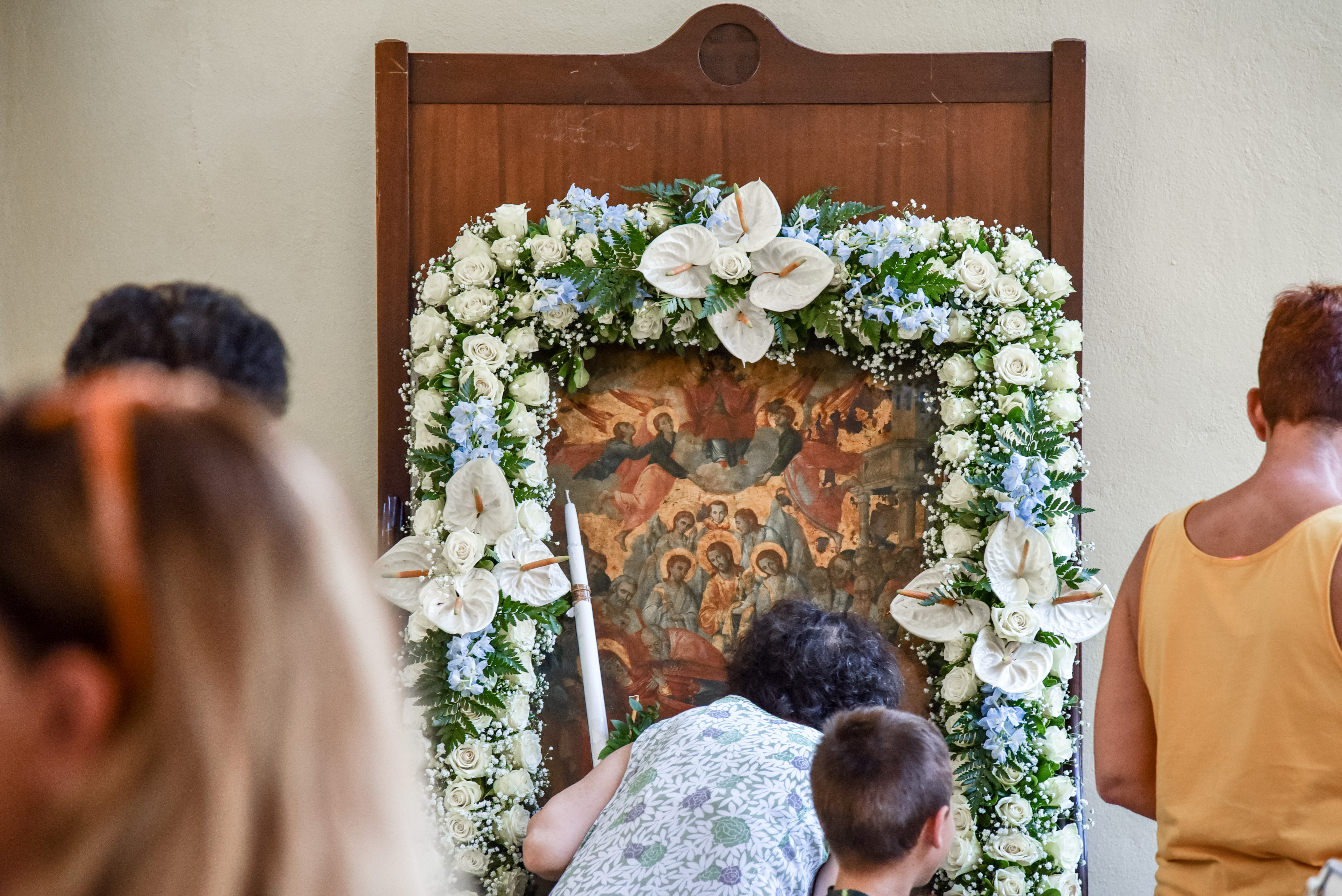
 In the Dodecanese, the feast of the Dormition of the Virgin Mary, has for centuries been bound up with family, the sea, migration and the hope of return. That connection is visible in the sheer number of churches, monasteries and small chapels across the islands dedicated to the Virgin.
August 15, widely referred to in Greece as Dekapentavgoustos, is one of the most important dates on the Orthodox religious calendar. In the Dodecanese, it is far more than a religious observance. It is the moment when islanders who have settled abroad, in Athens or elsewhere in Greece return to their home villages, drawn by pilgrimages, music and dancing that fill village squares for days.
A holiday built around return
For generations, moving between islands and villages was difficult, and the large religious feasts became fixed points around which social life was organized. That role has not disappeared. August remains the month of return for thousands of people from the Dodecanese who now live in Athens, elsewhere in Greece or abroad. For many, the feast of the Virgin is the date around which trips home, and reunions with relatives and friends, are planned.
Family customs tied to the feast, including votive offerings known as tamata and visits to specific churches, are passed down from parents and grandparents. Many families continue to visit the same church every year, keeping alive a habit that began generations earlier.
Why the village feasts still matter
Each island has its own way of marking the day, but common elements appear almost everywhere: preparations at the church, Vespers, the Divine Liturgy, the sharing of food, local musical instruments, traditional dances and, above all, participation by the whole community.
For older generations on the islands, these panigyria, or village feasts, were far more than entertainment. They were among the most important occasions for people to come together. Families reunited, relatives returned from distant places, young people met one another, and entire villages took part in the preparations.
Food remains central to that gathering, not simply as an accompaniment to the celebration but as a shared undertaking. Residents and volunteers often begin preparing dishes the day before a feast, working with large cooking pots and local recipes and ingredients. Recipes, dances and music differ from island to island, but the underlying idea, communal sharing, remains constant across the Dodecanese.
Rhodes: Panagia Kremasti and village celebrations
On Rhodes, August 15 is traditionally one of the most significant days of the summer. Churches and monasteries dedicated to the Virgin become the focus of religious events, chief among them the feast of Panagia Kremasti, considered the largest religious celebration on the island. In many villages, the church service is followed by a traditional feast. Church courtyards and village squares turn into gathering places, with music, local dances, food and wine completing what has become the familiar setting of a Rhodian panigyri.
Karpathos: tradition as living practice
Karpathos holds a distinct place in Dodecanese cultural life, with customs, music and dances that have retained a strongly local character. On the island, these feasts remain an active part of social life rather than a re-enactment of the past. The lyra and the laouto, traditional string instruments, accompany songs, improvised rhyming couplets known as mantinades, and traditional dances in a ritual that brings together different generations. In villages that have kept especially strong ties to tradition, the feast functions as a living link between past and present.
Kasos and the smaller islands
A similar picture holds on Kasos, an island with a particularly strong musical and culinary tradition. Its feasts are marked by community participation, traditional instruments and songs handed down across generations, with the shared meal an integral part of the celebration. Across most of the Dodecanese, a panigyri is unthinkable without food and the collective work that goes into preparing it.
On Kalymnos, Kos and Leros, as well as the smaller islands of the group, August 15 continues to bring together residents, visitors and returning islanders around churches and monasteries. On Nisyros, Tilos, Chalki, Symi and Astypalaia, that sense of community is often even more pronounced, with locals and visitors sharing the same table and the same celebration.
Nisyros and the custom of the Koupa
Speaking to the Athens-Macedonian News Agency, Nisyros Mayor Christofis Koronaios described a local custom known as the Koupa. He said the custom holds a distinct place in the island’s tradition, describing it as a dance that combines religious devotion with celebration and offerings to the Virgin of Spiliani.
On the night of August 15, residents of Mandraki, the island’s main town, gather at the traditional dancing ground and the celebration begins with the Koupa. A woman leads the dance while a man who chooses her as his partner places money in a cup, or koupa, that she holds. For decades, the custom served not only as an expression of respect, affection and social recognition but also as a way of raising funds for the monastery.
In earlier times, the Monastery of the Virgin of Spiliani played a defining role in the island’s social and economic life, including the operation of local schools, which made the money raised through the custom especially significant. The Koupa remains one of the most distinctive traditions on Nisyros today, linking faith with memory, family, romance and collective giving. As Koronaios put it, the custom continues to be observed with particular devotion and remains a valuable part of the island’s cultural identity.
Music that carries the tradition forward
Music is one of the strongest carriers of Dodecanese tradition. The lyra, the laouto and other instruments, depending on the island, accompany songs and dances handed down through generations. At feasts that have kept their original character, dancing is not a performance staged for visitors. It is participation. Older islanders pass on steps, songs and an entire code of behavior within the celebration to younger generations, and when a feast lasts until the early hours of the morning, it repeats a scene that has played out across the islands of the Aegean for many decades.
The feasts of the Dodecanese have inevitably changed. Tourism, new forms of entertainment and different rhythms of daily life have all shaped how they are organized today. Yet behind the loudspeakers, the lights and the larger summer crowds, an older core remains: the need of a community to come together. That is why August 15 in the Dodecanese continues to mean more than a date on the religious calendar. It is the return of those who left, a candle lit in a small chapel, a family meal, music in the square, the first dance and a celebration that can last until dawn, one of those moments in the year when the islands, through their own people, remember who they are.