“If the violin is the most perfect musical instrument, the Greek language is the violin of human thought.” — Hellen Keller
On Feb. 9, UNESCO celebrates the Greek language as one of the oldest and most influential languages in the world, noted Greek-Australian MP Steve Georganas in the Parliament of Australia, delivering part of his speech in Greek and emphasizing the importance of the language as a shared global heritage. Historically, Greek served as the official or administrative language of great empires, from the Hellenistic era shaped by the conquests of Alexander the Great to the Byzantine Empire founded by Constantine the Great.
Today, it is the official language of around 12 million people, primarily the residents of Greece and Cyprus.
One of the most salient characteristics of the Greek language is perhaps its resilience over time, as it is among the very few languages—alongside Chinese and Hebrew—that have been spoken continuously and without interruption for more than 4,000 years. The recent discovery of Linear B tablets dating from around 1450–1350 B.C. clearly demonstrates this continuity.
At the same time, Greek has played a decisive role in shaping not only Western languages, but also languages of the East, enriching their vocabularies with words rooted in Greek—particularly in fields such as science, political life, and the arts. The English language alone has over 50,000 words derived from Greek.
Despite the decline in the number of Greek speakers over the centuries, the enduring appeal of Greek continues to attract people from all corners of the world. But who are these people, and what makes Greek appealing to them? According to Emily Intzekostas, a Greek teacher and co-founder of Greek Language Experts based in New York City, interest in learning Greek appears to be on the rise.

Emily Intzekostas Greek teacher and co-founder of Greek Language Experts
Why people around the world are turning to Greek
The reasons vary widely, with each learner driven by different personal, cultural, or academic goals. Intzekostas speaks of 2 different categories of learner, based on her own experience: those of Greek origin and non-Greeks. “I believe the need to learn Greek has deep roots, going back to the first generations of Greeks who migrated abroad. As these communities began building families, the desire to pass on their language and cultural identity to their children grew stronger,” she says.

Emily Intzekostas teaching online
In recent years, however, she points out that there has been a noticeable increase in interest not only among second- or third-generation members of the diaspora, but also among people without a Greek background.
Diaspora children and second- or third-generation adults who didn’t have the opportunity to learn Greek at a young age now want to reconnect with the language and culture of their ancestors, Intzekostas notes. “Many students want to learn Greek because their parents or grandparents speak the language. Others are married to Greeks and want to communicate more meaningfully with their partner’s family,” she says, presenting her own husband as an example, who speaks English and Spanish, while her mother speaks very little English.

Alex Jones, with his Greek girlfriend visiting Greece
Alex, a Londoner, also falls into this category. “I started learning Greek because of my Greek girlfriend—I wanted to be able to speak her language and communicate properly with her family, especially her ‘giagia’ (grandmother) and ‘pappou’ (grandfather). It felt important to make that effort and be part of their world. Plus, if I’m being honest, it definitely makes ordering a beer in Greece a lot easier, which is always a bonus!” he notes. Meanwhile, Kerrin, a graphic design student living in Indonesia and a self-taught learner, says she started because of her love of Greek culture and language, as well as her deep appreciation for the country’s history.
For many, however, Greek is necessary for their work, since they conduct business with Greeks. Alex points out that he interacts with Greek clients and colleagues through his work in the shipping sector. “Even being able to greet someone politely or have a short conversation in Greek helps build stronger relationships and shows respect,” he emphasizes. Another notable example is Nia Vardalos, who took daily lessons to prepare for her performance at the Pallas Theater, demonstrating how language preparation can be essential for professional work in Greece.
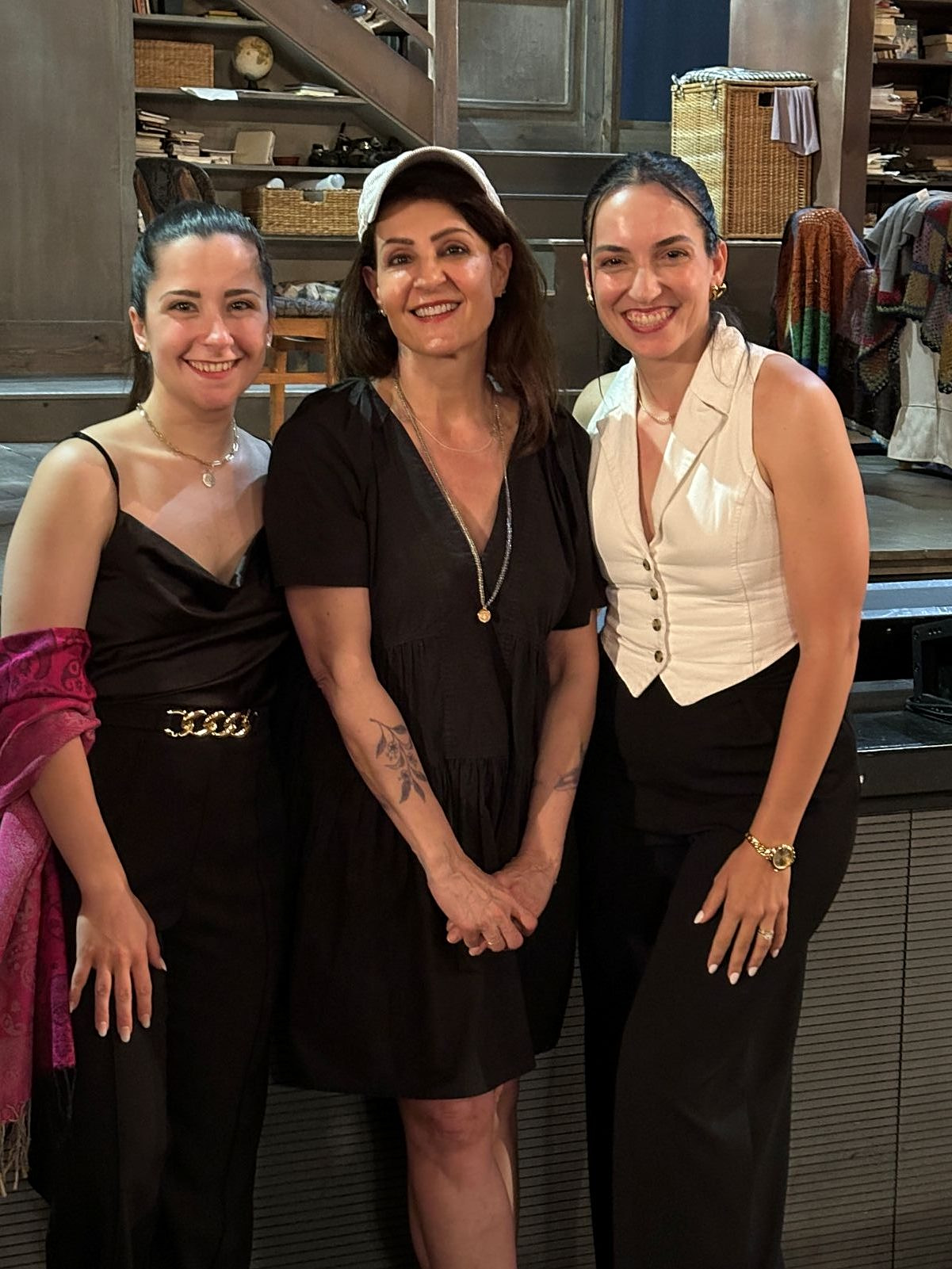
Intzekostas helped Hollywood star Nia Vardalos improve her Greek for her performance at Pallas Theatre
Another factor that has contributed to the growing interest in learning Greek, especially among young people, is Greece’s growing status as a digital nomad hub. Intzekostas confirms this trend when she notes: “Many of my students are planning to live or work in Greece in the near future, which makes the language an essential tool for connection, integration, and everyday communication. Add to that the rise in digital nomads and Greece increasingly becoming a destination of choice.”
Technology opens new doors for learners
The demographic profile of students has also broadened significantly, largely thanks to the introduction of technologies such as online lessons and applications that allow access to courses without the need for physical attendance in a classroom.
“At the moment, our students come from the United States, Canada, Chile, England, Australia, and China.” She adds that technology has played a crucial role in spreading the Greek language. In the past, many diaspora Greeks relied mainly on community centers and churches to learn the language—options that were not accessible to everyone. Online schooling has now opened many doors for students who wish to learn Greek, but have limited time or live far from organized learning centers.
Moreover, Intzekostas stresses that educational apps make lessons more interactive and effective. “In practice, we use many of these tools alongside printed or digital materials, so students can enjoy a comprehensive and flexible learning experience,” she says.
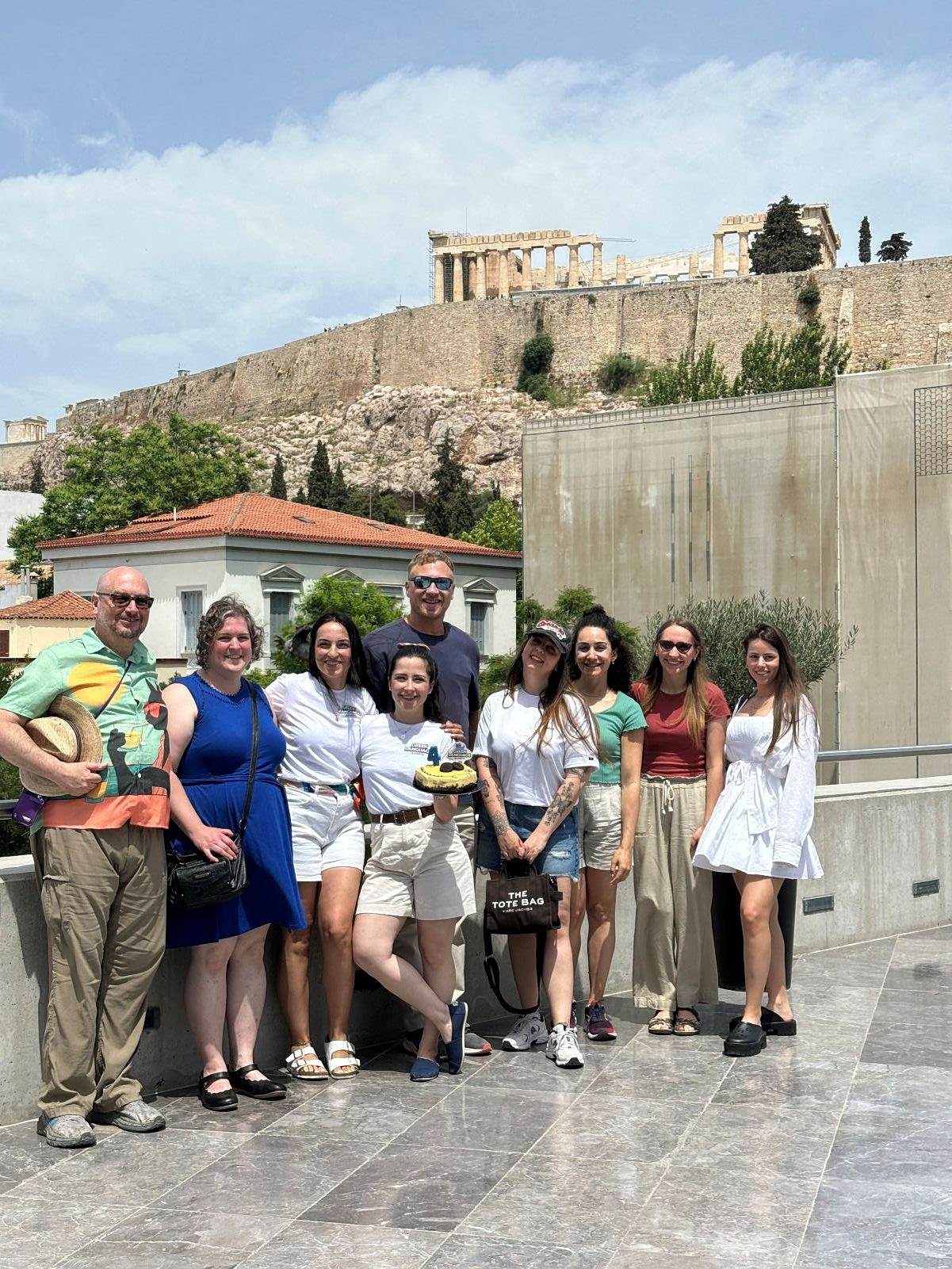
Emily Intzekostas with Greek learners under the Acropolis, Athens
Kerrin also highlights how these new technologies were essential in her own learning journey. Living in Indonesia, she has no access to Greek teachers or language schools, as Greek is a rare pursuit in the region.” “So I learned mostly on my own,” she explains. Initially, she used Duolingo, but later she began connecting with Greek people online through platforms such as Instagram and Discord to practice the language and make friends. “We chatted in Greek and sometimes had voice calls on Discord servers. Whenever I made mistakes, they helped correct me, so I could improve,” she says.
The challenge—and the rewards—of learning Greek
The experience of learning also varies greatly and is heavily influenced by geography, as well as by the availability of suitable educational materials for language learning. So, while Kerrin finds it quite difficult in Indonesia, Alex says his own experience has been fairly trouble-free, because he does most of his lessons online. He notes, however, that if he wanted to learn face-to-face, he isn’t far from several teachers, as the Greek community where he lives has been incredibly supportive. “Living in London also helps, because there’s such a strong Greek and Cypriot presence, so you’re never too far away from someone willing to help or practice with you,” he added. Intzekostas says that educators are also challenged by the limited learning material designed to cater to the specific needs of Greek-as-a-second-language students, including authentic audio and visual material. “There aren’t many Greek films or series accessible abroad with English or Greek subtitles that we can consistently use to give students more exposure to the language in real-life contexts,” she noted.

Kerrin Winona Greek learner from Indonesia
Finally, although they may sometimes encounter challenges, Greek learners focus on how rewarding the journey can be. “The difficulty of the language is actually part of what makes it so enjoyable — it’s incredibly rewarding when Greeks reply to me in Greek and encourage my efforts,” Alex said. Meanwhile, Kerrin stressed: “When I speak Greek, I feel connected to Greece’s history and culture. I can better understand and follow what is happening in Greece and in Greek communities around the world.”