 Μake us preferred on Google
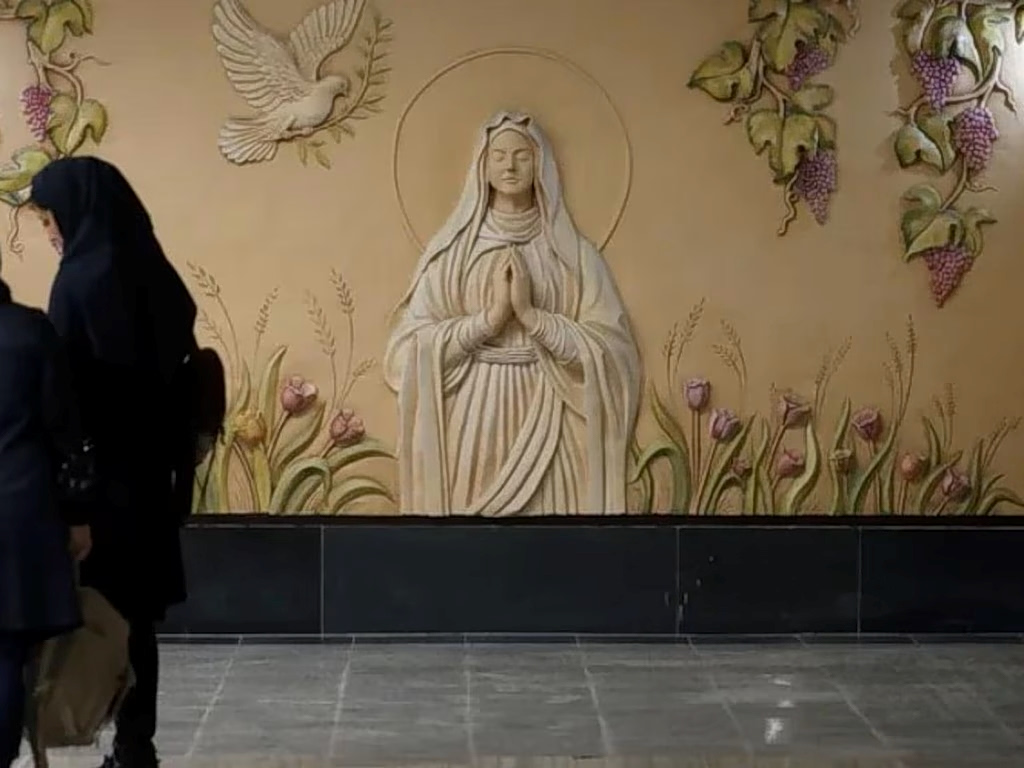
 We think of the Virgin Mary as the “great mother” of Christian and post-Christian societies. There is, however, another religion in which believers recognize Mary as a mother. What is the place of the Virgin Mary in Islam?
Angeliki Ziaka, professor of Religious Studies at Aristotle University of Thessaloniki and coordinator of Interreligious Dialogue at the World Council of Churches, explains to To Vima: “Mary (Maryam) is the only woman mentioned by name in the Quran, with the 19th surah (chapter) bearing her name. She is presented as the virgin mother of Jesus, chosen by God and enjoying divine protection from her birth (Quran 3:36). The virgin conception of Jesus is presented as a particular manifestation of God’s will in the world (19:20-21). Mary and Jesus are jointly described as a ‘sign’ (aya) of God’s omnipotence among humanity (21:91).
“Mary is associated in the collective consciousness of Muslims with trial and endurance, both during the pains of childbirth and the social ordeal that follows (19:23, 27-28). The theological framework is different, however, as the Quran does not accept the divinity of Jesus and does not attribute to Mary the Christological titles ‘Theotokos’ and ‘Panagia,’ while Mary’s suffering is not connected with participation in the Passion of Jesus.”
How, then, does Mary’s presence in the Quran relate to her place in the broader Muslim cultural world?
Younus Mirza, founder of the Barzinji Institute for Global Online Learning at Shenandoah University in Virginia, a researcher at Georgetown University’s Center for Christian-Muslim Understanding in Washington and author of the 2025 work The Islamic Mary, tells To Vima: “In the Quran, Mary is presented both as a mother and as an exemplary daughter. She represents a model of female empowerment within patriarchy, beginning with her birth, which is regarded as a divine blessing. Mary’s mother, Hannah, dedicates the fruit of her womb to God, expecting a boy who would become a priest. When she gives birth to a girl, she is surprised. This reflects a pre-Islamic patriarchal mentality in which the birth of a girl was not considered a blessing, extending in some cases to female infanticide. Through the figure of Mary, the Quran affirms the birth of girls, while her dedication to God takes place through an alternative supernatural path.”
A connection with Judaism
The Quran refers to Mary as the “daughter of Imran” and also as the “sister of Aaron.” The identification has generated scholarly discussion because of the resemblance to Miriam, the sister of Moses in the Old Testament, but the precise relationship between the two figures remains a matter of interpretation. Mary thus also provides a link between Islam and Judaism.
She is regarded as “chosen by God above all women” and is placed among a group of four exemplary women that also includes Asiya, the wife of Pharaoh who saved the infant Moses from the Nile; Khadija, Muhammad’s first wife; and Fatima, his daughter. In Islamic tradition, Mary is regarded as one of the greatest women.
Are there differences from the Christian narrative?
“In the Quran,” Mirza explains, “emphasis is placed on the pains of childbirth, whereas in Christianity the belief in a miraculous birth without labor pains prevailed. The realism of the Quran brings Mary closer to the suffering of the ordinary woman.
“Mary is alone during labor and wishes that she had died and been forgotten (19:23). To a Christian, this may appear to be blasphemous lack of faith. For Quranic commentators, however, Mary is thus connected with the righteous of Islam who undergo trial and suffering as they affirm God’s will. The word ‘hamala’ means that Mary ‘carries’ Jesus, just as Noah’s Ark carried the righteous.”
“In the hadith, accounts that form part of the tradition known as the Sunnah,” Mirza continues, “Mary is presented as a bridge that unites believers, as a foundation of communal solidarity and universal relations with Christians. At an early stage, when the first Muslims found themselves in Abyssinia, they read the story of Mary to Christian religious leaders and the king, who were moved to tears. Emotion bridged the doctrinal divide and the vulnerable Muslim community was saved.”
The account of the first Muslims in Abyssinia refers to the traditional story of their encounter with the Christian ruler known as the Negus. According to the Islamic tradition, Ja’far ibn Abi Talib recited passages concerning Mary and Jesus before the ruler, who was deeply moved. The episode has subsequently been understood as an early example of common ground between the two faiths.
According to another Islamic tradition, when Muhammad returned triumphantly to Mecca, he ordered the removal of representations from the Kaaba, with Mary and Jesus said to have been treated as an exception. The tradition has prompted discussion among Islamic scholars because of the tension between the reported image and the broader Islamic rejection of religious iconography.
The secret of Mary’s significance in Islam, Mirza argues, lies in the fact that she remains “uncharted.” Islamic scholars have debated whether her extraordinary status makes her a prophetess (nabiyya), because she spoke with an archangel, or a “friend” of God (wali), a saint whom God defended when she was wronged.
This ambiguity has allowed Mary to occupy a distinctive place in Islamic thought. Islamic tradition attributes extraordinary signs and miracles to her, while her precise theological status has remained debated. The figure of Mary therefore does not fit neatly into the established categories of Islamic theology.
From a feminist perspective, she inspires women to defy rigid hierarchies. Sufi mysticism saw in Mary the model of the mystic before the overwhelming presence of God: The mystic assumes a “feminine” posture, culminating in “divine pregnancy,” when we carry God within us and experience the “pangs” of transformative rebirth.
In this experience, there is an element of gender equality, with women taking a pioneering role, as did the eighth-century mystic Rabia al-Adawiyya. Like Mary, she had no husband and showed women a path toward divine love that was not mediated through submission to a man.
In the poetry of the 13th-century Sufi Jalaluddin Rumi, every soul is a Mary carrying the Messiah, while, by extension, the entire world carries the dead, who will be born into the “second world” through their resurrection.
The Sunni-Shia distinction
What, then, of the distinction between Sunnis and Shiites?
“Among Shiites,” Ziaka points out, “the parallel between Mary and Fatima, the daughter of Muhammad, wife of Ali and mother of Hasan and Hussein, is strongly emphasized, with particular attention to maternal suffering. Fatima assumes a powerful eschatological significance and is presented as the quintessential suffering mother, closely associated with the martyrdom of Hussein at Karbala.
“Louis Massignon, one of the early scholars of Islam, described Mary and Fatima as ‘holy hostages’: two women associated with acceptance of divine will, motherhood and suffering.”
Mary’s figure therefore opens a conciliatory dialogue between Christianity and Islam, as well as around anthropological, social and political questions concerning the encounter between divine will and human freedom, the question of authority over the human body and the limits of self-determination, motherhood and the position of women within religious traditions and societies historically shaped by patriarchal structures.
An undeniable point of common ground remains the turning to the Virgin Mary as a figure of consolation and hope.