One paints “human landscapes.” The other unleashes explosions of color and life. What, then, could connect Eduardo Sacaillan and Anna Maria Tsakali, two artists whose starting points seem so different—apart from their place among the most significant figures in contemporary Greek painting and the fact that they have shared their lives for decades?
The new exhibition “From Chaos to the World,” on view through August 23 at the Tinos Cultural Foundation, presents new works by both artists for the first time, creating a dialogue between their two distinct artistic universes.
The exhibition’s title offers the first key to understanding it, pointing to the moment when the formless acquires shape and experience is transformed into an image of the world. Curator Giorgos Mylonas explains the idea to To Vima:
“In Tsakali’s plant compositions, from a distance you see a garden, vegetation that seems to breathe as a single body. But as you move closer, that unity dissolves. Where you once saw foliage, you now discover pure color, bold brushstrokes, gestures that do not ‘hide.’ It is as though you are seeing both the world and the materials from which it is born at the same time.
“With Sacaillan, the journey works almost in reverse. The viewer begins in the world of festivals, beaches and streets, only to suddenly encounter compositions of strict geometry in which color has receded. At the center of one wall, that discipline is overturned by a monumental explosion of color. There is therefore no linear narrative. The visitor moves constantly between ‘chaos’ and form. Just when they think the image has stabilized, the painting reveals once again the uncertainty from which it emerged.”
The Children of Cremonini
The idea for the exhibition came from Filippos Pierros, the new president of the Tinos Cultural Foundation. Splitting his time between Paris and Tinos, Pierros hopes to open the institution to an international audience.
Likewise, Anna Maria Tsakali and Eduardo Sacaillan work between Athens and Paris, are represented by international galleries, and create paintings that engage with a world extending well beyond Greece’s borders. Mylonas became involved as curator organically, having a deep familiarity with both painters’ work.
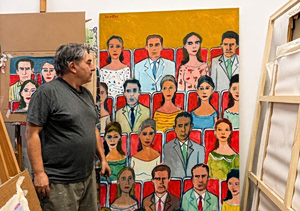
The Resurrection Festival, Eduardos Sakayan, 2026
As Mylonas tells To Vima:
“What fascinates me is that these are artists who move alongside each other in both art and life, without ever converging on a single visual language. It is often said that a painter is a ‘walking gallery.’ They are shaped by the works they have seen, the books they have read and the teachers under whom they studied—and both describe themselves as ‘children’ of Leonardo Cremonini.”
Mylonas is referring to Leonardo Cremonini, one of the major figures of European figurative painting in the second half of the 20th century, whose students included a number of important Greek painters.
“When two painters share the same life for decades, that exchange becomes part of everyday existence. Their shared studio in Gkyzi—with separate spaces for each of them—resembles a riverbed through which two rivers flow in parallel. Their waters draw close without ever mixing.
“I think this is precisely the delicate balance that Alexandra Goulaki-Voutira recognized when she chose to present them at the Telloglion Fine Arts Foundation in 2022. This is not an easy juxtaposition, but a meeting of two painting consciousnesses that illuminate one another.”
The exhibition therefore brings together two very different landscapes that, on closer inspection, have more in common than might initially appear.
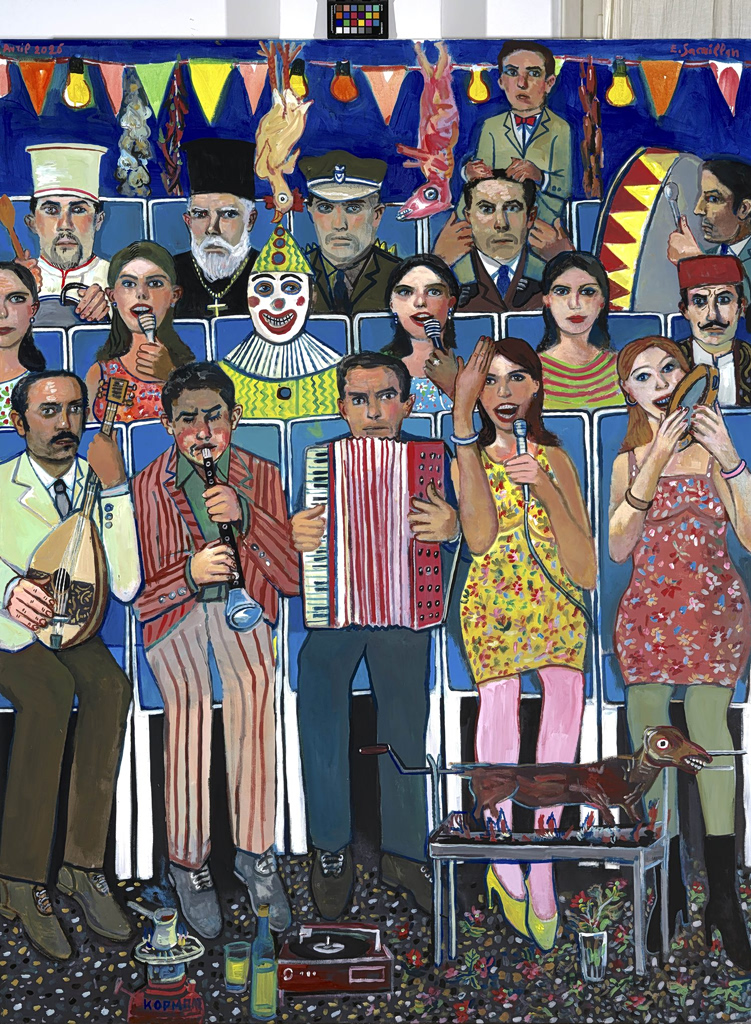
Festival, Eduardo Sacaillan (2026).
Mylonas elaborates:
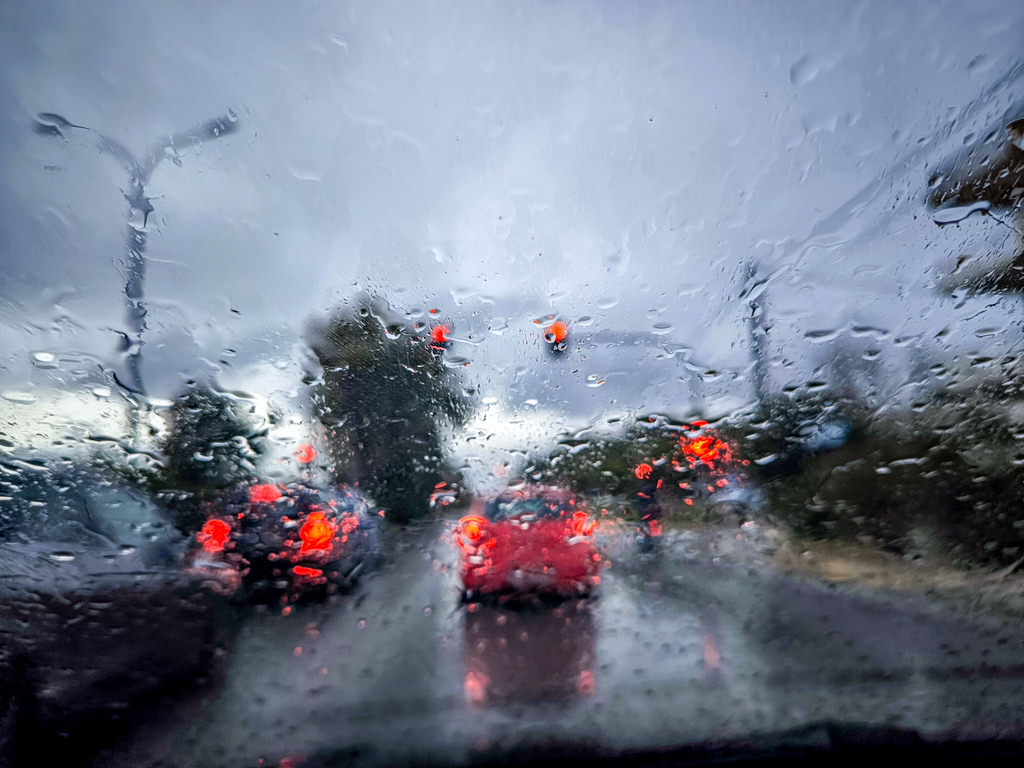
“One is the landscape of the human condition. Sakayan almost always paints people as members of a community. Spectators, bathers and drivers caught in traffic form a collective body.
“In Tsakali’s work, meanwhile, her flowers and gardens are a living organism that grows continuously. Even the rooftops of Paris are treated according to the same logic, as though the city itself has developed its own vegetation. In one case, the density is human; in the other, botanical.
“Yet both are painting the same truth: that the world is not a sum of separate things, but a continuous field of relationships. That is why their works coexist in the same space. They engage in a dialogue because they are looking in the same direction, each from a different shore.”
From Nolan to the Great Masters
The exhibition, however, does not impose a single interpretation tied to its central theme.
“I don’t believe painting enters into a public dialogue because it takes positions. Whenever this has been attempted through committed artistic movements, it has had an expiration date. Something paradoxical happens in front of a painting. Ten people stand before it, but no one sees exactly the same thing.
“Each person brings their own memories, losses and expectations. That, in my view, is where painting’s profoundly democratic nature lies. It may be the only public ‘language’ that is not completed on the canvas but in the gaze of the other. One person will focus on Sakayan’s people; another will lose themselves in Tsakali’s gardens.”
For Mylonas, the enduring power of a work of art does not depend on the period in which it was created, but on its ability to generate new interpretations and speak differently to every viewer.
“I think of Christopher Nolan’s Odyssey. We still read the Poet—not because we live like his heroes, but because every era asks them different questions.
“Something similar happens with great works of art. They remain alive because they are inexhaustible. They allow every era to see them anew without ever exhausting them. The work does not change; the viewer does.
“Even within our own lives, we stand before the same work differently at 20 than we do at 50. Different experiences, different losses and different joys alter the way we see. And a great work can withstand all those transformations of the gaze.”
Exhibition Information
“From Chaos to the World”
Tinos Cultural Foundation, Main Building, Tinos, Cyclades, Greece
On view through August 23, 2026.