 Μake us preferred on Google
 Greece’s power grid operator has taken a formal step toward building the undersea cable that would link Cyprus and Israel to the European electricity grid, submitting an investment request to regulators in both countries as part of a project Athens has cast as strategically vital for the region.
ADMIE, the Independent Power Transmission Operator that is overseeing the Great Sea Interconnector (GSI) on behalf of the three governments involved, filed the request under the European Union’s TEN-E Regulation, the framework that governs cross border energy infrastructure. The filing is a required step before Cyprus and Israel’s energy regulators can begin formally evaluating the project.
What is the GSI?
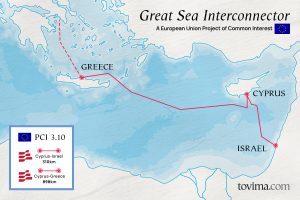
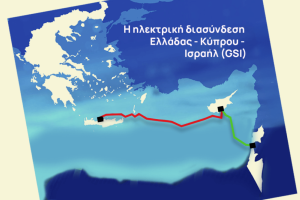
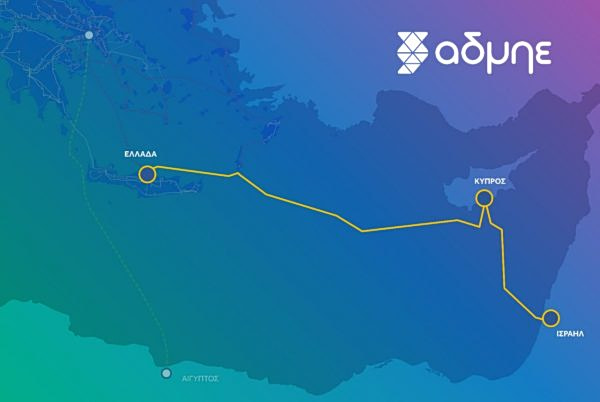
The Great Sea Interconnector is envisioned as a subsea power cable running from Greece through Cyprus to Israel, designed to connect the electricity markets of the Eastern Mediterranean to the European transmission network. It has been designated a Project of Common Interest by the European Union, a status reserved for cross border energy schemes considered essential to EU policy goals.
The GSI as a whole is designed to carry a nominal capacity of 1,000 megawatts through a bipolar high voltage direct current (HVDC) system operating at 500 kilovolts. The Cyprus-Israel leg specifically would run roughly 324 kilometers offshore, at depths of between 2,200 and 2,400 meters, and would be capable of transmitting power in either direction, allowing electricity to flow from Cyprus to Israel or the reverse depending on demand.
On land, the cable would connect to a converter station at Kofinou in Cyprus and a corresponding station in the Hadera area of Israel.
A week of momentum
One week earlier, ADMIE signed an agreement at the Maximos Mansion, the seat of the Greek prime minister’s office, bringing in the French investment group Meridiam as majority shareholder of the company developing the project’s first leg, the Greece-Cyprus interconnection.
The filing also came after Greece’s environment and energy minister, Stavros Papastavrou, spoke by phone with his Israeli counterpart, Eli Cohen, about pushing forward the Cyprus-Israel link.
Studies point to viability
The investment request builds on two studies required under EU rules: a cost-benefit analysis and a proposal for how the cable’s costs should be shared across borders. Both were completed through an extensive consultation process involving the energy ministries of Cyprus and Israel, Cyprus’s transmission system operator (DSMK), and Israel’s grid operator, NOGA. The studies were updated to reflect the latest assumptions about electricity demand, the growth of renewable energy and the infrastructure both countries will need in the coming years.
According to ADMIE, the results confirmed the project’s economic viability under every scenario examined, and pointed to its potential in strengthening energy security, integrating more renewable power and further linking Eastern Mediterranean electricity markets with Europe’s transmission system.
The investment filing now clears the way for regulators in Cyprus and Israel to begin a formal evaluation, which will include agreeing on how the cable’s cost will be divided between the two countries. That cost would ultimately be recovered through regulated revenue once the interconnector is operational.
What comes next
ADMIE, which took on the role of project promoter for the interconnector as a whole, said it continues to work with the relevant authorities, transmission system operators and other stakeholders in each country to advance the technical, regulatory and financial steps needed to build the cable.
Once Cyprus and Israel reach agreement, the next milestone will be a final investment decision, which would trigger the start of financing for the project. ADMIE has said it aims to bring in additional investors for the Cyprus-Israel leg, following the model used for the Greece-Cyprus segment, where Meridiam’s entry helped anchor the project’s financing.
Source: OT.gr