The European Commission’s Spring 2026 Economic Forecast dedicates a special section to the policy responses to the new energy shock triggered by the Middle East crisis, and it records a significant shift from 2022: less fiscal space, smaller support packages, and a greater emphasis on targeted interventions.
The difference is already visible in the numbers. According to the Commission, the measures announced so far by EU member states to address the new energy crisis total 14.5 billion euros, equivalent to just 0.07% of EU GDP in 2026. Even if extended through the end of the year, the cost is estimated at 0.2% of GDP. In 2022, by contrast, the total fiscal cost of support measures reached 1.2% of GDP, and over the full period 2022 to 2024 it came to 2.2% of European GDP.
Different Conditions Than 2022
The Commission notes that Europe is entering this new crisis from a different starting point. In 2022, the post-pandemic recovery was still underway, interest rates were low, and the General Escape Clause was still active. Today, financing conditions are tighter, governments are facing demands for defense spending, competitiveness investment, and the green transition, and fiscal space has narrowed considerably.
In this environment, the Commission, through its AccelerateEU framework, is calling for measures to be “targeted, temporary, and time-limited,” avoiding interventions that increase energy demand or place a permanent burden on national budgets. It also emphasizes electrification, grid investment, geothermal energy, biomethane, and energy autonomy.
What is notable, however, is that the report itself records that 75% of the measures taken across Europe remain untargeted, primarily through fuel tax cuts and other price interventions. And this is precisely where Greece’s approach stands apart.
The Greek Case
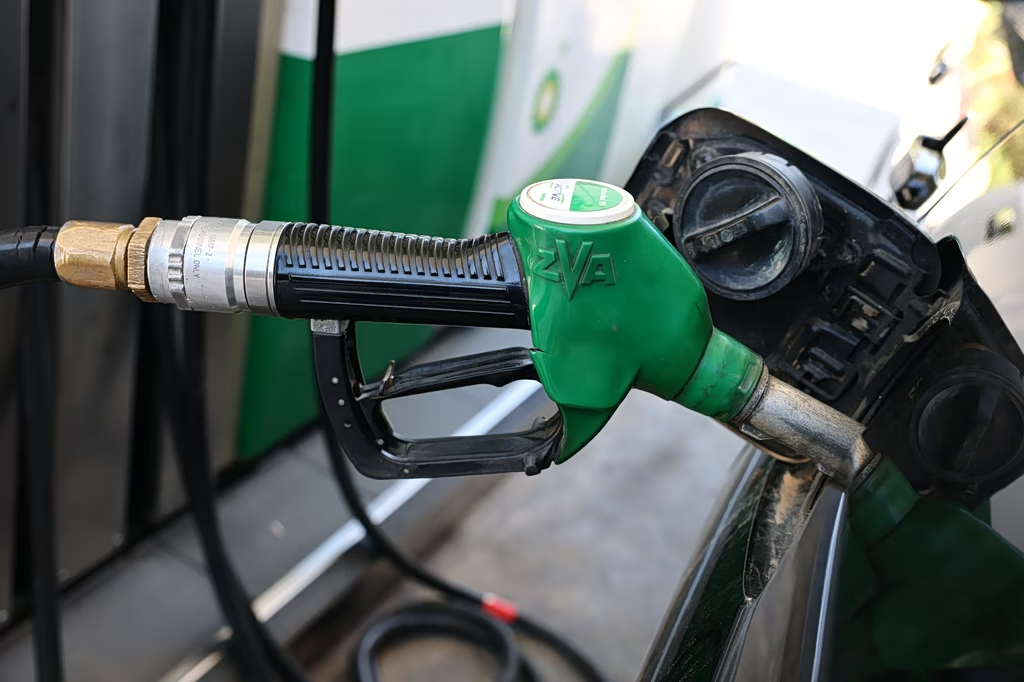
Greece, both during the previous crisis and this one, chose not to cut the Excise Duty on fuel (ΕΦΚ), opting instead for targeted support in the form of Fuel Pass subsidies and pump-level price relief.
The reasoning, as government officials explain, was both fiscal and more beneficial to the consumer. The excise duty on diesel currently stands at 41 cents per liter, while the EU minimum is 33 cents, leaving only 8 cents per liter of room to maneuver through a tax cut. By contrast, through direct subsidies the relief could reach approximately 20 cents at the pump including VAT, while through the Fuel Pass scheme the total relief translated to roughly 36 cents per liter of average consumption, with higher support on the islands.
In practical terms, the model Greece chose appears more closely aligned with the new European direction. The Commission argues that tax cuts and broadly applied price measures weaken the energy-saving signal to consumers, boost demand, and ultimately deepen dependence on costly energy imports.
The central message of the Spring Forecast is therefore not simply that Europe is facing a new energy shock. It is that 2026 is not 2022: the margins are narrower, the interventions more limited, and the conversation is shifting from blanket subsidies toward targeted support and the energy transition.