 Μake us preferred on Google
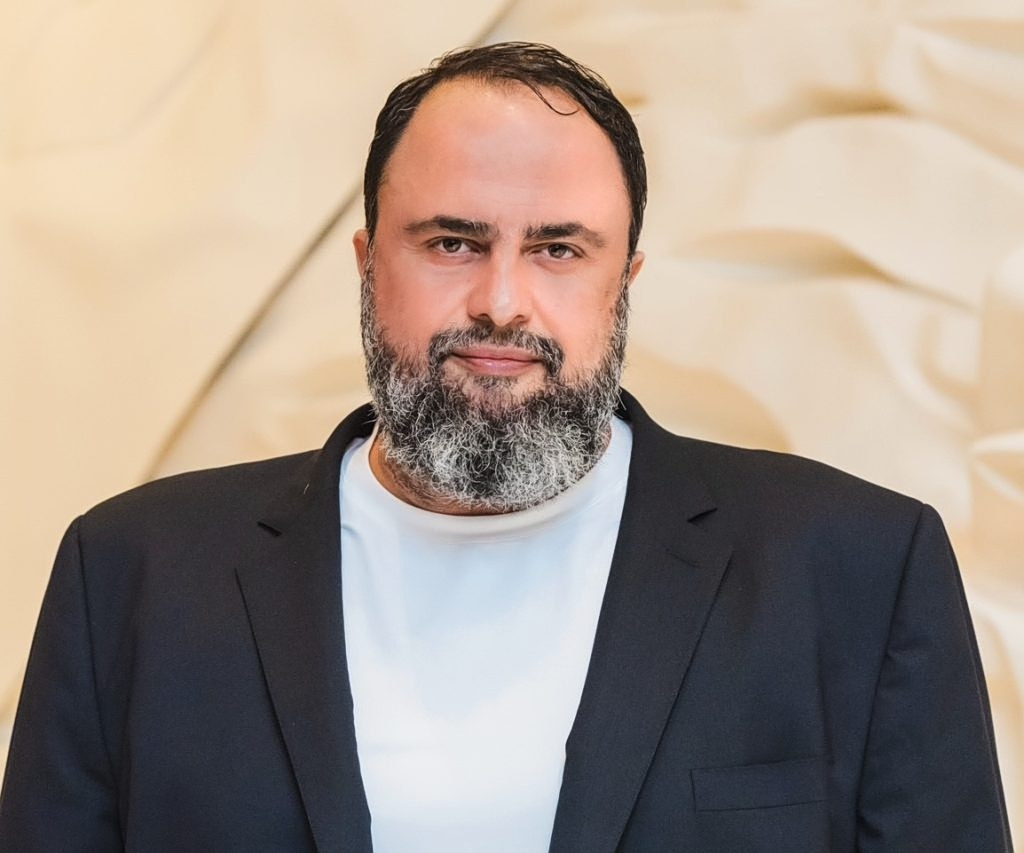
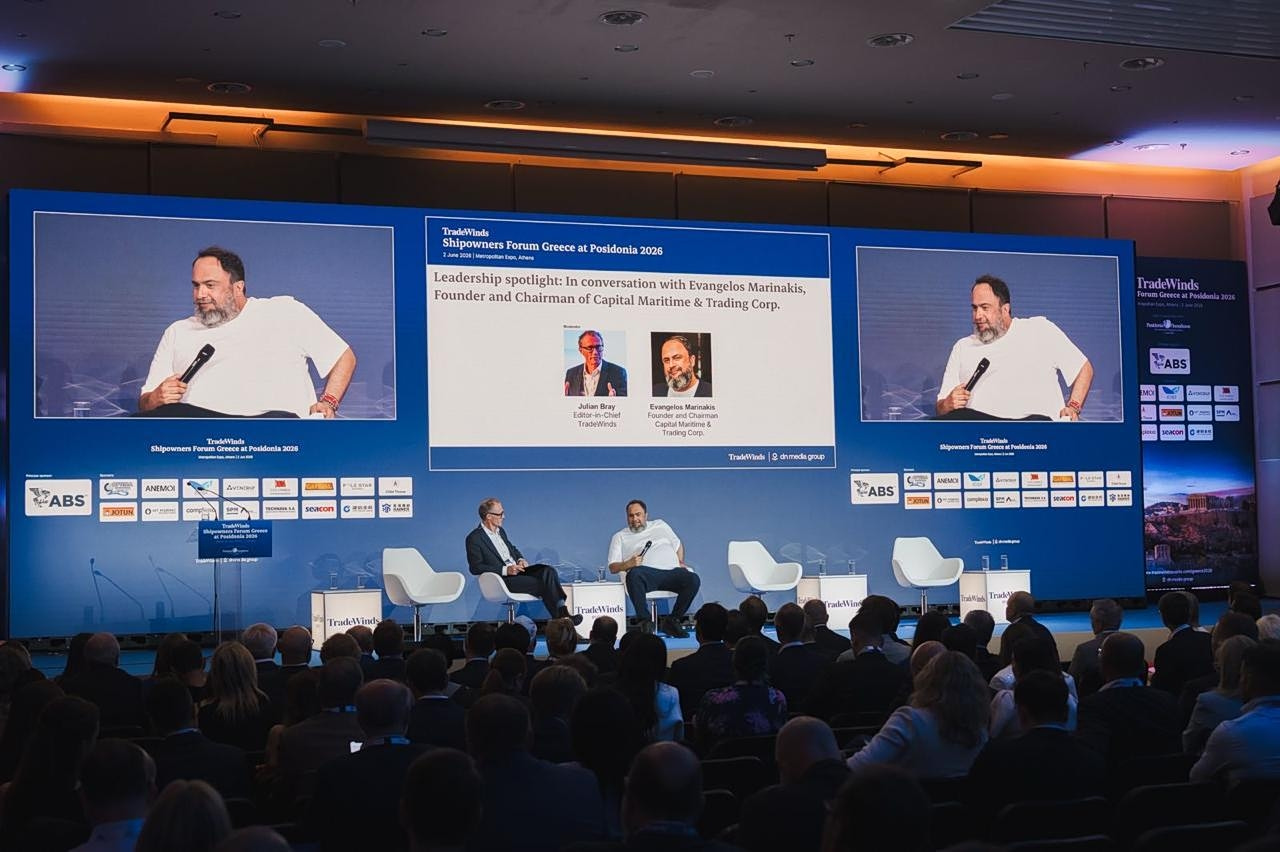
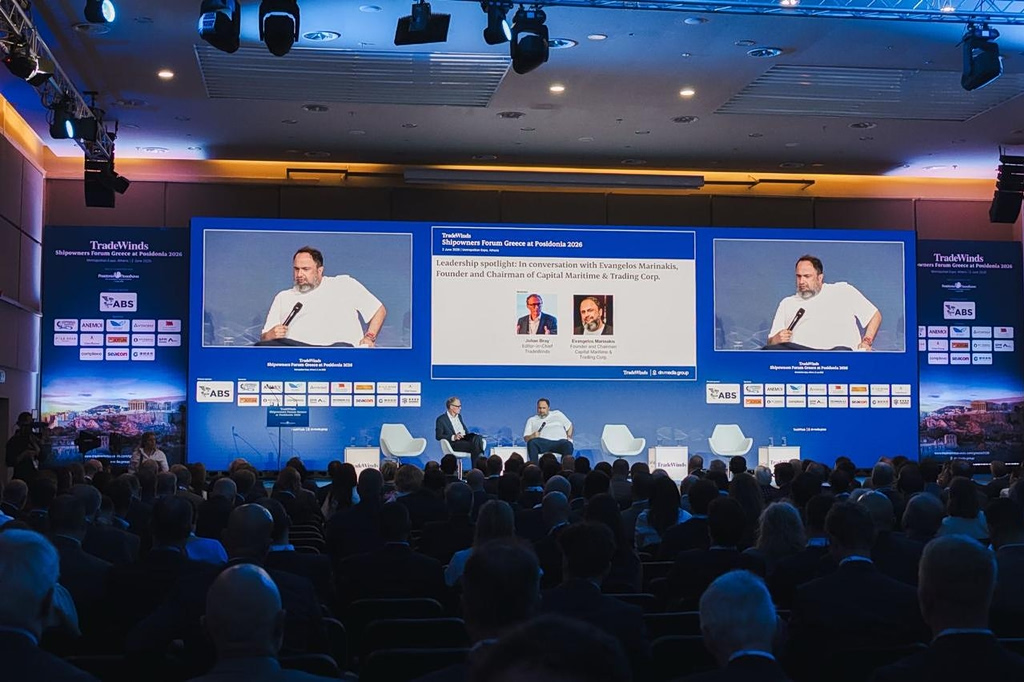
 ATHENS — Evangelos Marinakis used his appearance at the TradeWinds Shipowners Forum to make a striking case on the Strait of Hormuz: that paying a transit fee to the nations bordering the chokepoint would be a far better outcome for shipowners than seeing the waterway closed — or than the years of war-risk premiums they have paid with no war to show for it.
The closure of the Strait during the Gulf war between the United States, Israel and Iran — described by the International Energy Agency as the greatest energy shock ever — dominated the discussion. Marinakis revealed that the Capital group made a deliberate decision to stay out of the area entirely.
“Our ships, as far as navigation in and out of the Straits is concerned, have not been affected, because we were lucky enough not to have a vessel inside,” he said. Asked whether that was foresight or chance, he was candid: “No, no, it was coincidental that we didn’t have a vessel loading or discharging in the area. And that was very fortunate, because it has been only on rare occasions that you don’t have a ship in and out of the Arab Gulf — especially our tankers or containers, which always call there.”
The choice to suspend trading in the region, he explained, was about risk, not opportunity. “We took a decision that we don’t want to navigate in and pass the Straits. In case something happens, a casualty — we wouldn’t be able to take such a risk.”
Positioned for the reopening
With every day seeming to bring a final peace agreement closer and then further away again, Marinakis said the group is ready to move the moment cargo starts flowing.
“We have a lot of vessels trading close to the Arab Gulf. We trade there at significant discounts in order to position ourselves — to be three, four, five days away from it. Other ships are trading in India, others in East Africa or even the Singapore area, and we are between three to 10 days from the Gulf. So in case we have a peace agreement and, after a while, the cargo starts moving, we’ll be there. That’s the best we can do.”
But he poured cold water on hopes of a freight bonanza once the Strait reopens. “Unfortunately, historically in shipping, when we have great expectations, we face the biggest crises,” he said. “Of course there is expectation — it’s normal, because a lot of stocks are nearly running out, and it’s logical to think that as soon as this treaty is signed, everybody will rush to restock. My opinion is that we need to be there in the area, but maybe we will not see the freight rates we have in mind. It will be something that is built slowly and conservatively. We already have a very good market, and I don’t think we’ll see any of the crazy numbers we saw when the war started.”
On oil prices, he said the market had held up better than many feared. “It’ll be too expensive to restock at 90 dollars a barrel. But oil at 90, with all this going on, is still quite manageable. Someone would have thought that, with the Straits closed now for over 70 days, we would be facing a barrel price of 120, 130, 140.”
He even floated the idea of transit fees to the nations bordering the chokepoint. “Even if we had to pay a fee, it would be much better than to have the Straits closed. And we need to remember that all these years we have been paying extra ‘war risk’ expenses for no war. If you calculate how much money we’ve paid so far, navigating in and out of the Gulf or in the Red Sea without an actual war, it would be better to pay a fee of 100,000 or 200,000 dollars, depending on the size of the cargo and the vessel, and not have all this hassle.”As he later clarified: “I would prefer to pay a toll for the right to navigate through the Strait of Hormuz immediately and safely, rather than pay huge extra war risk premiums. This means cargo flow resumes immediately— oil, gas, raw materials — economies stop being hurt and destroyed, and crews navigate safely. This protects our valued crews, and that same money could go toward the reconstruction of the region and the countries that have suffered. Human life and safety come first”.
Newbuildings and the dark fleet
Marinakis defended the group’s heavy newbuilding commitments at China’s Hengli yard by pointing to an ageing global fleet and the scale of the shadow tonnage in the market.
“If you analyse the profile of the world crude fleet, you’ll see it’s the oldest we’ve had in the last two decades. So there is definitely a need for new tonnage. The second thing is the dark fleet — 850 ships, but in my opinion over 1,000. So if you look at the age profile on one side and the dark fleet on the other, for 2026, 2027, even 2028, we need ships. If you have a newbuilding programme with prompt deliveries, you are well placed. And don’t forget that we sold a significant number of second-hand VLCCs over the last 18 months. It’s wise to replace them with new ships that are far more environmentally friendly and consume much less.”
He was unusually complimentary about the Aponte family’s push, through MSC, to build a major position in the VLCC market. “My opinion is that it was a very clever move. There aren’t many businesses where you can corner a market responsible for 80 percent of energy transportation to China. I made a quick calculation — all the VLCCs trading today, including the dark fleet, are worth about 60 billion. So with 10 billion you can corner this market. There aren’t many businesses you can do at this size with that kind of money. It was a brilliant move. The only question is how they’ll manage to trade the vessels from now on.”
On the LNG dual-fuel optionality he championed early, he conceded the payoff is still some way off. “It’s still not bad. Maybe for a few more years we won’t be paid for it. But in the long term, when gas prices are low enough, it will be worthwhile — and you get the reduction in emissions on top. The main advantage, I think, will come from the price of gas.”
A scrapping window for the dark fleet
Marinakis renewed his long-running call for a sanctioned-vessel scrapping window, welcoming early signs of movement from US authorities.
“I was one of the first to campaign about it, and some people disagreed. They thought that if you allow a dark-fleet vessel to be scrapped and the owner to receive the money, you’re helping the owner. That makes no sense. If you calculate the scrap cost — about 500 to 550 dollars per light weight, whether it’s an MR tanker, an Aframax or a Suezmax — we’re talking about 5 to 15 million dollars per ship. That’s less than these owners make on a single trip. So you’re not helping them; you’re helping yourself to get rid of the dark fleet. If they have the incentive to sell vessels within a deadline of the next three or four months, I think we’ll see at least a 20 percent reduction in the dark fleet. I would like to see permission not for four vessels, but for a hundred vessels.”
‘We are penalising ourselves’
His strongest words were reserved for European sanctions policy.
“As I’ve said in the past — and again, many people disagreed — the sanctions imposed by the European Union on Russian oil are completely wrong, and they are not harming the Putin administration. They are harming the European consumer. European countries are not allowed to buy Russian oil, while the Indians, the Chinese and the Saudis buy it at a significant discount. And then we Europeans go to their refineries and buy the oil products at sky-high prices. Does that make any sense whatsoever? If they want to impose serious sanctions, they should blockade any shipment from Russia to the rest of the world. That is a proper sanction. If the sanctions apply only to half the world, or only to Europe, we penalise ourselves. It’s as simple as that.”
He was equally blunt about the environmental gamble of letting substandard tonnage operate off European shores. “How can we afford to let dark fleets operate next to our islands, our coastlines — in Greece, in Italy, in Spain, in France — and take such an environmental risk with ships that have no maintenance, completely unskilled crews and no insurance? We let them navigate and pass 10 miles from our homes, from our seaside, all over Europe, and the governments do nothing.”
The case for Greek shipping
That led him to a broader argument about why Greek shipping punches so far above its weight.
“Greece is a very small country, a poor country, as I would describe it, but we are doing all these miracles in shipping. Why? Because there is no government intervention. We compete all around the world with freedom, and we’ve achieved what we discuss every day. Wherever the government is far away, we overperform. Where the government interferes, you see a big problem. It’s as simple as that.”
‘More important than ever before’
Marinakis closed on an optimistic note about the industry’s place in a volatile world.
“We need to be optimistic — not because we are involved in shipping and have built a number of ships and have a significant size in nine different sectors, but because everything that has happened in recent years, with all these geopolitical events, at the end of the day helps our industry develop and become more important in the world than ever before. This is the right time for owners and for governments that need energy efficiency and energy security to develop the relationship further — for us to be there whenever we are needed, to transport energy and all the materials we need for our daily lives. The role of shipping has been more important than ever before, and that’s why we need to feel much more responsible for what we do and to perform as best we can.”