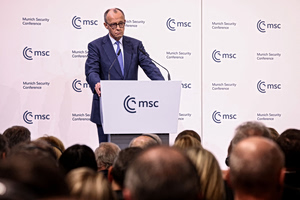
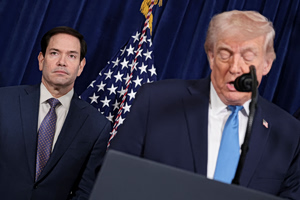
The US Secretary of State’s 14 February 2026 speech at the Munich Security Conference and the audience’s reaction to it was a virtual love fest, as befitted the day on which it all happened, Saint Valentine’s. With smooth demeanour, carefully crafted language and even throwing in an occasional joke, Marco Rubio managed to outperform last year’s US keynote speaker at the same conference, Vice-President J.D. Vance, earning for himself a standing ovation to Mr. Vance’s cold silence. Were the two speeches so different in substance, as the very different styles of the respective speakers and audience reactions would have one believe? Has there been a major change in the Trump Administration’s policy vis-à-vis Europe over the past year, or is it a bad cop – good cop routine tried on the European allies?
What is for sure is that instead of attacking and embarrassing his audience, as Mr. Vance had done in 2025, Mr. Rubio opted for a softer, kinder approach to conveying the Trump Administration’s messages. He stressed the shared history of Europe and America, acknowledged the latter’s roots in the former, and referred movingly to his own European roots. He stretched his hand out to Europe calling it to join the US in a new Western alliance, basically a new white and Christian empire, which would revive the glory of European empires of the past and would guarantee the West’s interests through world domination. He was unapologetic about the wrongdoings – what wrongdoings? – of Western empires over the previous centuries and, in a clear if diplomatic criticism of European policies of recent decades, stressed that the purpose of the grand Euro-American alliance he was calling for was not “to operate a global welfare state and atone for the purported sins of past generations”.
If the Europeans wanted to respond obligingly to all of Mr. Rubio’s exhortations, they would have to drop the continent’s trademark welfare state and pro-climate policies, rescind apologies for past colonial occupation, slavery and exploitation, stop all assistance to developing countries, and dedicate themselves once again to pursuing the white man’s conquering and civilizing destiny. In other words, to avoid “civilizational erasure”, as Mr. Rubio put it, Europe should erase from its collective conscience the lessons learnt from centuries of war, oppression and destruction within and beyond its borders, including two world wars.
Interesting to note that when Mr. Rubio spoke about preserving the Western civilization, apparently against a perceived onslaught of non-European and non-Christian immigrants, he basically negated the long-established US narrative of America as the melting pot of humanity. This was supposed to be the place where people of all nationalities, cultures and creeds, came together to develop their full potential in a context of personal and economic freedom, where hard work and innovative ideas were rewarded, and where “the sky was the limit”. Not to mention that Mr. Rubio’s Eurocentric definition of the West inevitably excludes, on grounds of ethnicity, cultural and religious traditions, close Western allies in East Asia, namely Japan and South Korea. The illusion of a homogeneous West that Messrs Trump and Rubio promote runs contrary to basic realities on the ground and is an affront to the diversity of the US and its up-to-now allies. The historically less open and more regulated European societies, and Europe as a whole, are now proving to be more respectful of diversity within and beyond them than melting-pot America.
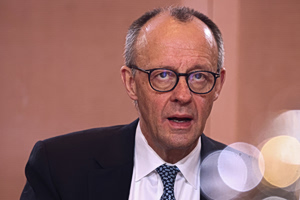
The audience did rise and clap strongly at the end of Mr. Rubio’s speech. That should not be interpreted, though, as stretching a European hand to meet the US one in mid-air, a sign of unconditional friendship, partnership and all, thankfully not. For one, the psychological wounds inflicted on European policymakers and publics alike by President Trump and his Administration over the past thirteen months of their reign in the US are deep and difficult to heal. Europeans feel they cannot trust Mr. Trump after his tariff blackmails, his threats to take over Greenland, his distancing from supporting Ukraine, his overall contempt for international law in the Middle East, the Americas and beyond. They are, thus, going ahead with plans for a stronger Europe that stands on its own feet, politically, economically, militarily, technologically, energy-wise, culturally and environmentally. They are forging alternative partnerships, like those with India and South America, they are speaking independently with China, and resist pressure to join President Trump’s Board of Peace that clearly wants to sideline the UN.
To avoid being taken over by its prodigal daughter, as incarnated in today’s Trumpian US, Europe needs to continue with even greater resolve on the path of collective self-determination. Concrete elements of that could include demanding a place in the negotiations for ending the Russia-Ukraine war; bringing back the UN in the handling of the situation in the Middle East, including affirmation of Palestinians’ rights, the reconstruction of Gaza and good-faith negotiations with Iran; establishing an independent EU military intelligence and response capability; collaborating with middle powers from around the world to address multidimensional global challenges like climate change, biodiversity loss, pollution and pandemics. Post-World War II and post-Cold War Europe should be proud of its hybrid system that combines socially liberal and participatory democracy with a mixed economy and a predominant middle class, of its support for international law and the UN Charter, of its solidarity towards less privileged parts of humanity. No more mumbling and fumbling about all this but a stern attitude towards Mr. Trump and his lieutenants, who are trying to profit by recklessly destabilizing the world.