Some countries are tested by what happens within their borders; others are tested additionally by the image they choose to construct of themselves. Greece appears to belong to both categories. On the one hand, it faces chronic weaknesses and deep-rooted dysfunctions in its institutions, public administration, education, healthcare and economy. On the other, a persistent narrative of progress, normality and “excellence” often seeks to replace a serious discussion of the country’s actual condition and its place in the world.
The problem is not that a government seeks to present its record in a positive light. That is an expected part of political contestation. The problem begins when communication ceases to serve the public’s need for information and is instead used to distance society from reality. When selective figures, constant declarations of success and the repetition of an embellished image leave no room for meaningful scrutiny, communication becomes a mechanism of reassurance. Claims of success are made with increasing frequency even when the basic functions of the state fail to meet the demands of everyday life. The gap is most clearly exposed in the lives of citizens themselves. They hear of economic growth and wage increases, which should theoretically strengthen their purchasing power and broaden their choices. In practice, however, many do not experience such an improvement. Their income does not last until the end of the month; needs must be prioritised ever more strictly, plans are postponed and aspirations curtailed. Citizens are forced to make compromises everywhere—and above all, with their dreams. When the official image of prosperity bears little resemblance to society’s daily experience, political communication begins to function as a modern “opium of the people”: not because it eliminates problems, but because it seeks to make them easier to tolerate.
Konstantinos Tsakalidis/SOOC
This gap between image and experience is also reflected in the use of the word “excellence”. In public discourse, it is frequently invoked as a promise of meritocracy, effectiveness and progress. But what happens when the system’s actual operation rewards party loyalty, personal connections and conformity more than ability and independent thought? Excellence then risks being reduced from a political principle to a communications label.
Against this promise stands the concept of “kakistocracy”. It should not be understood simply as rule by the incompetent. It describes a system that reproduces mediocrity because it regards mediocrity as safer. A capable but independent person may challenge authority, demand accountability or refuse to conform. By contrast, someone whose advancement depends on the machinery of power has a strong incentive to protect it. The selection of individuals is therefore not always determined by who can contribute the most, but by who can be incorporated most easily.
The same logic can be seen in the movement of political figures between parties with different, even opposing, ideological origins. A politician’s decision to change parties is not inherently objectionable: views can evolve and political circumstances can change. Yet when a change of allegiance is not accompanied by a convincing political explanation, it creates the image of political “chameleons” who adapt their convictions to the requirements of power. Political beliefs then cease to function as a commitment to citizens and are sacrificed on the altar of participation in government at any cost.
The consequences of this system are not confined to institutions. They create a form of exile both within and beyond the country, reflected in the lives of people who feel that they have no space in which to create, develop or express a different view. Some leave Greece in search of an environment where their knowledge and work will be assessed more fairly. Others remain but experience a form of internal exile: they live in their own country without feeling that they participate as equals in its public, professional or political life.
Marginalization does not always require an official prohibition. It can arise through silence, exclusion from opportunities, a lack of visibility, or the persistent portrayal of dissent as eccentricity or exaggeration. In this way, people who could contribute to change either leave or stop trying. The country loses not only scientists and professionals, but also different ways of thinking.
The outlook becomes even more troubling when a country not only struggles to retain its own people but also risks ceasing to be attractive even to migrants seeking security, employment and a new beginning. A society without meritocracy, functioning institutions and genuine opportunities for advancement does not discourage only those who leave. It also discourages those who might otherwise come, work and invest their future in it.
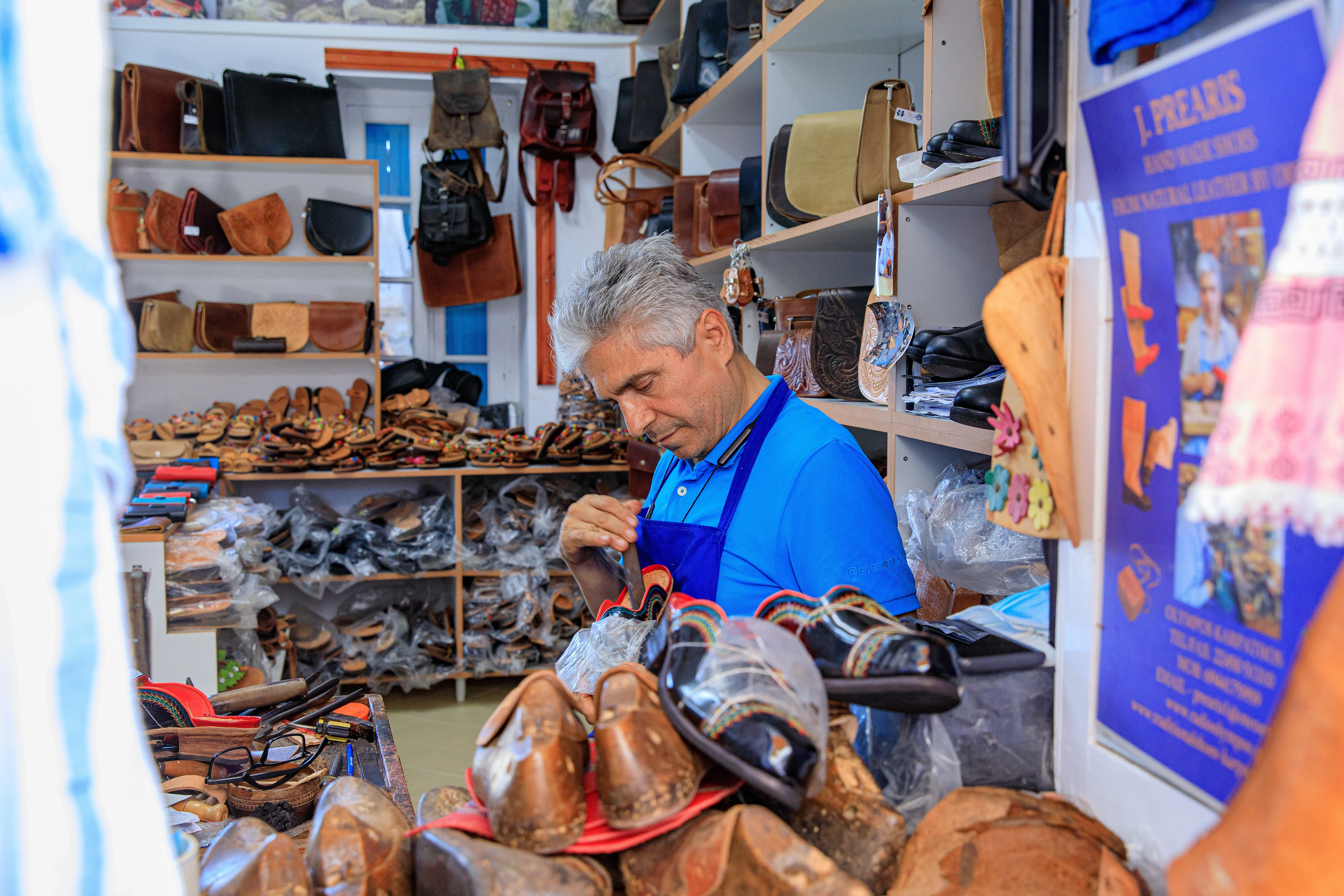
Shoe cobbler in his workshop in a small village in Karpathos. TravelGirl1981 / Shutterstock.com
At the same time, the clientelist system does not survive solely because it is imposed from above. It is reproduced because it permeates everyday life. A personal connection used to secure a job, party mediation used to obtain a public service, or a minor favor are presented as practical solutions in a dysfunctional environment. Gradually, the exception becomes the rule and the transaction assumes the appearance of normality.
Citizens forced to adapt to this reality find themselves in a difficult and contradictory position. They may be both victims and minor participants. They survive by using the very mechanism they criticize and, precisely because they depend on it, find it difficult to challenge. Corruption thus ceases to appear only as a major abuse of power. It is reproduced on a smaller scale, enters social relationships and cultivates the belief that “this is simply how things work”. The normalization of such transactions gradually distorts society’s value system: equality before institutions gives way to access through personal connections, while meritocracy is replaced by the ability to cultivate networks. The outcome is not merely moral or political. It is also social, as inequalities deepen between those with access to networks of power and those who remain outside them.
Greece thus appears caught between its reality and its narrative. Its international image cannot be shaped exclusively by government announcements or by isolated successes detached from their broader context. A country’s standing is judged by the quality of its institutions, citizens’ trust, the possibility of social mobility, the condition of education and healthcare, freedom of information, and the prospects it offers young people. Communications management may temporarily conceal contradictions, but it cannot resolve them.
The distance between the image projected domestically and external assessments is not abstract. In Reporters Without Borders’ 2026 World Press Freedom Index, Greece ranks 86th among 180 countries and is among the three lowest-ranked members of the European Union. The organization also points to the “oligarchization” of the media landscape and threats to journalists’ safety. Similarly, the World Justice Project’s 2025 Rule of Law Index ranks Greece 48th among 143 countries, but 29th out of 31 countries in the wider region comprising the European Union, the European Free Trade Association and North America. It also records deterioration in institutional checks and safeguards that constrain executive power. Such indices do not capture the whole of reality, nor can they substitute for political judgement. They do demonstrate, however, that international assessments are far more complex than a one-dimensional narrative of uninterrupted success.

ColorMaker / Shutterstock.com
As long as public debate is confined to a clash between two extremes—the image of a country that is “constantly progressing” and that of a country in which “nothing works”—reality remains obscured. Criticism is not a denial of all progress, and recognition of a success should not be used as a pretext for concealing failures. A mature democracy must be able to look at itself without either idealizing or dismissing itself entirely.
At this point, the most difficult question emerges. Who is ultimately responsible for perpetuating this situation? Is it the political system, which controls the terms of participation, reproduces clientelist relationships and rewards conformity? Or is it the citizens, who continue to choose the same individuals, tolerate the same practices and, at times, participate in them?
A further concern must be added to this discussion: the belief among part of society that the executive does not always remain within its institutional role, but seeks to influence or manipulate the functioning of the judiciary. This perception should not be presented as established fact without evidence. Yet neither can it simply be ignored. When the World Justice Project records a decline in Greece’s scores on indicators examining whether the judiciary limits executive power and remains free from improper government influence, the issue ceases to concern political confrontation alone. It concerns citizens’ trust in the separation of powers itself.
If we continue to vote for the same people, how can the country change? And if anyone who differs from the system is marginalized before acquiring a genuine opportunity to challenge it, how free is our choice in the end?
Perhaps, then, before repeating that “we get the politicians we deserve”, we should examine who is genuinely able to enter politics, who is excluded, and who shapes the choices ultimately placed before the citizen.