 Μake us preferred on Google
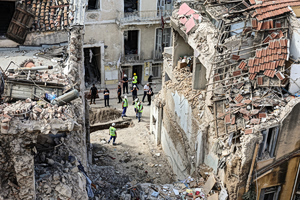
A new clash has broken out between Kostas Bakoyannis and Haris Doukas over the €2.8 million earmarked to restore the building on Lysikratous Street in Plaka, which collapsed after an explosion that killed six people.
The former mayor questioned the size of the funding. “With that much money you could restore three houses, not just one,” he said. He also raised questions about the procedure that was followed, taking jabs at Doukas, and said nothing about it had been posted on Diavgeia, the government’s transparency portal. The mayor of Athens later denied this, calling his predecessor “clueless and dangerous.”
According to the mayor, his predecessor’s insinuations show not only his ignorance but also an attempt to score petty partisan points on a matter in which human lives were lost.
Doukas also argued that Bakoyannis’s obstruction tactics could put local residents at risk and are prolonging the hardship for people in Plaka, where Lysikratous Street has been closed to traffic for a long time.
Closing his statement, the mayor of Athens launched a new attack on his predecessor over the “Great Walk” project, accusing him of turning central Athens into a construction site for years and causing needless hardship for residents.
In a postscript to his statement, Doukas included a link to Diavgeia, which he said contains the Interior Ministry’s documentation of the amounts.
Bakoyannis then hit back with a new statement, insisting on the questions he had raised about the €2.8 million for restoring the building on Lysikratous Street after its collapse.
The former mayor accused Doukas of resorting to personal attacks and insults instead of answering questions about the cost and how the contract was awarded. He again asked who calculated the €2.8 million cost, whether there is an official technical study and a detailed budget, and what role the municipality’s Technical Services played in approving and checking the figures. He also raised a transparency concern about the possibility that the same company that estimated the cost would also carry out the work, and asked whether the city had considered seeking bids from other companies, even under emergency conditions.
The former mayor stressed that the issue concerns the management of municipal money, not the mayor’s personal affairs, concluding: “We are waiting for evidence. No more insults. Mr. Doukas, you will be held accountable.”
The exchange did not end there. Doukas responded again, referring Bakoyannis to the relevant prosecutor, the fire service’s Special Disaster Response Unit (EMAK) and the responsible ministers for questions about the work carried out on Lysikratous Street and the investigation into the case in Plaka.
The mayor of Athens stressed that the municipality acted on a prosecutor’s order. He then went on the counterattack, bringing up the “recycling kiosks” and the “Great Walk,” projects of the previous city administration.
Closing, he sent another pointed message to his predecessor: “If anyone needs to be held accountable, it is you. The time is approaching.”