

 Μake us preferred on Google
Turkish Foreign Minister Hakan Fidan on Thursday reiterated Ankara’s longstanding positions on Greece, Cyprus and the eastern Mediterranean, warning that Turkey would maintain a “resolute stance” against any action it considers detrimental to its national interests and the rights of what it describes as its compatriots in western Thrace and the Dodecanese.
Addressing the planning and budget committee of Turkey’s Grand National Assembly, during the presentation of his ministry’s 2027 budget, Fidan said Ankara’s fundamental objective in its relations with Athens was to promote good-neighborly relations and cooperation.
He recalled the sixth meeting of the Greece-Turkey High-Level Cooperation Council, held in Ankara in February 2026, under the leadership of President Recep Tayyip Erdogan and Prime Minister Kyriakos Mitsotakis.
“Our fundamental objective in our relations with Greece is to proceed with an understanding of good neighborliness and cooperation. We believe this approach best serves the common interests of both countries,” he said.
However, he added that Ankara would maintain a “resolute stance” against steps that could harm its national interests or the rights of what it calls its “compatriots” in western Thrace and the Dodecanese.
The remarks revived official Turkey’s misrepresentation of the identity of the Muslim minority in western Thrace. Greece recognizes the minority in the northeast Greek province as religious, in accordance with the 1923 Treaty of Lausanne, while Turkey over recent decades insists on an ethnic Turkish identity.
What the Treaty of Lausanne actually says
The relevant provision is Article 45 of the Treaty of Peace of Lausanne, signed on July 24, 1923, under Section III, concerning the Protection of Minorities.
It states:
“The rights conferred by the provisions of the present Section on the non-Moslem minorities of Turkey will be similarly conferred by Greece on the Moslem minority in her territory.”
The wording is significant, as the treaty explicitly refers to a “Moslem minority” in Greece, not a Turkish ethnic minority. It also establishes reciprocal minority-protection obligations, granting Greece’s Muslim minority rights corresponding to those afforded to non-Muslim minorities in Turkey.
Fidan reiterates two-state position on Cyprus
Fidan also reaffirmed Turkey’s position in favor of a two-state solution in Cyprus, saying that the island republic is home to “two separate peoples, two separate democracies and two separate states.”
He added that Ankara would continue to defend what it describes as the legitimate cause of the Turkish Cypriots and argued that any lasting settlement should be based on what Turkey considers the realities on the island.
Athens and the Cypriot government stress that this position is incompatible with the bizonal, bicommunal federation framework endorsed by the United Nations and provided for in relevant Security Council resolutions.
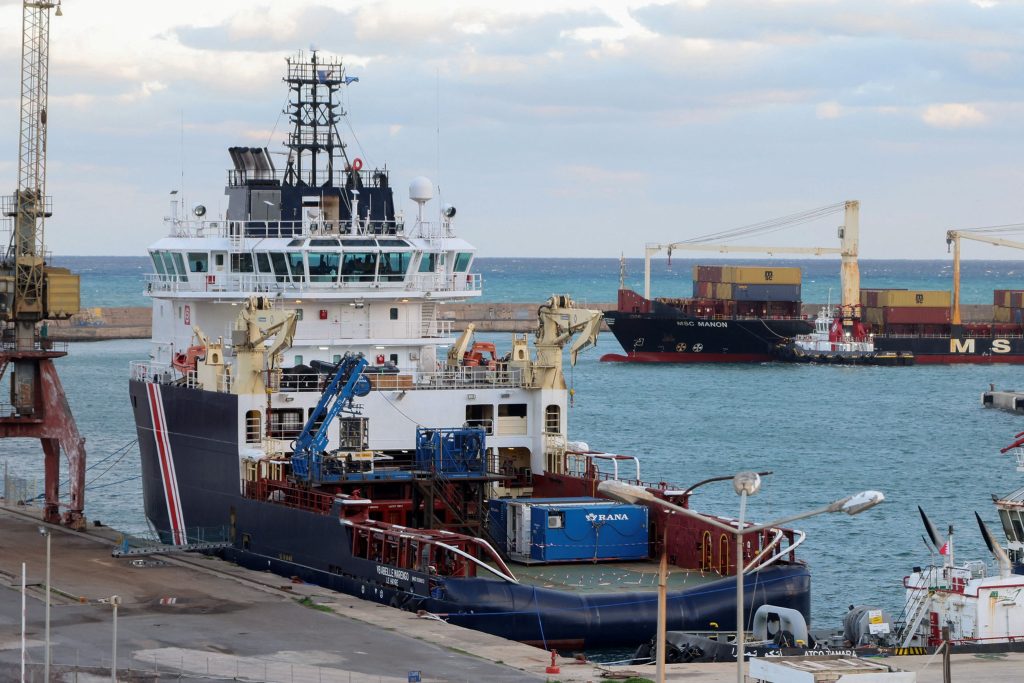
French survey vessel ‘Abeille Marengo’ for the Greece-Cyprus power link, is docked at the port of Heraklion, Crete, Greece, November 7, 2026. REUTERS/Stefanos Rapanis
Aegean and eastern Mediterranean
Referring to the Aegean and eastern Mediterranean, Fidan said the region should become an area of stability and prosperity rather than confrontation, arguing that this required an approach that took into account the legitimate interests of all parties.
His remarks come amid continuing Turkish disagreement, often leading to saber-rattling and belligerent rhetoric, over maritime jurisdiction and seabed surveys associated with the Greece-Cyprus electricity interconnection project, the Great Sea Interconnector (GSI).
Athens maintains that the surveys are being conducted within the framework of international law and rejects Ankara’s attempts to challenge its jurisdiction and licensing authority in the areas concerned.
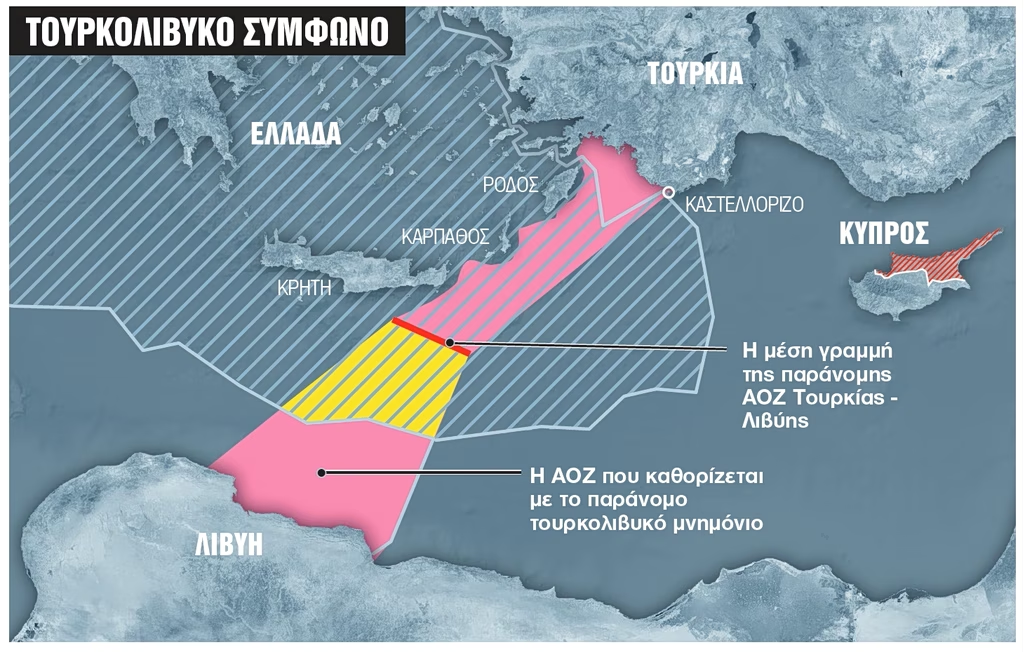 Fidan also referred to Libya, describing the October 20 unanimous approval by the country’s eastern-based House of Representatives of the controversial 2019 Turkey-Libya maritime delimitation memorandum as evidence that Ankara’s policy was producing results.
The memorandum, signed between Turkey and Libya’s then internationally recognized Government of National Accord, is rejected by Greece as unlawful and without legal effect, while the European Union and regional countries have also maintained that it infringes the sovereign rights of third countries.