 Μake us preferred on Google
 Despite my exemption (a result of leaving Greece at only 40 days old), in 2024, at the age of 27 I decided to take a year of unpaid leave from my work at the European Commission to serve in the Hellenic Army. There, I had the privilege of serving in the 2nd Paratrooper Squadron in Aspropyrgos, Attica as a Special Forces Airborne Trooper.
People told me it was a waste of time, even within my own family. The Officers in the recruitment center did not even want to process my papers to send me to the Special Forces School. All these people were met with the same determination and tenacity with which I chose this path. This passage is my call to action to you, the Hellenic diaspora, to answer this same call.
According to 2024 estimates of the General Secretariat of Hellenes Abroad, there are approximately 5 million Greeks of the diaspora scattered across the globe. While we can debate the exact figure, the reality is it does not matter. If ever the moral obligation arises and young Greeks receive the call of duty, our homeland will need every single man and woman it can spare to support our defense.
Many Ukrainians also did not expect to receive this call in their lifetime. But our current geopolitical realities push us to think more cautiously. With revisionism, authoritarianism, and geopolitical tensions on the rise, especially within our own neighborhood, we do not have the luxury to turn a blind eye.
Oftentimes I hear my fellow compatriots, both young and old, complain about the current issues facing Greece. This is a result, they claim, of having “the politicians we deserve.”
This criticism is usually followed by chatter of an unwillingness to fight to protect the integrity and ideals of their country and its politicians.
To these people I say one thing: do not mistake the concept of politeia with the notion of politeuma. Politeia is a group of people who share certain core characteristics, who together form a collective. Your parents, your friends, your neighbors, etc. Politeuma, or kathestos, constitutes the current system or model of governance which makes up the institutional aspects of a state or society.
Experiencing what it means to be a soldier taught me the difference, at least in my eyes.
The Commander-in-Chief of the Armed Forces (i.e. the President of the Republic) is the only person who can declare war on another nation. But the fervor to put on your uniform, lace your boots and arm yourself in defense of your country does not reside with the President, or any of the political elites for that matter.
It lies in virtues of our flag that we saluted every morning and what it represents. Your family who stands behind you, for whom you are the last line of defense. The brothers by your side with whom you share a bond unlike any other that you experience as a civilian. Our passion lies in this ideal. This service is to our community and to those people who make up that community and unmistakably give life to it through their existence. Not from a political figure or a government, which can change from one day to the next.
There are countless lessons that I learned in the army. Some came from the instructors in their effort to pass on their knowledge and experience to us conscripts. Most, however, came by virtue of being in an environment so foreign and uncomfortable that your growth becomes steep and inevitable.
The most glaring reminder of this came upon my return to Brussels. After all the yelling, the sweat, and childish jokes, the realization struck me with awe when I returned to my office. For instance, passive-aggressive emails that would trigger an emotional response no longer seemed to have their desired effect. Instead, they ricocheted off my ‘armor,’ and revealed the insecurity of other people.
In the early stages of my service, I would always feel frustrated by fellow soldiers who were not disciplined. The endless punishments and push-ups that we endured as a result would bother me. In my mind I asked myself “why can’t they just stand still and obey what they are told?” This was until I realized that the role of instructors is to break us, and the role of soldiers is not to crack under pressure. I put this to use during my paratrooper training.
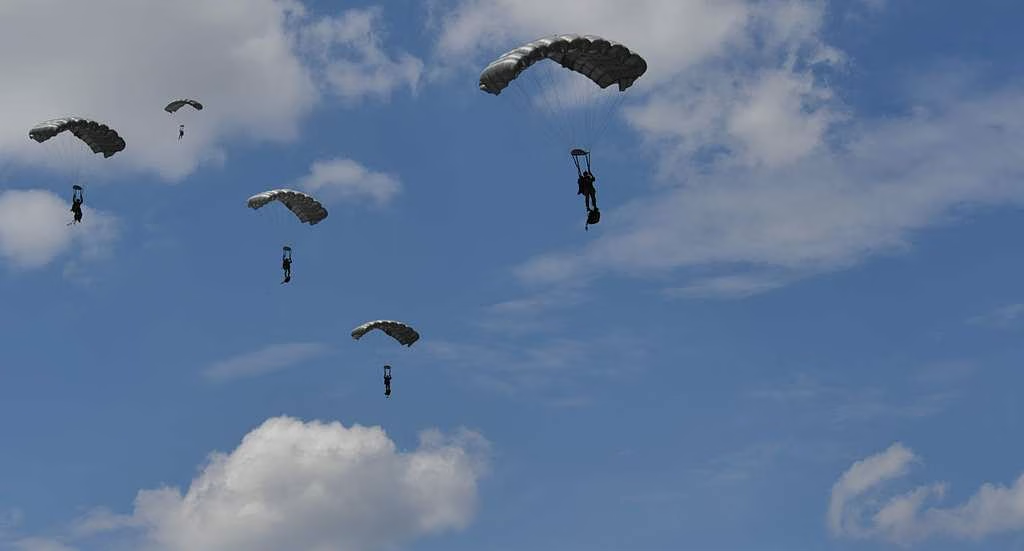
After letting go of my ego – and the expectation that everyone would be disciplined – I understood my limitless potential. More punishment just meant more push-ups and more physical training. It was an opportunity to get more ‘jacked’ and to hone our minds and spirits to levels of unconquerable sharpness, as is demanded of soldiers. More yelling meant that I had to be more humble and hungrier in the pursuit of knowledge and better understanding what I was learning to do. In this case, to recognize the dangers present from jumping out of a perfectly good aircraft and landing safely.
It was clear as day that I developed completely differently these nine months in the Hellenic Army than I would have had I not pursued this route and exposed myself to these unique circumstances. Instead of deepening my preconceptions, I experienced profound emotions and ways of thinking far beyond anything I felt in the past. I met people I never expected to meet, whom I deeply respected, and opened up myself to situations that ignited a fire within me that carried spiritual power and disciplined ferociousness.
With the new conscription model spearheaded by the Ministry of Defense under the “Agenda 2030,” soldiers are now provided high-tech training and lifelong skills that serve them beyond the confines of their service. This modernization is about defending our borders, as much as arming young people with the skills they need in today’s world.
Conflicts in and around Europe are now raging in full effect, increasing the chances of a miscalculation in the Eastern Mediterranean. Our message must be as clear as it is firm: young Greeks will be in the frontline when called upon to defend Hellenism and the sovereign integrity of our country. Anyone seeking to question this will be met with the zeal of millions of Greeks, both at home and abroad, willing to defend their homeland.
Nikos Theodosiadis works at the Secretariat-General of the European Commission, preparing briefings for the President and Executive Vice Presidents.
Disclaimer: The information and views set out in this article are those of the author and do not necessarily reflect the official opinion of the European Commission.