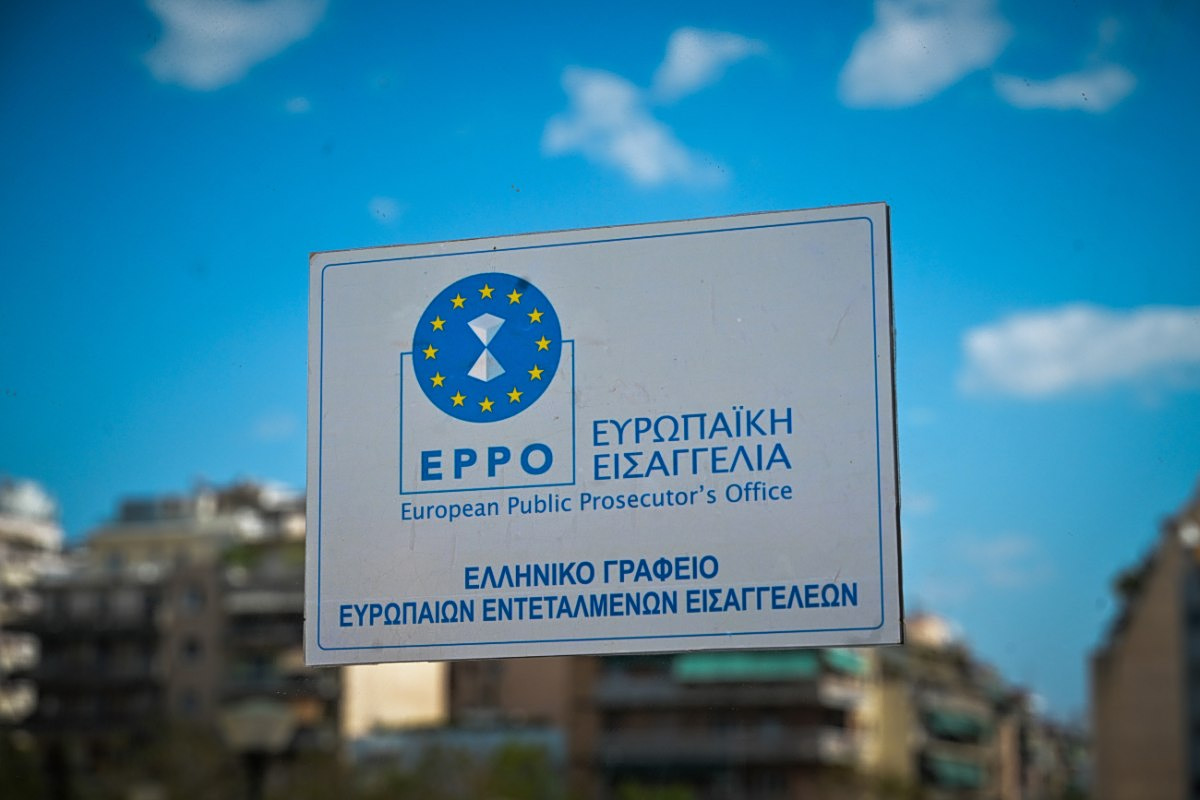
The latest annual report from the European Public Prosecutor’s Office (EPPO) lists 175 active investigations in Greece involving alleged crimes against the financial interests of the European Union. The estimated damage linked to those cases amounts to €2.68 billion.
Of the total active cases, 117 were opened in 2025, with estimated damage of €1.02 billion.
The EPPO, the independent EU body tasked with investigating and prosecuting fraud against the EU budget, tracks both expenditure fraud — involving misuse of EU funds — and revenue fraud, including VAT and customs-related offenses. In Greece’s case, the €2.68 billion total is split almost evenly: €1.34 billion relates to expenditure fraud and €1.33 billion to revenue fraud. Other fraud cases account for €12.32 million. The estimated damage to the EU budget alone stands at €1.33 billion.
Greece’s Position in the EU
With €2.68 billion in estimated damage from active cases, Greece ranks below Italy, Romania, France, Germany, Belgium and Poland, but above most other participating member states. The figures represent alleged financial impact under investigation, not final court determinations.
Where the Cases Are Concentrated
The investigations in Greece cover a broad range of EU-supported sectors. Agricultural and rural development programs account for the largest share, with 53 active cases. Another 47 fall under other or doubtful categories, while 21 relate to regional and urban development and 13 to recovery and resilience programs.
Additional cases involve asylum and migration, research and innovation, education and culture, employment and social cohesion, maritime and fisheries, mobility and transport, and security and defense programs; underscoring the wide scope of EU-linked funding streams now under scrutiny.
Judicially, 13 cases are in the trial phase, six are in appeals, and the report records two final convictions involving 10 individuals.
Opposition: “A Particularly Negative Picture”
Beyond the legal implications of the ongoing EPPO investigations, the report has once again brought questions of EU-linked fraud and public oversight to the forefront of Greece’s political debate.
PASOK described the report as a serious indictment of the country’s current governance. Party spokesperson Kostas Tsoukalas said the scale of the estimated damage paints “a particularly negative picture” for Greece within the EU. He argued that the breadth of the investigations, spanning sectors from agriculture to migration and infrastructure, shows that “almost every aspect of public activity” is now under review by European prosecutors.
Tsoukalas also compared Greece’s financial exposure to that of other EU countries, saying the country’s position in the ranking is damaging to its credibility. “This is a damaging picture for Greece and its credibility in Europe,” he said, adding that ending corruption would require a change in government.
New Left lawmaker Nasos Iliopoulos adopted similar language, calling Greece the EPPO’s “best customer.” He emphasized the €2.68 billion in estimated losses and said the figure should be kept in mind during domestic debates about public spending, including pay increases for doctors, nurses and teachers. The scale of the alleged financial damage, he argued, raises broader questions about priorities and oversight.
source: eppo, in.gr