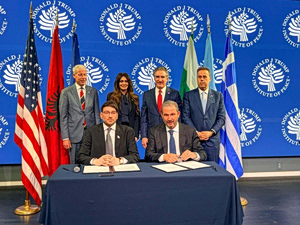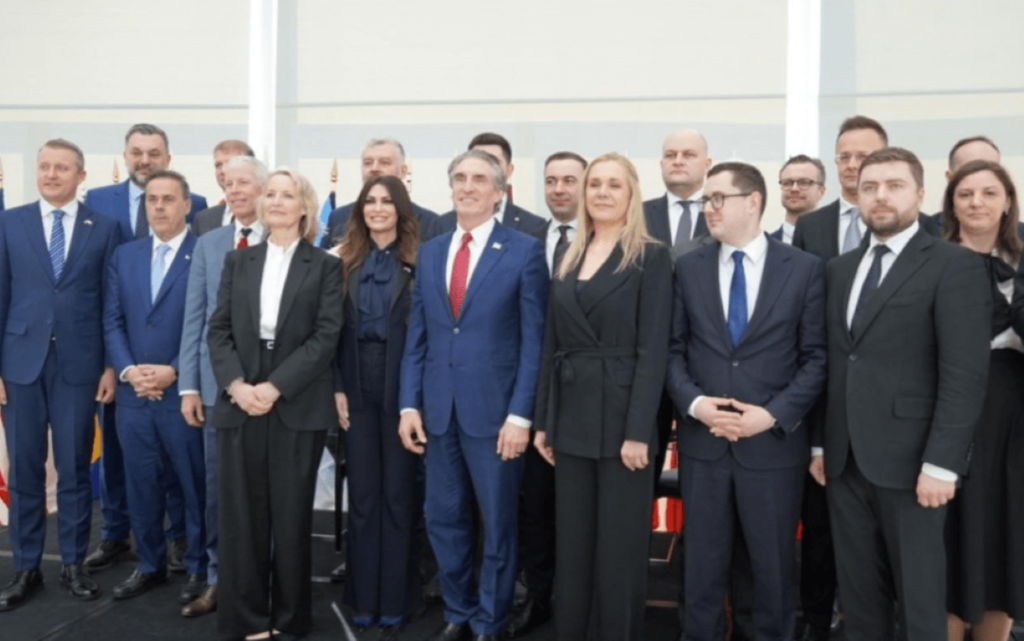
As U.S. and European officials gathered for a transatlantic energy summit focused on natural gas security, Greece arrived with a clear objective: to cast itself as an indispensable hub linking American LNG to Southeastern Europe.
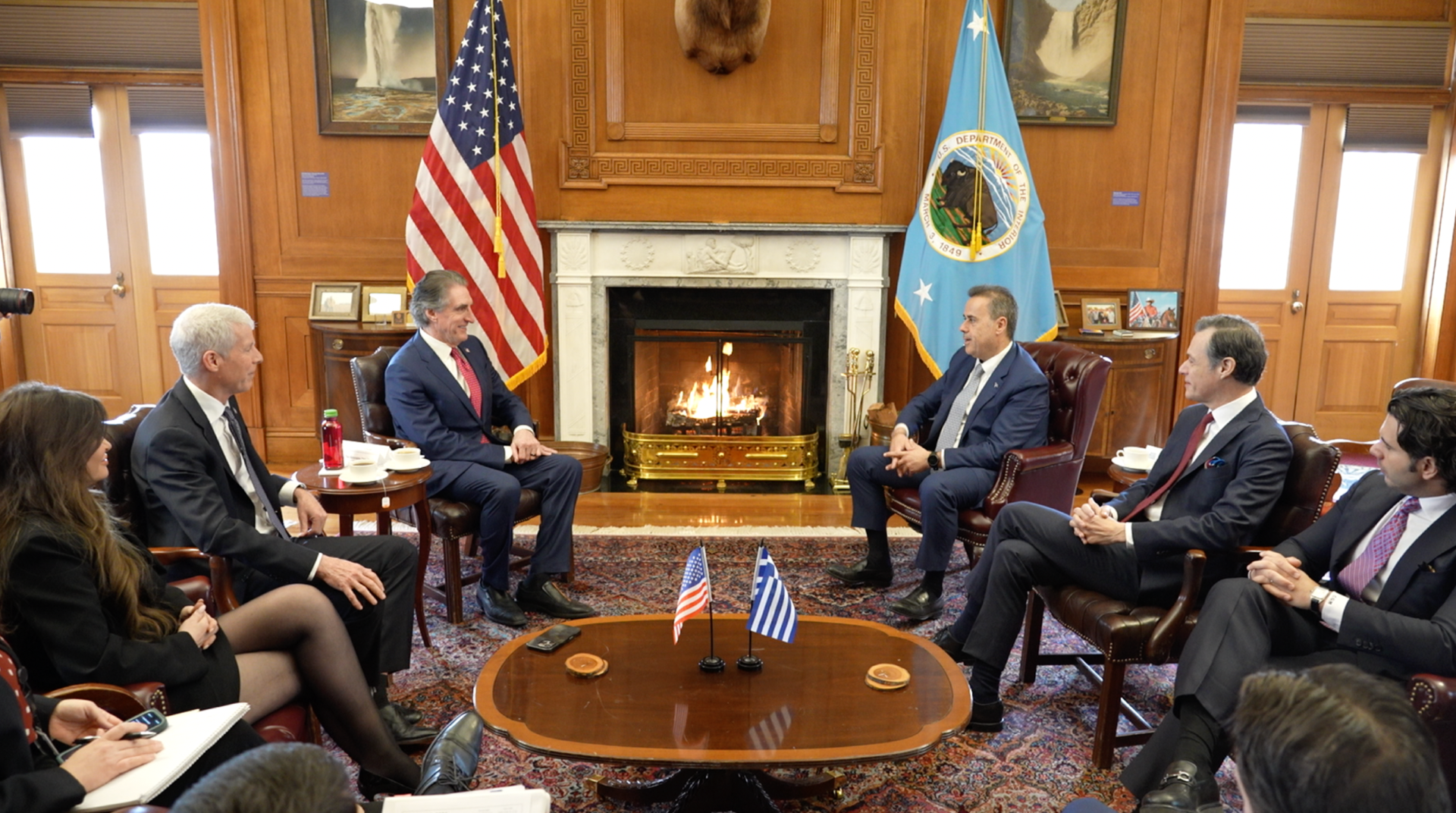
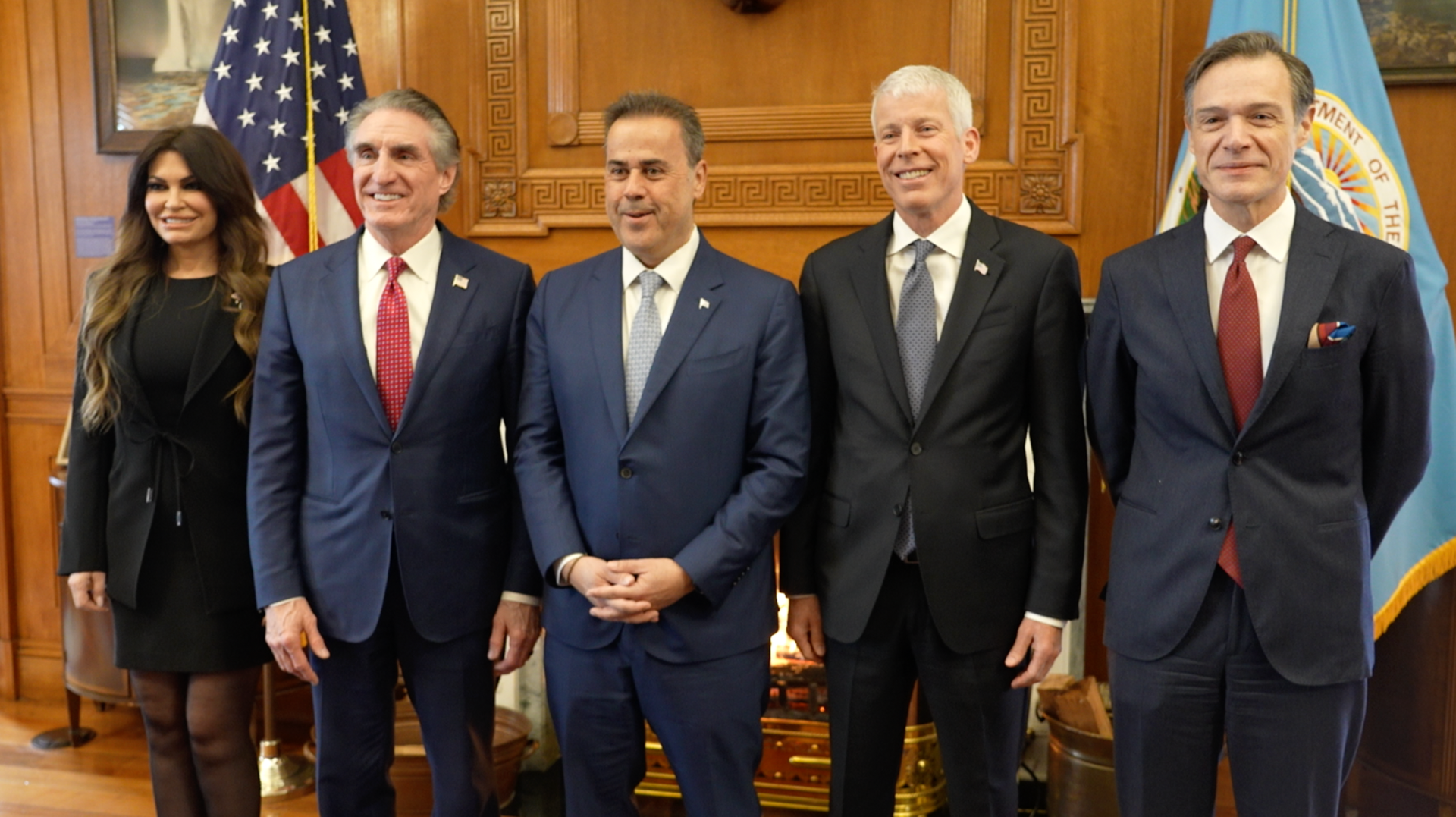
Parallel to the summit, Greece’s environment and energy minister, Stavros Papastavrou, scheduled meetings across Washington. On Wednesday he was to hold a trilateral discussion with Interior Secretary Doug Burgum and Energy Secretary Chris Wright. He also planned meetings with bipartisan lawmakers on Capitol Hill, including Senator Jim Risch, chairman of the Foreign Relations Committee, and Representatives Chuck Fleischmann and Randy Weber.
Energy diplomacy on Capitol Hill
One meeting attracted particular attention. Papastavrou’s discussion with Representative Chuck Fleischmann, the congressman who introduced an amendment supporting funding for the Eastern Mediterranean Energy Center.
The amendment’s path through Congress was far from guaranteed. It appeared in the House version of the annual energy and infrastructure funding legislation but was initially absent from the Senate version, raising concerns that it could disappear during final negotiations.
Fleischmann, however, insisted on keeping the language during reconciliation, the phase where differences between House and Senate bills are consolidated before final approval.
Inside Congress, survival through reconciliation is more than a technical detail. Provisions that make it through are generally seen as having bipartisan durability, which means they are less vulnerable to political turnover.
For Greek policymakers, that distinction matters. It signals that cooperation in the Eastern Mediterranean is gradually moving from political rhetoric to institutional policy, giving Athens a more stable foundation for long term collaboration with Washington.
A strategic alignment
The broader context is a rare moment of convergence between American and European priorities.
The Trump administration’s strategy of energy dominance emphasizes expanding markets for U.S. LNG exports. Europe, still recalibrating after years of dependence on Russian gas, is searching for secure alternatives. Greece sees an opening to translate geography into geopolitical influence.
Officials on both sides describe the current moment as a window of opportunity. If agreements signed this week evolve into stable commercial flows, and if Europe moves quickly enough to address regulatory barriers, Athens could move from the periphery toward the center of Europe’s evolving energy map.
If not, participants acknowledged privately, the summit risks becoming another well intentioned conference in Washington that produces headlines but limited structural change.
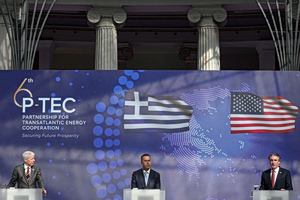
The atmosphere at the Transatlantic Gas Security Summit, organized by the White House’s Energy Dominance Council at the Donald Trump Institute for Peace, reflected that tension between ambition and execution. Participants said the discussions emphasized concrete contracts and measurable outcomes rather than general declarations.
Jarrod Agen, the council’s chief executive, recently said that the administration was not interested in conferences for their own sake, a message echoed throughout the event.
Deals with a Greek footprint
Of the six energy agreements announced during the summit, five directly involved Greek interests. For many in attendance, the volume of deals suggested that the so-called Vertical Corridor, a proposed network designed to move LNG and natural gas through Southeastern Europe, is shifting from concept to marketplace.
Atlantic SEE LNG Trade, a company jointly owned by AKTOR Group and DEPA Commercial, signed new long-term sales agreements for American LNG with four countries in the region. METLEN also reached agreements, reinforcing Greece’s role in the emerging supply chain.
The deals underscored how Athens is attempting to anchor itself at multiple levels of the regional energy architecture, from commercial contracts to infrastructure planning.
The elephant in the room
Behind the optimism, however, one issue dominated private discussions. Russian gas.
Despite Europe’s declared objective of reducing dependency, Russian natural gas continues to flow into Europe, primarily through Turkey, with market estimates placing volumes at roughly 17 to 18 billion cubic meters annually.
That reality was widely described by participants as “the elephant in the room.” As long as Russian gas remains available at competitive prices, the commercial viability of long-term LNG contracts remains uncertain. The Vertical Corridor depends on predictable flows and multi-decade agreements, conditions that become harder to secure when buyers expect cheaper alternatives to remain available.
For Washington, the problem is not only geopolitical but commercial. Countries in the region will hesitate to lock in long term American LNG contracts unless they believe Russian supplies will not reemerge as the lower cost option. The uncertainty has led many governments and companies to delay final commitments.
President Donald Trump has previously criticized European governments for continuing to import Russian gas while relying on American security guarantees through NATO, framing the issue as both an economic and strategic contradiction.
One of the few areas of convergence
At a time when transatlantic differences have grown across trade, industrial policy and strategic priorities, energy diversification remains one of the few areas where Washington and Europe broadly align.
For U.S. policymakers, Southeastern Europe remains a region whose political orientation is not fully consolidated within the Western camp. Reducing reliance on Russian energy is seen as a tool of geopolitical stabilization.
For Europe, and especially for Greece, expanding infrastructure and interconnections creates economic cohesion in a historically fragmented region. Officials increasingly link these projects to wider corridors such as the IMEC corridor, in which energy infrastructure serves as a foundation for broader trade integration.
Why countries are still hesitating
Yet despite Europe’s stated ambition to largely eliminate Russian gas imports within the next two years, many countries remain reluctant to sign long term LNG contracts.
Market participants cite two main reasons.
First, political uncertainty. Some governments and industry actors remain unconvinced that Europe will fully enforce all measures aimed at excluding Russian supplies.
Second, regulatory constraints. Existing European rules governing capacity allocation and tariffs were designed for a different energy era and are widely viewed as misaligned with today’s needs. Companies considering long term investments say regulatory uncertainty complicates decisions involving multi decade contracts.
Addressing those issues is now the focus of a technical meeting scheduled at the U.S. Department of Energy, bringing together transmission system operators, European Commission representatives and national energy ministries.
Participants describe the political will as largely established. The challenge ahead is technocratic: rewriting rules, adjusting market structures and turning diplomatic momentum into physical energy flows.
For Greece, the question is whether this moment represents the beginning of a durable transformation or simply another promising chapter in the long history of unrealized energy ambitions in the Eastern Mediterranean.