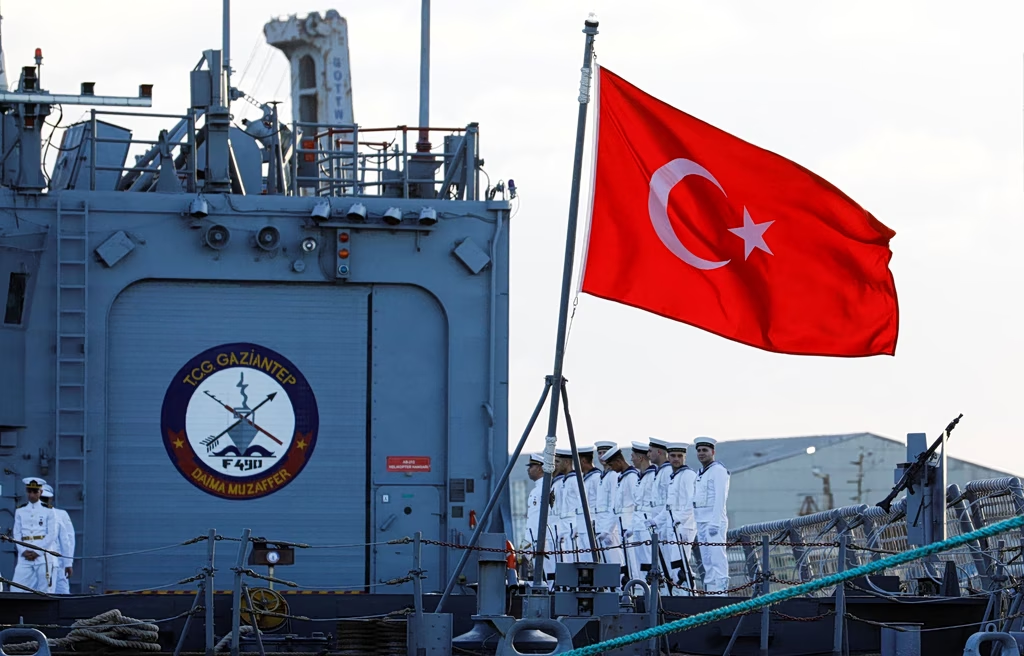
Turkey is preparing to pass legislation that would enshrine its sweeping maritime claims in the Aegean and Eastern Mediterranean into domestic law, according to reports in Bloomberg and the Turkish daily Milliyet. Athens is watching closely and has already dismissed as legally baseless.
The bill, as outlined in media reports, is expected to incorporate Turkey’s maritime spatial plan — which ignores Greek islands and effectively bisects the Aegean — along with two Turkish marine parks, one near Kastellorizo and one in the northern Aegean between Samothrace and Lemnos. It would also codify the 2019 Turkey-Libya maritime memorandum, which Greece and the European Union have declared invalid. According to reports, the legislation would also grant the Turkish president the authority to unilaterally designate areas as being under a “Special Maritime Status,” even in zones where Turkey has not formally declared an exclusive economic zone.
The timing is not incidental. Athens has been systematically strengthening its own maritime and diplomatic position, through its maritime spatial plan, the extension of its territorial waters in the Ionian Sea, hydrocarbon exploration agreements with Chevron south of Crete and the Peloponnese, the establishment of marine parks in the Ionian and southern Aegean, and defense upgrades on Lemnos, Karpathos and in Cyprus. Greek government sources say Ankara is reacting to mounting domestic pressure, having failed to match Athens’ pace of consolidating its maritime position, and is now seeking to project resolve to a domestic audience.
Government spokesman Pavlos Marinakis responded to the Turkish reports on Monday, offering a pointed but measured dismissal. “Any unilateral action carried out through national legislation — meaning a bill passed by a state — obviously carries absolutely no weight whatsoever under international law,” he said. “None at all. It is addressed solely to the domestic audience of each country. In other words, it’s for domestic consumption.” Marinakis added that the international law of the sea sets out with “absolute clarity” the procedures and criteria for delimiting maritime zones, and that selective application of international law was not permissible. Greece’s own moves, he said, were not determined by the actions of other countries, including neighboring ones, and rested on solid legal ground, “with the maritime spatial plan as the crowning achievement, whose outermost potential limits were established with Europe’s seal of approval.”
Greek government sources described the anticipated legislation as “a domestic law with absolutely no international validity.” They noted, however, that it remains to be seen whether its content will stay within the bounds of the unlawful and legally unfounded claims Ankara has previously submitted to the United Nations, or go further and require a different order of response.
The reaction extended to the European level, with Greek MEPs both from the governing New Democracy party and the main opposition party PASOK also raising the alarm in Brussels. Eliza Vozemberg, head of New Democracy’s delegation in the European Parliament and a member of the EU-Turkey Joint Parliamentary Committee, submitted an urgent question to EU foreign policy chief Kaja Kallas, arguing that Ankara was seeking to legitimize unlawful claims and create facts on the ground in the Aegean and Eastern Mediterranean in disregard of Greek sovereign rights. She also highlighted reports that the bill would grant the Turkish navy and coast guard intervention rights even in areas where no Turkish EEZ has been declared, and called on the European Commission to state how it legally assesses Turkey’s actions and how it intends to press Ankara to respect the sovereign rights of EU member states, which she said Turkey was “deliberately and systematically” violating.
Four PASOK MEPs, namely Giannis Maniatis, Nikos Papandreou, Sakis Arnaoutoglou and new “transfer” Nikolas Farantouris, separately addressed a written question to Kallas asking whether she intended to propose sanctions against members of the Turkish government who advance a law violating the sovereign rights of two EU member states, Greece and Cyprus, and contradicting both the EU acquis and international law. The PASOK MEPs also drew attention to reports that the bill would rest on Turkey’s legally unfounded claim that islands aren’t entitled to a continental shelf or EEZ. This position, the PASOK MEPs noted, was directly at odds with the United Nations Convention on the Law of the Sea, which forms part of the EU acquis, as well as with the jurisprudence of the International Court of Justice in The Hague.
What gives Athens particular cause for concern, based on the leaked outlines, are two specific features of the bill. The first is the apparent entrenchment of the six-nautical-mile limit as a direct counterweight to Greece’s stated intention to extend its territorial waters in the Aegean to 12 nautical miles. The second is Turkey’s apparent ambition to impose a new reality in the region, under which no economic, scientific or environmental activity could proceed without its consent. Both are seen as a significant setback for the relative calm that has characterized Greek-Turkish relations in recent years. The concern is compounded by the fact that earlier this year Turkey’s foreign ministry leadership had signaled a notable shift on the casus belli, the longstanding parliamentary resolution threatening war should Greece exercise its right to extend its territorial waters. Prime Minister Kyriakos Mitsotakis had pushed the issue publicly, including at the Supreme Council of Cooperation in Ankara, where he called for the threat to be formally lifted.