 Μake us preferred on Google
 The countdown has begun to the resumption of surveys for laying the Greece-Cyprus electricity interconnection cable. On one hand, Athens is waiting for the French embassy’s request, in line with the established procedure and after intensive consultations, so it can issue the necessary NAVTEX reserving the disputed areas in the Eastern Mediterranean. On the other hand, and more importantly, it is trying to decode Ankara’s messages and intentions.
The Prime Ministers office and the Foreign Ministry are examining every possible scenario, including a potential escalation of tension, even on the ground. As all parties involved in the project know, the seabed mapping must be completed and the final route drawn by the end of the year. It is therefore easy to see that the time margins for Athens, Paris, and Nicosia are narrow. By contrast, Ankara is in no hurry, repeating the same message almost monotonously: “The execution of any energy project in the Eastern Mediterranean requires Turkey’s permission or approval.”
The Initiative Goes to the French
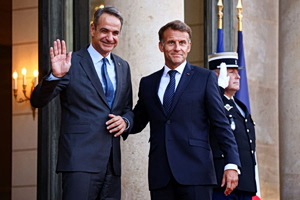
Within this suffocating framework, diplomatic efforts are accelerating. Athens, however, has left the initiative to the French, who will also dispatch the research vessel, which sails under the French flag with a French crew. This is because Greece’s repeated attempts in the recent past to reason with Ankara, aiming for the smooth completion of the project, proved ineffective.
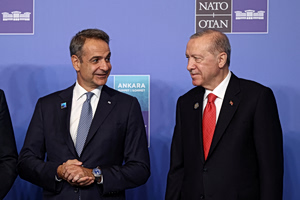
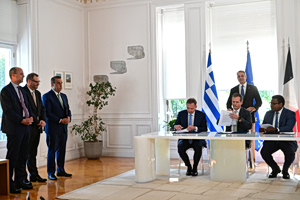
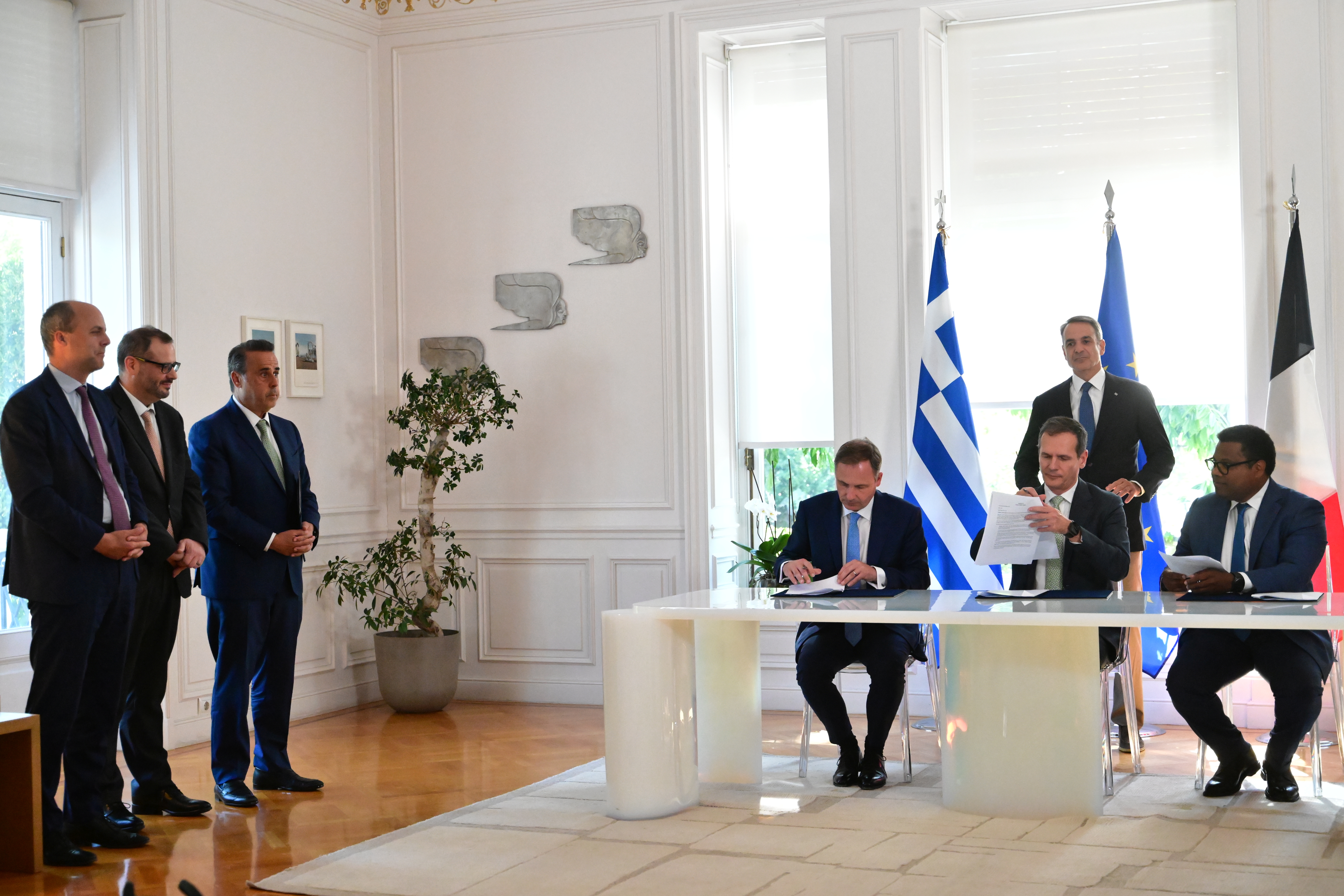
According to reliable information, the issue was raised at every meeting between Kyriakos Mitsotakis and Tayyip Erdogan since the summer of 2024. It was also one of the main topics of discussion between the two foreign ministers, Mr. Gerapetritis and Mr. Fidan, throughout the period of “calm waters.” It is widely acknowledged that the majority stake held by the powerful French investment firm Meridiam, combined with the earlier involvement of NEXANS, also a French company, as the cable manufacturer, gave the project financial and diplomatic momentum.
However, the Greek-French approach followed so far, of “informing” Ankara about the restart of the surveys, does not appear to meet Turkish demands. Under this approach, French diplomatic authorities will notify all coastal states of the vessel’s details and the route it will follow, without, of course, asking Turkey for permission, since such a move would create a major problem for the Greek government.
However, as ΤΟ ΒΗΜΑ has noted many times, Ankara is not interested merely in some form of notification or communication. Turkey claims the authority to permit surveys across the entire area east of the 28th meridian, which notably cuts Rhodes in half, advancing the unlawful argument that this area falls within the Turkish continental shelf.
This was clearly confirmed last week.
Ankara first signaled, through a targeted leak to the Turkish press, that the French vessel should “coordinate” with Turkish authorities to avoid any incident. The neighboring country’s Defense Ministry then took up the baton, warning that it would not allow “unauthorized activities that ignore the rights and interests of our country” and that “the necessary measures” are already being taken.
The Ghost of Kasos
Two years have now passed since the Kasos incident, when Turkish Navy units effectively prevented surveys from continuing outside Greek territorial waters. The troubled project now appears set to become a turning point, if not a breaking point, in Greece-Turkey relations. The extremely difficult position Athens must balance on is reflected in the view of diplomats inside and outside the Foreign Ministry: “Given Ankara’s positions, no particularly favorable scenario for Greece is being considered at this time. A solution acceptable both internationally and domestically is extremely difficult to find.”
Of course, no one can underestimate the extent of French influence, along with the interests Paris holds in the Eastern Mediterranean. Nor can anyone underestimate the creative ambiguity of diplomatic practice, which often offers solutions that, if not mutually acceptable, are at least not damaging to those involved. On the first front, outgoing President Macron’s leverage over his Turkish counterpart will have to prove effective.
On the second, managing an ambiguous solution will require political mastery, with the Prime Ministers Office hoping to avoid a new round of confrontation with its right flank over national issues. The cable, then, is sending current into domestic politics. Government lawmakers, especially those from border regions, know firsthand the impact Kasos had on voters. Now the forthcoming Samaras party is added to the equation, with the former prime minister speaking for months about “appeasement” and attacking the Prime Ministers office and Mr. Gerapetritis specifically over this issue.
Delicate Balances
It is worth noting, and a senior government source welcomed this, that Tayyip Erdogan chose a mild tone on Greece-Turkey relations during his stay in New York. Speaking from the podium of the UN General Assembly, the Turkish president referred, as he routinely does, to “interconnected” problems in the Aegean and the Eastern Mediterranean. In statements on Thursday, he described Turkey not as an enemy but as Greece’s “neighbor and ally,” attributing the causes of tension to the domestic political scene ahead of the 2027 national elections.
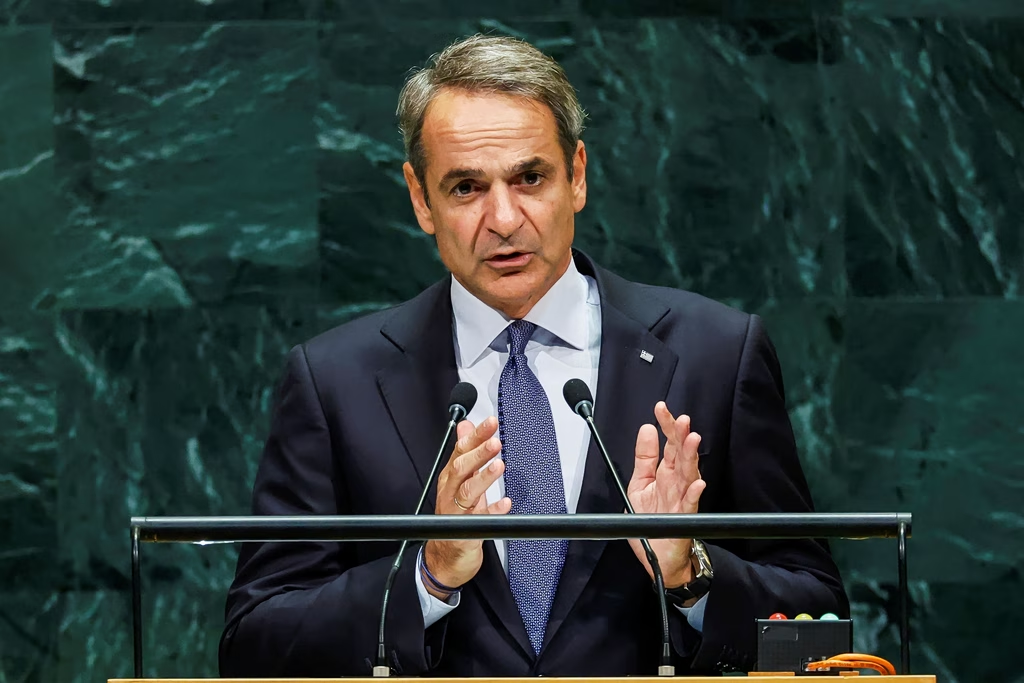
Similarly, Kyriakos Mitsotakis, without harsh language, denounced unilateral actions and the Turkish casus belli. He pointed to the Law of the Sea as the only institutional framework for resolving the single Greek-Turkish dispute and sounded the alarm about a possible broader undermining of stability in the Eastern Mediterranean. The Prime Minister highlighted the international dimensions of the Greece-Cyprus electricity interconnection as a “new generation project” aimed at connecting Europe and the Middle East, also bringing Israel into the equation.
The major question Greek diplomacy must answer these days, however, is how far Ankara is willing to go. The issue is not simply imposing its own view on the delimitation of maritime zones, but prevailing over the long term in the balance of power in the Eastern Mediterranean. If Turkey decides that the time has come to confine Greece to a vital space of 6 nautical miles, then attempts to block the survey with warships should be expected.
Such a move cannot go unanswered, as several government ministers and the Prime Minister himself have pledged to protect the project accordingly. Clearly, a confrontation on the ground is the last scenario Athens wants to see. On the other hand, as noted earlier, there is almost no room for delay, let alone for painful compromises.