 Μake us preferred on Google
Sunday November 15th marked nine years since the deadly flood of November 15, 2017, in Mandra, which killed 25 people. The relatives’ wounds remain open, especially after the defendants were acquitted in court.
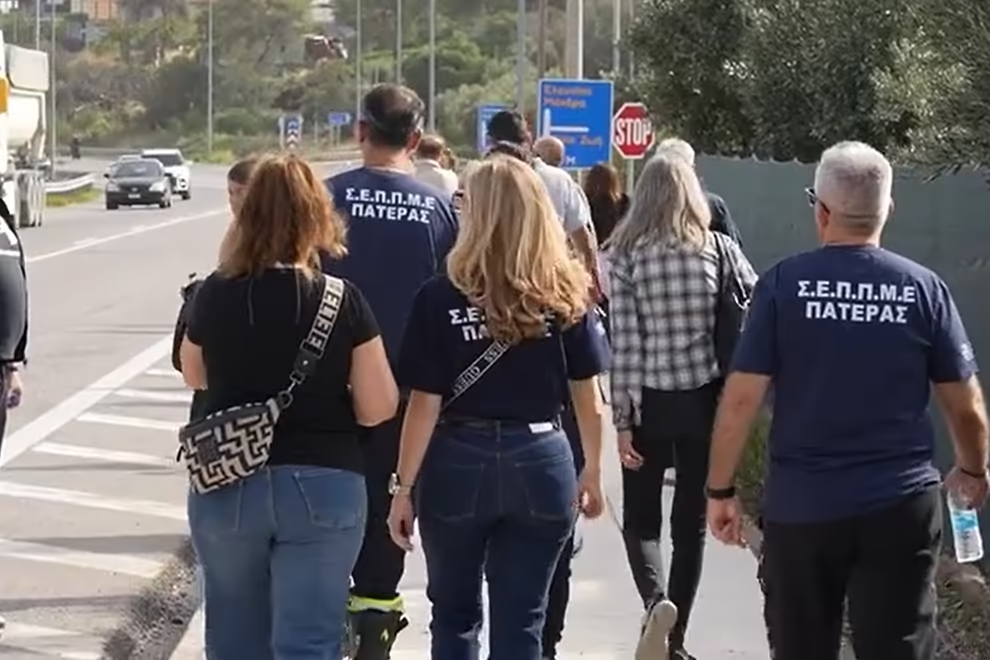
The Orange Press Agency joined the memory walk with Anastasios Beretas, president of the Association of Relatives of the Dead and Injured of Mandra 2017, who lost his father in the tragedy. Starting from the point where the raging torrent burst into the area, and following the route of death to the monument to the 25 victims at the corner of Koropouli and Stratigou Roka streets, Beretas pointed out the mud marks still etched on the walls at a height of almost two meters, describing what happened on that fateful day.
“As an association, we had asked for the walk to start from the first canteen. That was the point beyond which 14 people drowned alive. Unfortunately, the traffic police did not allow the road to be closed so we could hold this memory walk exactly as we wanted,” Beretas said at the outset.
He said the refusal reminded him of the negligence nine years ago, when the road was left open and passing drivers were swept away, among them his own father: “Personally, I’m not surprised, because nine years ago they also failed to close this road, which could have saved 14 lives. If that road had been closed, the trucks would not have gone through, my father would not have gone through, none of the people who went out unsuspecting to go to work would have gone through, and they would be alive today.”
Describing the moment the torrent struck his father’s vehicle, he said: “He was driving his truck through here to get to work, and at a moment he did not expect, the stream came through and flipped a 50-ton truck upside down. And it swept my father himself all the way to Elefsina, six kilometers from here.”
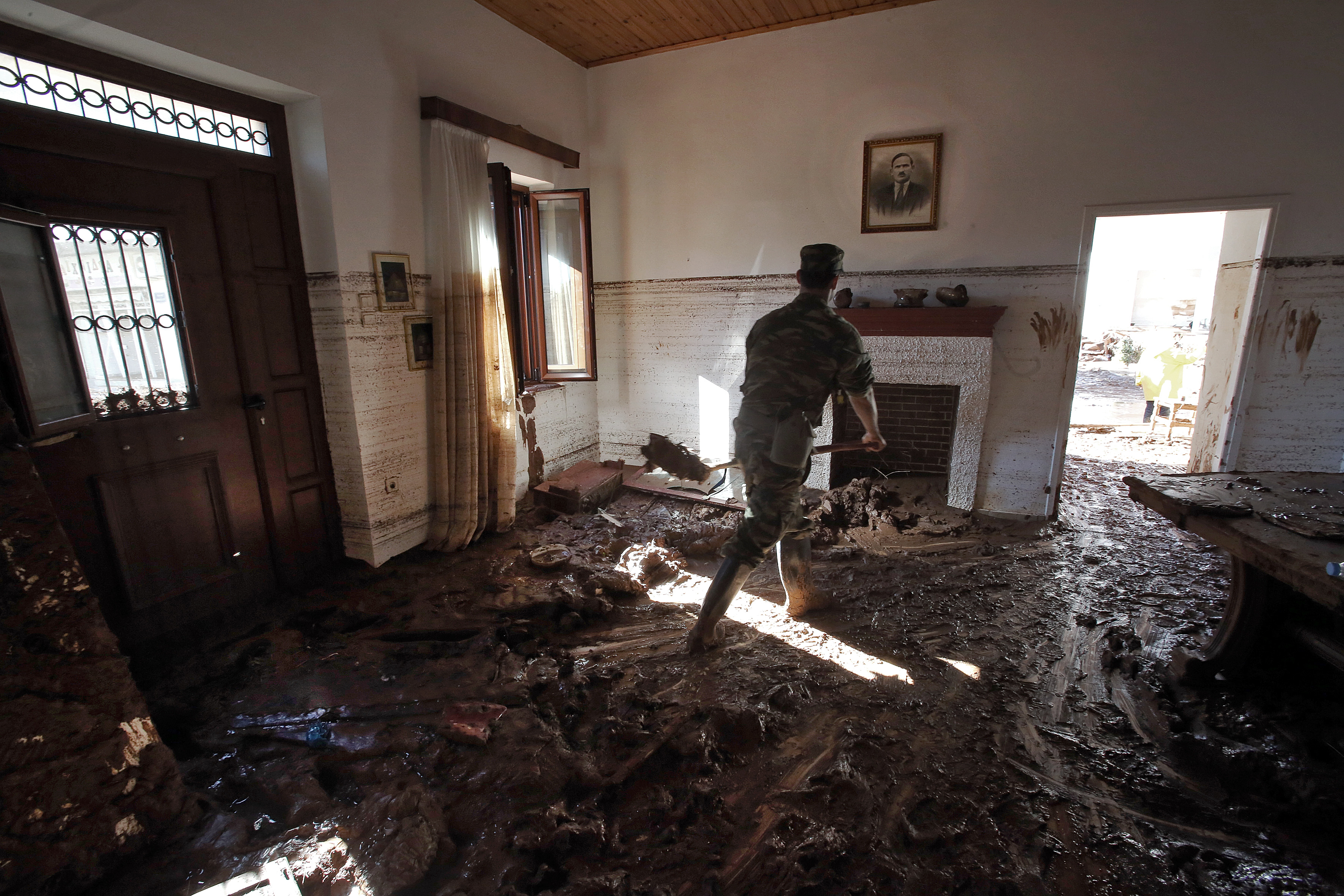
Soldiers take part in the operation to clear mud from roads and houses in the centre of Mandra, using shovels, on Tuesday, November 21, 2017, following the devastating floods that struck the area, leaving 21 people dead, one missing and causing extensive damage to homes, businesses and residents’ property.
“They Keep Blaming The People Who Died”
Beretas stresses that even though many years have passed, “we still cannot stand on our own feet. This day always marks us. This loss always marks us. At holidays, anniversaries, in joy and in sorrow, there is always a loss in our home. For so many years we have been waiting for the truth. We are waiting for answers, and unfortunately no one has given them to us.”
On the state’s stance and the defense strategy used in court, he expressed strong frustration because, as he says, “they keep blaming the people who died. Since I told you earlier what would have happened if they had closed the road, let me tell you that all these years everyone has argued that these people committed suicide. That they made the mistake of driving down this road.”
Beretas also referred to testimony by scientists during the hearings: “In fact, some scientists, like Lekkas, for example, who unfortunately came to court to defend the accused, said that people driving trucks should have made a U-turn on this road and gone back. I wonder how easy it is to make a U-turn and just leave. And we are not talking about the spot where we are now. We are talking about the points farther up, where the road is narrower.”
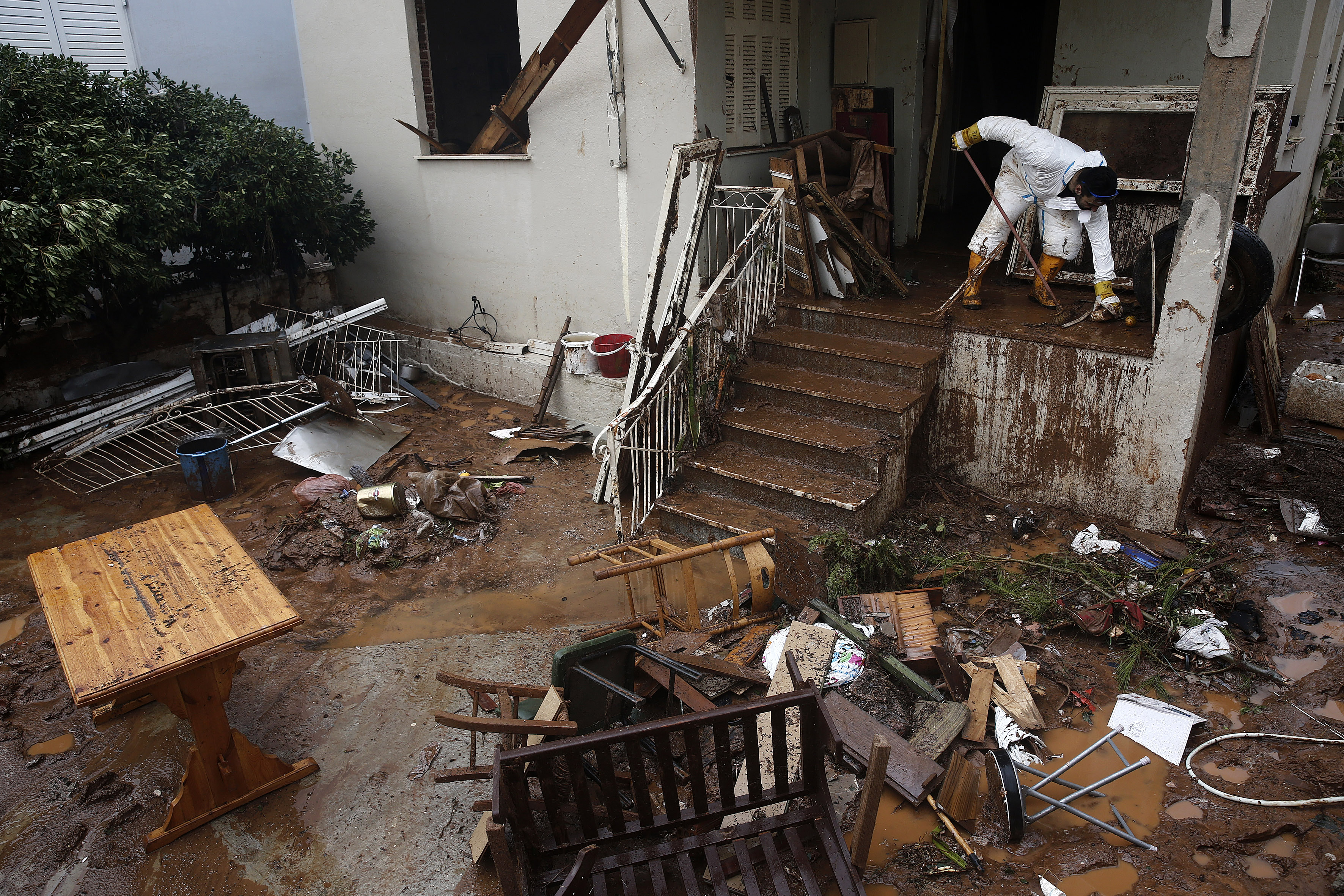
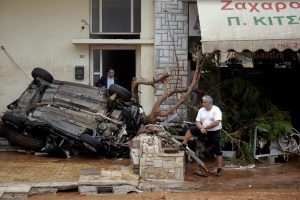
Residents try to clean their homes and shops in the Municipality of Mandra following torrential rainfall, on Sunday, November 19, 2017. The death toll from the severe flooding in Mandra, Megara and Nea Peramos has so far reached 20.
APE-MPE / APE-MPE / ALEXANDROS VLACHOS
The Agia Aikaterini Stream That “Drowned” Mandra
Continuing toward the point where the Agia Aikaterini stream burst into the town, he spoke about the lack of flood protection works: “A little farther down, I’ll show you the other stream, Agia Aikaterini, which was the one that drowned the town of Mandra. The plan back then was to build a large channel so the stream could pass without flooding the town. That was never done.”
As he pointed out, the complete lack of warning proved fatal for people living in ground-floor homes. “If people living on the ground floors had been warned back then, they would have gone up to higher floors, because most people here who live in apartment buildings are families. So nobody warned them, and it got to the point where people lost their lives. The reason these walls were built (editor’s note: he points to a tall wall around an apartment building) is to protect their homes, so the water can’t get inside,” he said.
“It Brought Down Washing Machines, Refrigerators, Beehives, Whatever It Found On The Mountain”
Walking along the straight stretch of road where most of the deaths in the town were recorded, Beretas said: “This is the Agia Aikaterini stream that drowned the town of Mandra. From here and down the road on the straight stretch is where we had most of the dead. This stream took with it whatever it found, because higher up there was a lot of rubble and debris. That’s why, when the flood happened, it brought down washing machines, refrigerators, beehives. Whatever it found on the mountain, it brought down.”
The deadly path of the rushing water continued all the way to Koropouli Square, where a simple monument to the victims now stands. “From here up to the monument we’re going to, we had eight dead. Seven dead who drowned in their homes and two who went to the hospital. And one house where a young woman’s mother died, which was a little below the monument,” the association’s president added.
The mud marks on the walls are undeniable evidence of the scale of the disaster. As Anastasios Beretas explains, “this road here, from the top where I walked down to the bottom, was the place where we had the most dead in the town of Mandra. A huge torrent came down, changing direction because of the obstacles it met, and that led to many lives being lost along the road we’re following all the way to Koropouli Square. Even so, you can see the marks of the destruction on the walls. What was it like that day? The whole river crossed this stretch here.”
Elsewhere, Beretas explains that the stream now runs under the town: “Thirty or 40 years ago there was nothing here. There was an open stream that ran through. Where we are standing right now, this road, the stream is underneath. The stream is right below. Why was this a mistake? Because, as I said before, they drew up the town plan but did not make sure to build a flood protection project, to regulate the stream so it would not run through the town. People in administrative positions started doing things without protecting human life. That’s why we keep saying that for everything that has happened here, we want explanations and answers, and whoever is responsible must answer to us.”
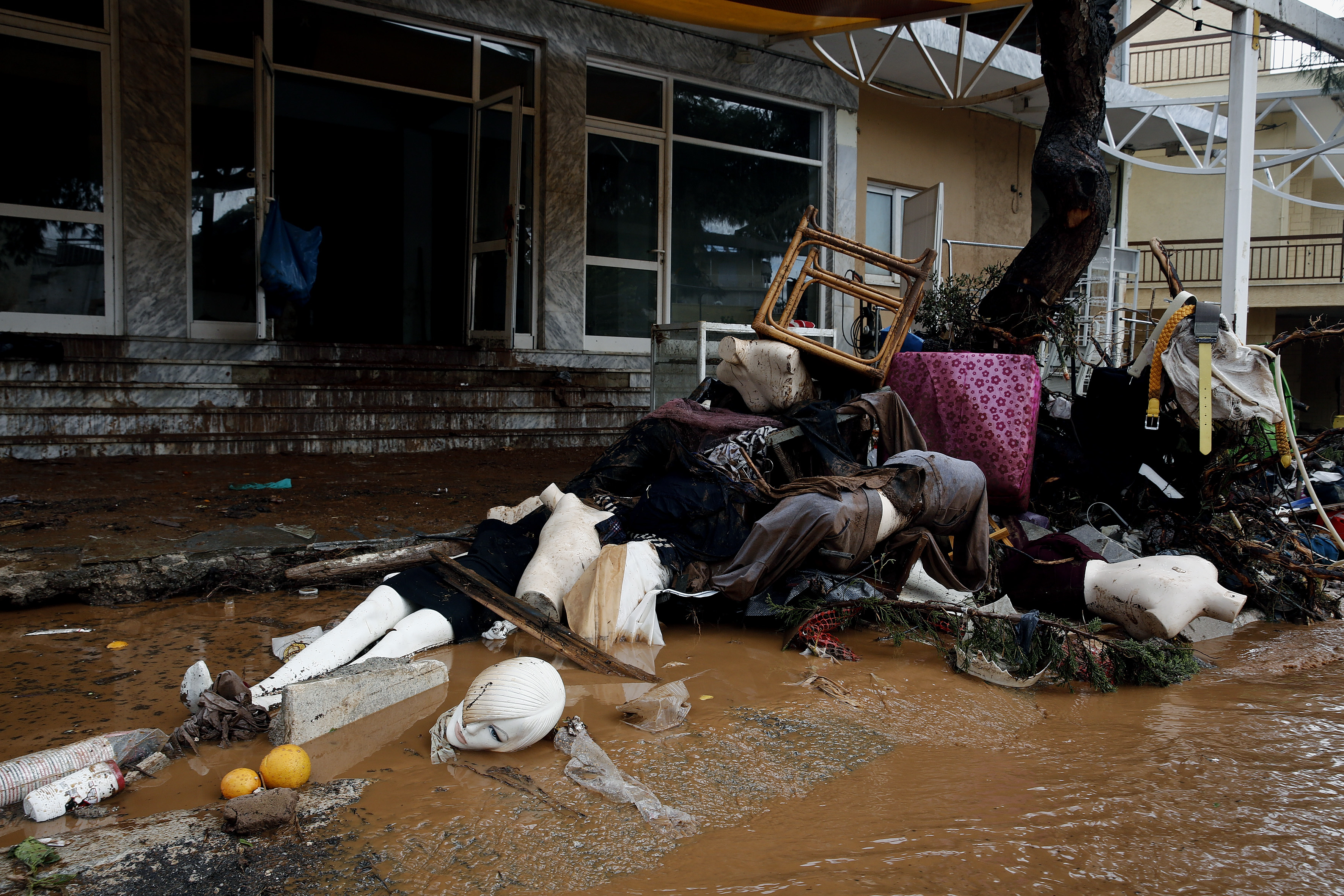
Residents try to clean their homes and shops in the Municipality of Mandra following torrential rainfall, on Sunday, November 19, 2017. The death toll from the severe flooding in Mandra, Megara and Nea Peramos has so far reached 20.
APE-MPE / APE-MPE / ALEXANDROS VLACHOS
The Moment He Learned Of His Father’s Death
Reaching the junction with Stratigou Roka Street, where the water reached its highest level, he explained: “This is the spot where it started rising higher. If we go down, there are points where the water reached 1.90 meters. The fire service measured it. Anyone living on a ground floor would have found it hard to survive, and so would people out here on the street. That’s why we say that if it had happened an hour later, we would have had many, many more dead.”
The vehicles swept away by the water had piled up at the same spot. “This is where the trucks were, where there were overturned cars, trucks on top of each other. It happened right here in front, because, as I told you before, all the water came here and ended up right here. It came together from all the side streets it ran through, then came down Stratigou Roka, which is right here, and reached its highest point at 1.90,” he stressed.
Ending the walk in front of the monument bearing the name of Christos Lioliopoulos, Anastasios Beretas spoke for the first time in such a personal tone: “This is the name of my stepfather, but a father is the one who raises you, not the one who makes you. We were together from when I was 2 years old until I was 24, when I lost him. Christos Lioliopoulos. I wasn’t here in Attica. I was in the provinces, and even though I was very worried that day, I didn’t have my phone with me, since I was at work. When I picked it up at some point, I saw many missed calls. I immediately thought something bad had happened. I called my mother, and the first thing she told me was that dad was gone. I couldn’t understand what she meant.
“I asked her to explain what had happened, and she told me a stream had swept him away with his truck and he was gone. In shock, I immediately left to come to Athens and make sense of what had happened. I was reading on the internet that a flood had hit Mandra. I couldn’t understand how this hit us, how it concerned us, since my father wasn’t from the area. And then I understood that he was going to work and ended up at that spot. Nobody tried to stop him. And not only him, but 13 other people who were there, and as a result they lost their lives for nothing.”