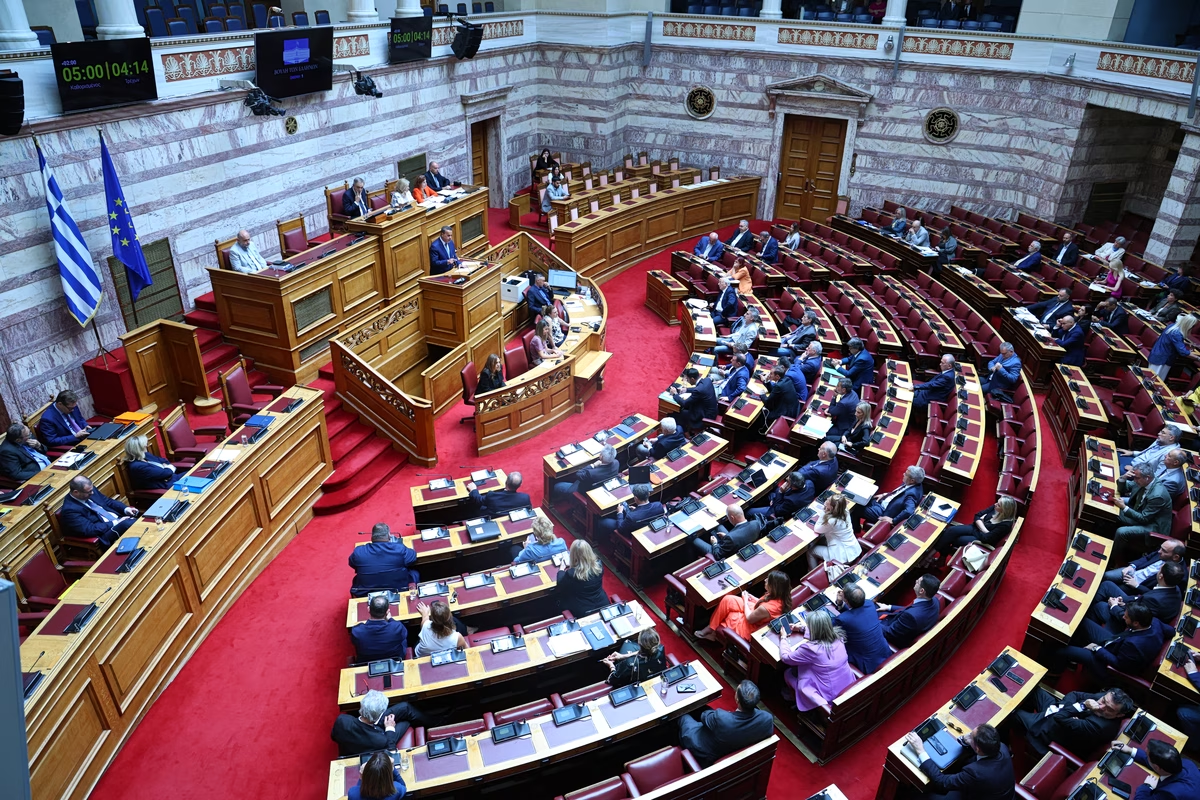
The Greek Parliament will hold a second vote Wednesday morning on a package of constitutional amendments, a procedural step that will shape how much latitude a future Parliament will have to actually rewrite the country’s founding document. The vote is scheduled for 10 a.m. Public sector unions have called a work stoppage for the same day, with a rally planned outside Parliament as lawmakers debate inside.
Wednesday’s session marks the final major step in the first phase of Greece’s two stage amendment process, in which the current Parliament identifies which articles of the constitution are open to revision without yet deciding what the new wording should say.
The significance of the vote count
Under Article 110 of the Greek Constitution, amending the charter requires two separate parliamentary votes held across two different legislatures, a structure meant to give voters an indirect say in constitutional change through the elections that fall between the two phases. If an article clears a qualified majority of three fifths of the chamber, or 180 of the 300 seats, in the first phase, only an absolute majority of 151 votes is needed to confirm it in the second phase, before the newly elected Parliament. If instead an article passes the first phase with an absolute majority of 151 votes but falls short of 180, the bar rises in the second phase, where a three fifths majority becomes necessary.
That threshold is what is being locked in Wednesday. In a first vote held in July, none of the articles New Democracy put forward for revision reached 180 votes. All of them, however, cleared the 151 vote threshold, with support ranging between 158 and 161 votes, meaning they proceed into the second phase but will need a three fifths majority in the next Parliament to actually be changed.
Opposition holds back support
Opposition parties have signaled they do not intend to give the next governing majority, whichever party leads it, unconditional backing for constitutional changes.
New Democracy has criticized that stance, and Prime Minister Kyriakos Mitsotakis addressed it in his annual press conference at the Thessaloniki International Fair (TIF) earlier in September. The success of a constitutional revision, he said, has historically depended more on the opposition’s cooperation than on the government’s own majority. “We are missing a great opportunity,” he said. The Prime Minister also presented his government as having made sincere efforts to open communication channels with opposition parties but had run into what he described as a reflexive habit of opposing anything the government proposes.
Mitsotakis reserved particular criticism for PASOK, saying the party had indicated it would vote against its own proposal even if New Democracy supported it.
PASOK leader Nikos Androulakis has focused his party’s objections on two provisions. He has said that allowing nonstate, nonprofit universities in Greece, which would require amending Article 16, should come only with strict operating standards to prevent abuses and the pursuit of narrow interests. He has also called for revising Article 86, which governs the process for prosecuting political figures, to end what he calls the special legal treatment for politicians.
Civil servants plan a walkout
ADEDY, the umbrella union for Greek public sector workers, has called for a walkout in response to the vote, saying public employees intend to make their opposition to the constitutional revision heard. The union’s leadership says the mobilization is meant to protest the broader direction of the constitutional changes, and in particular what it sees as threats to job tenure protections for civil servants and a risk of privatization in sectors such as health care and education.
The protest is set to culminate in a rally at Syntagma Square, the plaza facing Parliament in central Athens, at 1 p.m., timed to coincide with lawmakers debating the revisable provisions inside the chamber.
In its action plan, ADEDY also responded to Mitsotakis’s TIF announcements, saying they do nothing to meet public sector workers’ demand to live with dignity on their salaries, and describing the constitutional revision, a new disciplinary framework and efforts to weaken job tenure protections as part of a continuing attack on civil servants.