Μake us preferred on Google
The Hellenic Navy on Friday formally received its second French-built Belharra-class frigate, the Nearchos, as Greece presses ahead with a major naval modernization program aimed at strengthening its defense capabilities in the Aegean and the eastern Mediterranean.
The ceremony took place at the Naval Group shipyards in Lorient, western France, in the presence of Defense Minister Nikos Dendias and Greece’s military leadership. The raising of the Greek flag marked the vessel’s formal incorporation into the Hellenic Navy, following the delivery of the first FDI HN frigate, the Kimon, in late 2025.
Shipowner Athanasios Martinos and his wife, Marina Martinou, the vessel’s sponsors, also attended the ceremony.
Speaking at the event, Dendias described the Nearchos as another significant step toward strengthening Greece’s fleet and implementing the strategic partnership between Greece and France.
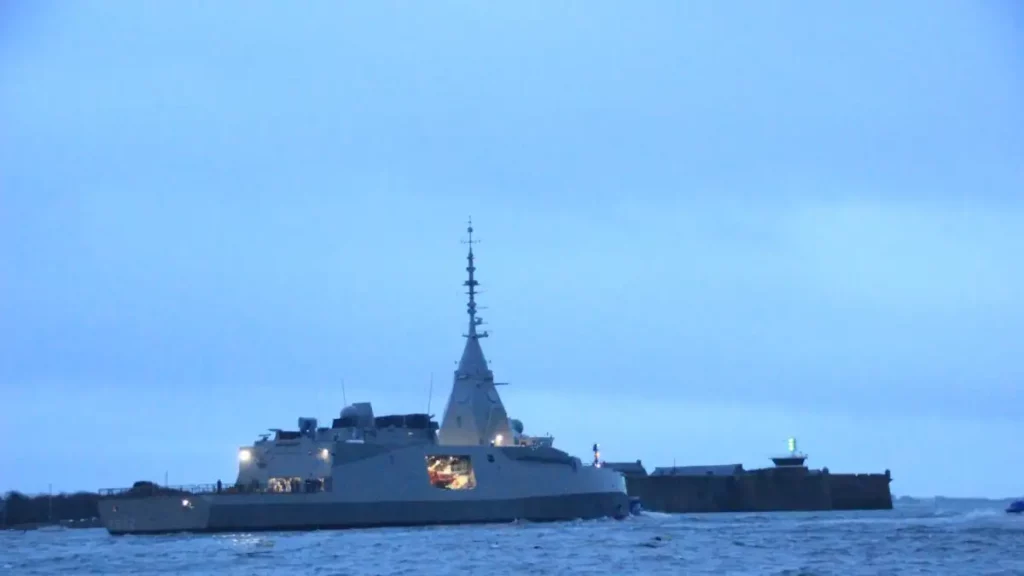
Greece is acquiring four FDI HN frigates, also known as Belharra-class vessels, from France’s Naval Group. The ships are designed to conduct air defense, anti-surface warfare and anti-submarine operations, combining advanced sensors, radar and combat management systems.
The vessel is being delivered in the Standard 2 configuration, with 32 active vertical-launch cells for missiles, twice the number activated on the Kimon. The increased capacity allows it to carry more Aster 30 surface-to-air missiles, enhancing its ability to counter aerial threats and protect other naval units.
Dendias said a third such frigate, the Formion, would follow before the end of 2026. The fourth vessel, the Themistocles, is scheduled for delivery in 2028. All four frigates are to be upgraded to the Standard 2+++ configuration by 2030 in cooperation with Naval Group.
At that level, Dendias said, the ships would possess advanced air defense and strategic strike capabilities, making them among the most capable vessels in their class. By the end of the decade, he said, Greece would have a new navy comprising 10 modern or modernized frigates.
The modernization effort also envisages integrating autonomous and unmanned systems into naval operations alongside conventional platforms, reflecting changes in military technology and the growing role of networked systems in contemporary warfare.
Dendias emphasized that cooperation with Naval Group would continue, highlighting the European dimension of the new technologies and the importance of closer defense-industrial ties between Athens and Paris.
The program builds on the strategic defense partnership between Greece and France, which has expanded through major arms acquisitions and bilateral defense agreements. Alongside the four FDI Belharra frigates, Greece has acquired French-made Rafale fighter jets, while cooperation in maintenance, training and defense technology has become an increasingly important component of bilateral relations.
The new frigates are expected to form the backbone of the Hellenic Navy’s surface fleet alongside upgraded existing vessels and additional ships planned for acquisition. Their introduction is intended to replace aging capabilities and improve the fleet’s ability to operate across multiple missions.