 Μake us preferred on Google
 Senior Hellenic Police officials tell Ta Nea that the coordinated arson attacks on the homes of three New Democracy officials, one of which led to the death of the mother of candidate Afroditi Nestora, appear to have been carried out by at least three young suspects, possibly linked to anti-authoritarian circles, one of whom acted as a lookout, all riding two motorcycles.
Investigators have camera footage tracking many of their movements and are also working through mobile phone data. Footage from previous days will also be reviewed, since the suspects likely scouted the target locations beforehand without concealing their features.
According to officials, the working theory is that whoever ordered the attacks likely comes from a group of 20 to 30 known anarchists tied to squatting activity in the city and to past incidents at Aristotle University. At the same time, police haven’t ruled out involvement from other circles.
Over the past year, there’s been renewed anarchist activism in the city, including protests outside the homes of ND lawmakers in Thessaloniki over the Alexandras Avenue refugee housing issue, along with attacks in Athens marking three years since the Pylos shipwreck that killed hundreds of migrants.
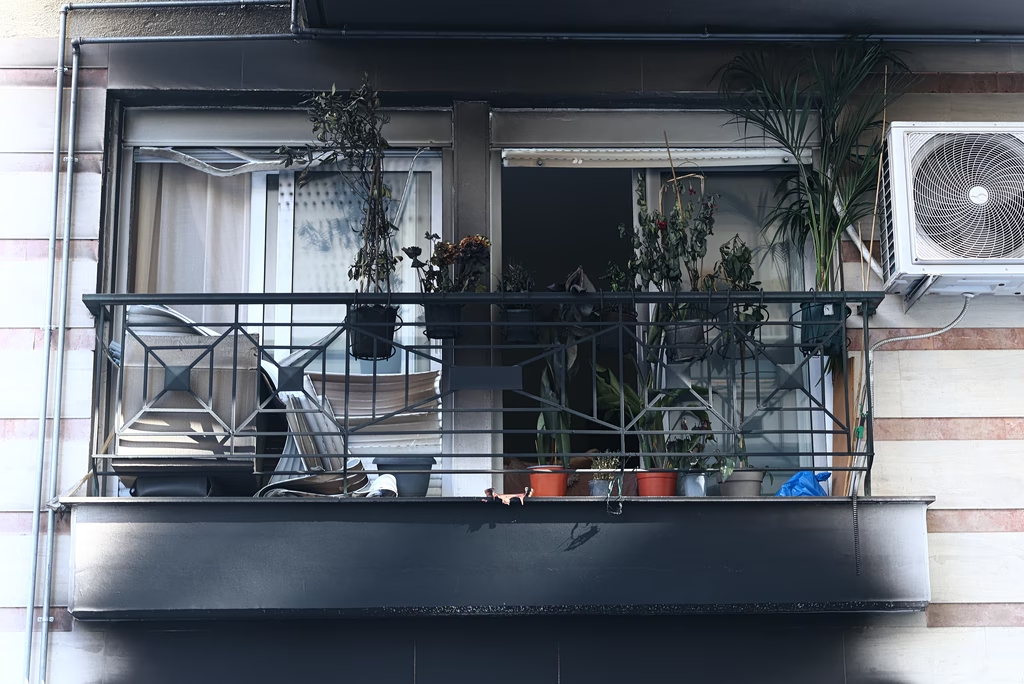
Two of the three arson attacks in the early hours of Wednesday caused minimal damage, since the devices, small gas canisters filled with flammable liquid, were placed at building entrances where there was nothing nearby to ignite. But the attack in the Charilaou area spread quickly after it set fire to cars parked under the building, ultimately leading to the death of the 72-year-old victim, who suffered burns over much of her body.
Because of that outcome, it remains unclear whether the group behind the attack will claim responsibility or continue its campaign. Officials note that in at least ten arson attacks over recent years, including a 2021 attack on a lawmaker’s office in Thessaloniki and a 2022 attack on an Athens radio station, there had been risks to human life from spreading fire or fumes, aside from the deadly 2010 Marfin firebombing. This time, officials said, that risk turned fatal.
A test run
Speaking to Ta Nea after the tragedy that has shaken public opinion, senior police officials described the attacks as relatively limited in scope, possibly a test run, using simple incendiary devices but with painful consequences. They said the operation required real planning to locate the homes of the three ND officials and carry out the coordinated strikes, with a surveillance and escape plan that may have involved additional people. Officials also noted that the attack wasn’t aimed at well-known politicians or others whose homes might normally be guarded.
The groups behind the wave of attacks
According to law enforcement officials, there’s a strong anarchist presence and frequent clashes with police around Aristotle University, the Rotonda and Kamara areas downtown, tied to marches, solidarity actions for detainees, or police operations. Officials also reminded Ta Nea that over the past 15 years, Thessaloniki has hosted local branches of Athens-based armed groups, including Cells of Fire (which once sent parcel bombs from Thessaloniki), a branch of Revolutionary Struggle, and anarchist associates of fugitive Vassilis Palaiokostas. During the 2010s, police also made arrests or built case files over arson attacks targeting banks, party offices, public services and other targets in the city. In recent years, an anti-authoritarian figure accused of mailing a bomb to Thessaloniki’s courts and of bombing credit institutions was also active in the city; he is now in custody in northern Greece.
28 attacks
Officials also noted that in September 2022, police arrested a 35-year-old man and his partner in Thessaloniki, accused of carrying out 28 arson attacks apparently linked to a group calling itself Anarchist Action.
Separately, on April 22 this year, a Tesla was set on fire in the Sykies area, an attack claimed by individual anarchists later identified by police. In their claim of responsibility, they described the act as driven by a desire to strike at the technology they feel forced to live surrounded by.
Anti-authoritarian groups have also carried out actions, without causing damage, at the home of ND lawmaker Stratos Simopoulos in the Analipsi area on June 4, and a day later at the home of Deputy Education Minister Nikos Papaioannou in Pefka. Their claim of responsibility said they wouldn’t allow further mistreatment of hunger strikers or the danger to their lives, and expressed support for the Refugee Housing Community on Alexandras Avenue.