 Μake us preferred on Google
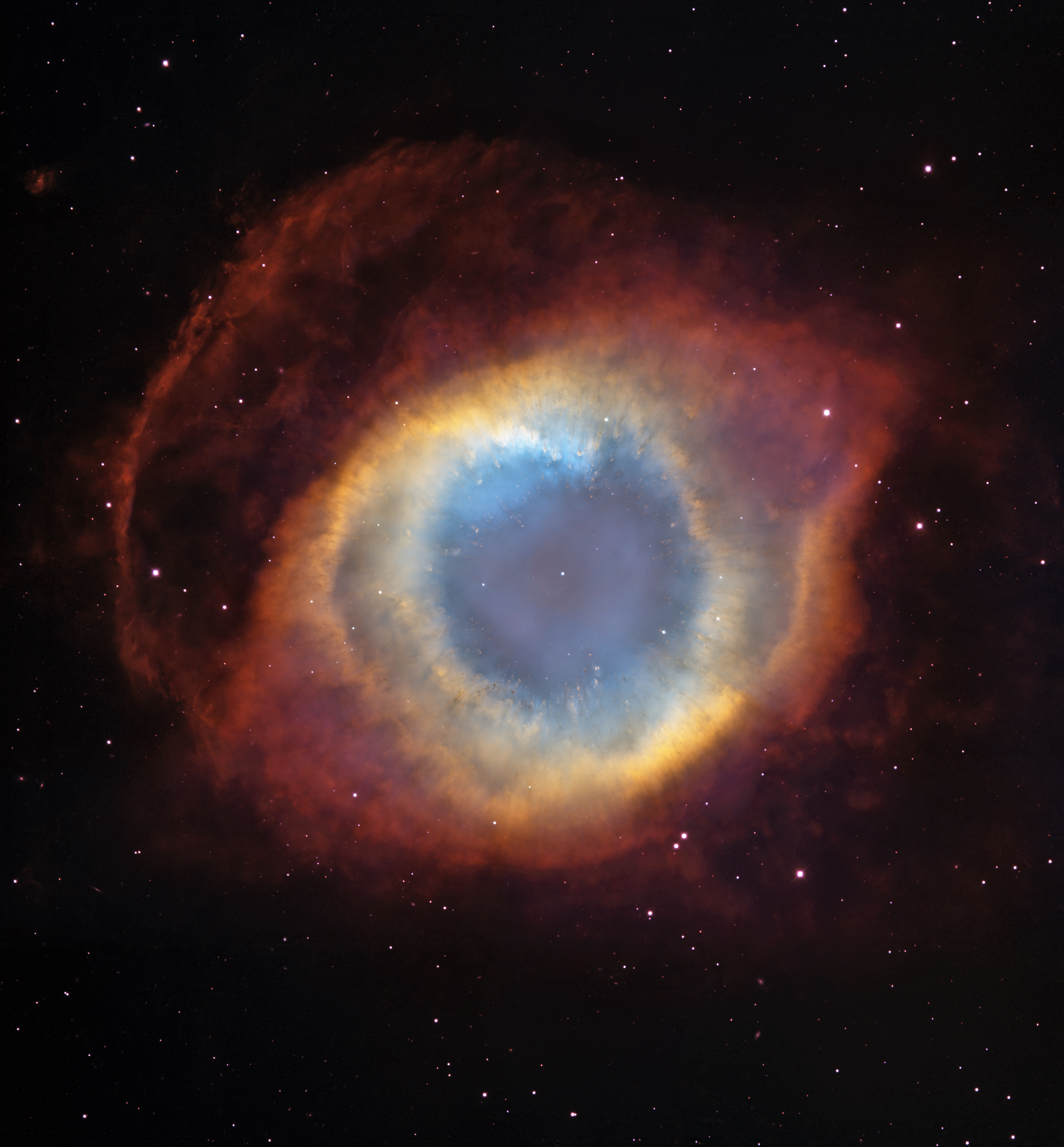
 Stars can live for millions or even billions of years, but they don’t live forever. When a star roughly the size of our Sun reaches the end of its life, it transforms into a striking planetary nebula. A classic example, as covered in an article on space.com, is the Helix Nebula, located 650 light-years away in the constellation Aquarius
Astronomers recently had the chance to watch the dead central star of this nebula being “recycled” back into the interstellar gas it originally formed from, closing the loop on its life cycle.
The Death Cycle of a Star
The death of a star like this begins when it runs out of the hydrogen needed for nuclear fusion in its core. This causes the core to contract and the outer layers to heat up, kicking off fusion there instead. The star swells into a “red giant.” Eventually, those outer layers detach and expand into space, forming the planetary nebula, while the inactive core shrinks down into a “white dwarf.”
As the nebula expands, it gradually disperses into the interstellar medium (ISM), feeding gas clouds with the elements forged inside the star. The next generation of stars will be born from those very clouds. Until now, though, astronomers had never actually witnessed the moment when the remains of a dead star get absorbed by the interstellar medium.
“We are seeing material shed near the end of a star’s life being broken apart and returned to the galaxy,” said Pieter van Dokkum of Yale University, who led the study. “That hand-off — from recognizable stellar debris to the diffuse gas between the stars — has been very difficult to observe.”
A Striking, Accidental Discovery
Van Dokkum’s team wasn’t even looking for this. The discovery happened during routine calibration of a new astronomical instrument called MOTHRA (Modular Optical Telephoto Hyperspectral Robotic Array) at the El Sauce Observatory in Chile. Once complete, MOTHRA will be equipped with 1,140 telephoto lenses scanning the night sky for traces of faint gas throughout our galaxy.
While testing the equipment, the team pointed it at the Helix Nebula, one of the sky’s best-known and most-photographed nebulae, to calibrate the lenses. That’s when they found something completely unexpected.
“We thought we were taking a calibration image of one of the best-known nebulas in the sky,” said Roberto Abraham of the University of Toronto. “Instead, we found this extraordinary network of bow-shaped structures. It was immediately clear that the faint outer Helix was telling us a story that had largely been missed.”
Arc-Shaped Waves and the Sun’s Future
The team discovered 22 complete or partial arc-shaped gas clusters in the nebula’s outer halo. These structures form when gas ejected from the planetary nebula collides with the interstellar medium, acting much like the waves that form in front of a boat’s bow moving through water.
Based on the team’s calculations, material from the planetary nebula can survive for roughly 10,000 years after contact with the interstellar medium before it finally dissolves completely and is absorbed.
The observation, published August 12 in the journal Nature, is more than just a striking astronomical phenomenon. It serves as a kind of “crystal ball” for the future of our own solar system.
Our solar system, including Earth, formed 4.6 billion years ago from elements produced by dead stars. In another five billion years, the Sun will also run out of hydrogen, turn into a planetary nebula, and follow the exact same path, handing its material back to the galaxy to help write the story of a new stellar system.