
 Μake us preferred on Google
 Media reports have begun raising the prospect of a “super El Niño” later in 2026. The scientific picture is more cautious however, projecting that a return of El Niño now looks likely, but its eventual strength remains uncertain.
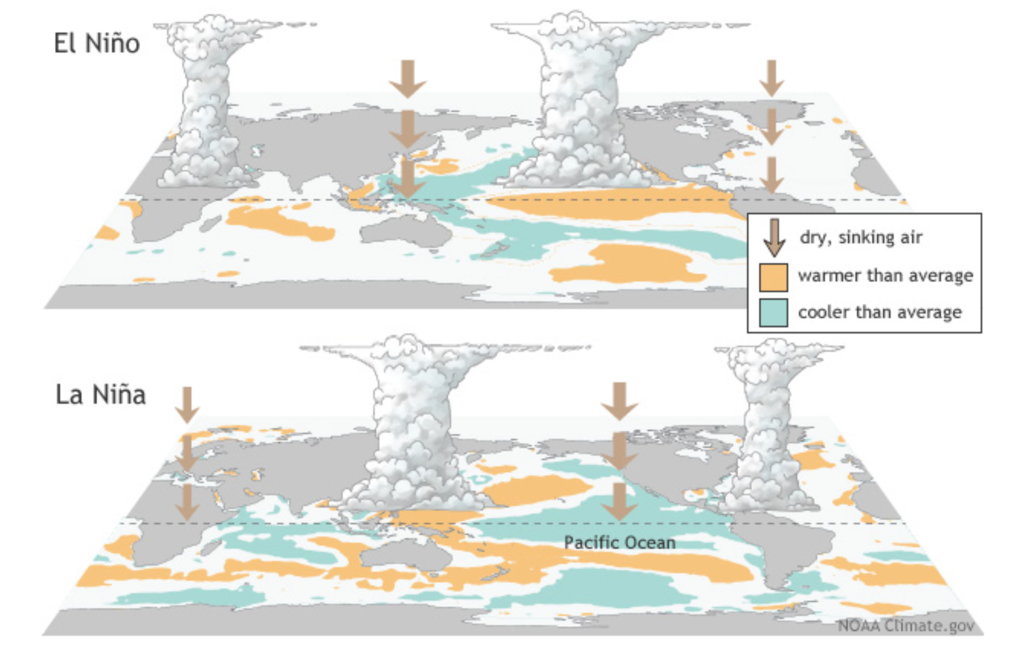
El Niño is the warm phase of the El Niño–Southern Oscillation, or ENSO, a natural climate pattern driven by changes in sea-surface temperatures, winds and atmospheric pressure across the tropical Pacific. The National Oceanic and Atmospheric Administration (NOAA) defines El Niño using sustained warming in the Niño 3.4 region of the equatorial Pacific, alongside evidence that the ocean and atmosphere are reinforcing each other.
The backdrop is a recent La Niña, ENSO’s cool phase. Forecasting agencies say the Pacific has now shifted toward neutral conditions, with El Niño increasingly possible later in 2026, but its strength remains uncertain.
As of NOAA’s latest ENSO Diagnostic Discussion, conditions were still ENSO-neutral. The Niño-3.4 index was near average, at -0.2°C, but subsurface Pacific temperatures had risen for five consecutive months. NOAA says El Niño is likely to emerge in May–July 2026, with a 61% chance, and persist through at least the end of the year.
The “super” label is where caution is needed. NOAA gives a roughly one-in-four chance of a very strong event, defined in its outlook as Niño-3.4 reaching at least +2.0°C. But it also stresses that this depends on continued westerly wind anomalies across the equatorial Pacific during the Northern Hemisphere summer- something “not assured.”
Credit: NOAA
The World Meteorological Organization also expects El Niño to develop from mid-2026 and says models are strongly aligned on its onset and possible intensification. But WMO explicitly notes that it does not use the term “super El Niño,” because it is not part of standardized operational classifications. It also warns that forecasts at this time of year face the “spring predictability barrier,” meaning confidence improves after April.
Australia’s Bureau of Meteorology makes a similar point: Pacific sea-surface temperatures are warming, but a sustained El Niño requires atmospheric coupling through trade winds, pressure and cloud patterns. It says it is too early to assign high confidence to winter and spring forecasts.
If El Niño develops, it could affect rainfall and temperature worldwide. WMO says El Niño typically has a warming effect on global climate and is often associated with drought in Australia, Indonesia and parts of southern Asia, and increased rainfall in parts of southern South America, the southern United States, the Horn of Africa and central Asia.
The bottom line: an El Niño appears increasingly likely. A “super” El Niño is possible, but not yet scientifically established.