 Μake us preferred on Google
 It was the 1950s in Komi Kebir, a small village in Cyprus, when someone scratched a crude line on the wall of the Turkish Cypriot school. Beneath it was a single word: Taksim, the Turkish Cypriot demand for the island’s partition.
Nikias was only five years old. He did not understand the slogan, or the future it threatened. But he never forgot the incident, he said, because he never forgot the fear he saw on his mother’s face.
That memory is one of the starting points of his new book, American Trojan, though the story soon moves far from Cyprus.
Nikias would go on to become president of the University of Southern California, one of the largest private universities in the United States. He made his career inside American higher education, first as an engineer and scholar, then as an administrator, fundraiser and university president.
Cyprus never quite disappears from the conversation. Nor does the suspicion, learned early, that institutions can look sturdier from the outside than they feel to the people living inside them.
In the book, Nikias borrows one of the best known lines from Ernest Hemingway’s The Sun Also Rises: “How did you go bankrupt? Two ways. Gradually, then suddenly.”
Nikias uses the line to describe what he believes has happened to American universities. “What we have been watching over the last three or four years in American universities,” he said, “is that sudden stage.”
It is a hard judgment from someone who spent much of his adult life inside the system he is now criticizing. Nikias does not speak like a populist outsider railing against elite universities. He speaks like an insider who believes that the institution he served has become unsure of its own purpose.
“In recent years, we reached a point where freedom of speech applies only to things we agree with,” he said. “The so-called cancel culture that has taken hold in recent years has been destructive for American higher education.”
He says this plainly. The crisis he describes is not only ideological. It is also financial.
USC estimates that a full time undergraduate living on campus will face a cost of attendance of $103,162 for the 2026 to 2027 academic year. Harvard’s published estimate for the same year ranges from $95,134 to $100,134 before financial aid.
Both universities stress that many students receive substantial aid. Still, those prices have become part of the political case against elite higher education, a visible measure of how remote these institutions can seem from the middle class families they still claim to serve.
Nikias says he is proud of expanding financial aid at USC during his presidency. In his account, affordability was not a public relations problem, but part of the university’s obligation.
The larger question is harder: how long elite universities can present themselves as engines of democratic mobility while their advertised costs move deeper into six figure territory.
Under President Trump, the confrontation has become more direct. In February 2025, the National Institutes of Health announced that it would cap indirect cost payments on NIH grants at 15 percent, replacing the negotiated rates universities had long used to cover research infrastructure, administration and facilities. NIH said the change would direct more money to science. Universities and research groups warned that it could damage the financial structure of federally supported research.
The dispute did not remain confined to grant accounting. Harvard sued the Trump administration after the government froze more than $2.2 billion in research funding, following Harvard’s rejection of federal demands related to governance, hiring, admissions and viewpoint diversity. In September 2025, a federal judge ruled that the administration had acted unlawfully in cutting Harvard’s research funding.
Nikias does not fully accept the universities’ version of events. On the administration’s move to limit certain overhead payments tied to research grants, he expects disruption, but not collapse. On warnings of a “brain drain,” he is skeptical.
“I’ll believe it when I see it,” he said.
What concerns him more is the university’s internal condition. In his view, universities made themselves vulnerable to political intervention by becoming political actors.
“To require a university president to take a position on every political issue is a recipe for disaster,” he said. “If there is no self regulation, if there is no honest self assessment, then others will step in. In other words, you invite the government to come in and regulate you.”
That is why he sees Harvard’s clash with the federal government as more than a legal dispute. He calls it “a major mistake.”
Nikias has spent much of his life thinking about institutions from the inside, how they acquire authority, how they lose it and how their symbols can outlive their original meaning. Even the title of his book carries that kind of irony.
The title of his book carries its own irony. USC’s mascot is the Trojan. Nikias recalls an American congressman joking at a ceremony in Los Angeles, “At last, a Greek is leading Troy.”
Later, when Gen. David Petraeus read the manuscript, he gave the phrase its final shape. “He told me, Max, you have the wrong title. You are the American Trojan.”
Nikias is a Greek Cypriot who rose through an American university branded around Troy. He is also a defender of the classics in a university culture increasingly shaped by technology, career anxiety, identity and politics.
His attachment to classical studies is not decorative. Even as president of USC, he taught courses on Athenian democracy and the tragedies of Sophocles.
“Human nature does not change,” he said. “Leadership is, above all, the understanding of human nature.”
The field he is defending has plainly contracted. In 2021 to 2022, American colleges and universities awarded 723 bachelor’s degrees in classics and classical languages, literatures and linguistics, according to federal education data. A 2024 survey by the American Academy of Arts and Sciences found that classical studies departments remained active, but small. The decline sits inside a wider retreat from the humanities, whose share of bachelor’s degrees fell to 8.4 percent in 2024, the lowest point since comprehensive tracking became possible in 1987.
Nikias sees something more than enrollment pressure.
“They have been described as oppressive, which is absolutely unacceptable,” he said. “Anyone who says that has not read the classics.”
At USC, he said, the resistance was not abstract. When he tried to restore classical courses to the general education curriculum, he encountered opposition. Some faculty members proposed, instead, a required course on Hollywood unions in the 1930s.
“I understand that it may be an interesting elective,” he said. “But mandatory, in place of Aristotle’s Nicomachean Ethics? That raises questions about the priorities of the university.”
His argument is not simply that students should read old books. It is that the American republic itself cannot be fully understood without the intellectual world from which its founders drew.
“The founders of the American republic were deeply educated in the Greco Roman classics,” he said. “How can one understand the Constitution itself without knowledge of Athenian democracy?”
The question lands differently coming from a man whose childhood was shaped by another political experiment: Cyprus, a small island where power sharing, communal coexistence and foreign guarantees all eventually failed.
Asked whether he has raised the invasion and continuing partition of Cyprus with powerful figures in his orbit, Nikias sounds more interested in what can still be built than in rehearsing every grievance of the past.
He points to the “3+1” framework among Cyprus, Greece, Israel and the United States, calling it “a truly remarkable achievement” when viewed over several decades.
But when the conversation turns to Turkey, Greece and Cyprus, he is blunt.
“There is only one power that can restrain Turkey in the Aegean,” he said. “And that is the United States.”
That reliance on Washington has also given the Greek diaspora an unusual role. Greek American influence has often worked not only through formal lobbying, but through personal relationships, institutions and private channels of access.
In the early 2000s, under the auspices of the American Embassy and the United Nations, Nikias organized a bicommunal conference in the buffer zone in Cyprus, bringing together 50 professionals from each side. It was, he recalls, “the first time they had met after 1974.”
At a time when crossing the Green Line was not yet free, the initiative carried meaning beyond the conference itself. Afterward, the American ambassador arranged for Nikias to travel to the occupied north, where he met alone with Turkish Cypriot leader Rauf Denktaş.
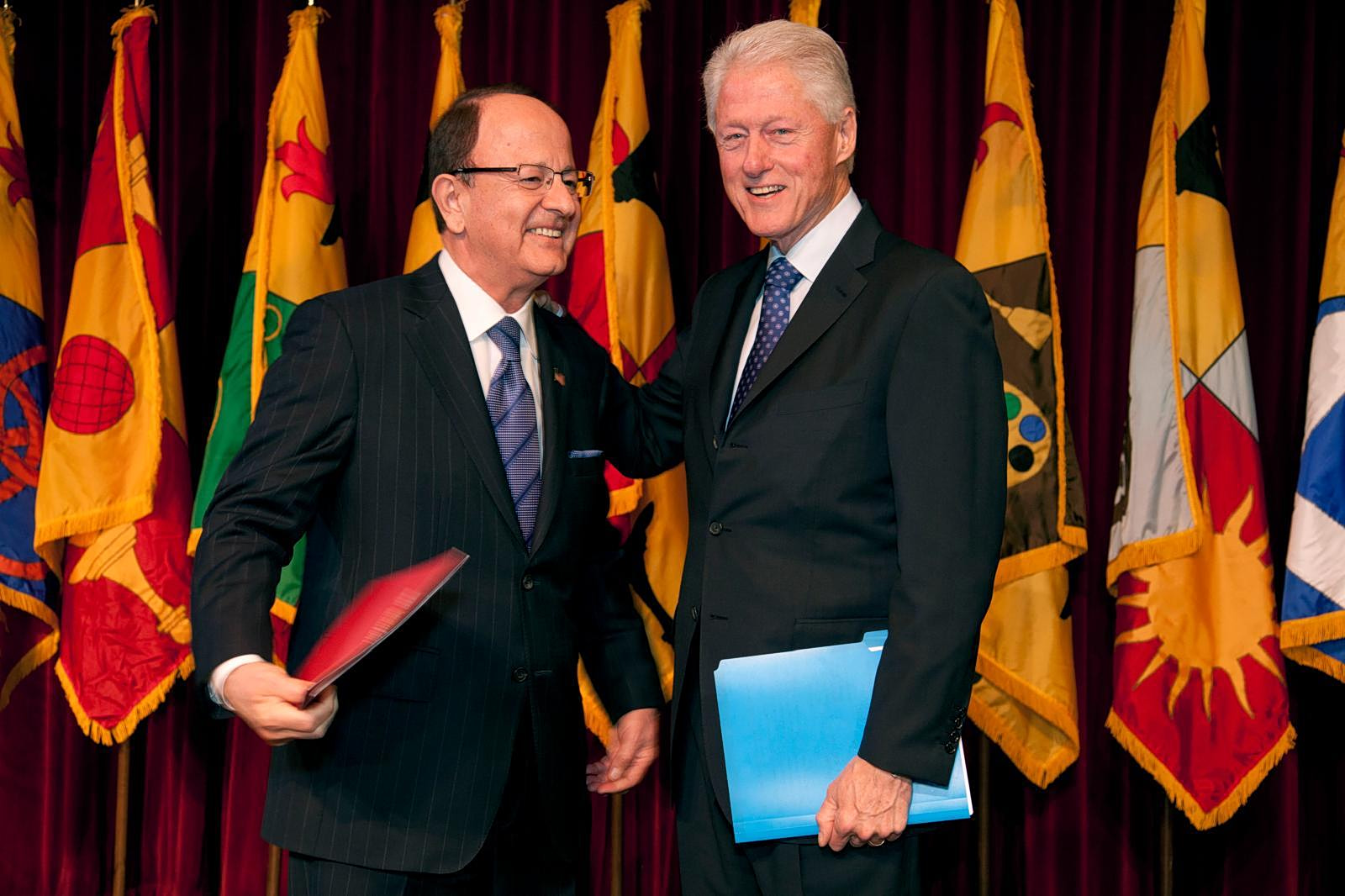
Greek American politics has long depended on such informal channels. Tasos Zambas of New Jersey brought his friend Bob Menendez into the Greek American community long before Menendez became one of the most powerful figures on the Senate Foreign Relations Committee. David Leopoulos of Arkansas played a similar role when his childhood friend Bill Clinton entered the White House.
Nikias is cautious when speaking about these episodes and avoids making himself the protagonist. But a separate account, based on conversations with Greek diplomatic sources in Washington, places him near one of the more delicate moments in recent Greek Turkish relations.
In the summer of 2020, when Greece and Turkey had deployed significant naval forces in the Aegean, Ambassador Alexandra Papadopoulou was trying to reach National Security Adviser Robert O’Brien. That was difficult. By protocol, he did not speak with ambassadors. So Papadopoulou turned to the diaspora.
The trail soon led to Nikias, who had a personal friendship with O’Brien. From Air Force One, the national security adviser called Papadopoulou and heard the Greek position, with President Trump standing beside him. Soon afterward, tensions eased. In a gesture of diplomatic courtesy, Trump himself called Prime Minister Kyriakos Mitsotakis to discuss the de-escalation.
The episode shows how Cyprus and the Aegean have followed Nikias into the highest levels of American political life. But for him, the issue was never only diplomatic. It was personal long before it became geopolitical.
His own connection to Cyprus is not confined to childhood. In 1974, he was stranded in Athens on the day a coup backed by Greece’s military junta attempted to overthrow Cyprus’s president, Archbishop Makarios. His wife, Niki, had arrived in Cyprus one day earlier, on the last flight to land in Nicosia before Turkey invaded. The coup and the invasion split the island in two, a division that remains unresolved half a century later.
When Nikias speaks about those days, his wife’s name keeps returning. He does not hide how central she has been to his life.
Neither he nor Niki has watched Famagusta, the Mega television series about the invasion and its aftermath. Friends have told them it is good.
“For most people, it is a story,” he said. “For us, it is our life.”
He said it with a faint smile, his resonant voice still marked by his Cypriot accent.