A new energy landscape in 2026 – the HERON–NRG deal, AKTOR’s entry, and major investments by PPC, MOH, DEPA, and HELLENiQ ENERGY
Green light for the 80 MW Olive Data Center in Spata. The growth of data centers, energy and water demands, and reactions from local communities
From offshore gas exploration to long-term U.S. LNG deals, 2026 marks a turning point as Greece begins to see results from major energy agreements signed over the past two years
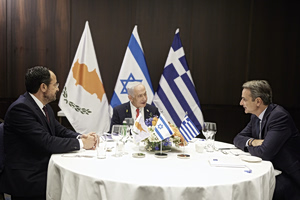
From Jerusalem, Greece, Cyprus and Israel present their trilateral partnership as a pillar of stability between East and West, with energy projects, U.S. involvement and a clear message to Ankara shaping the geopolitical stakes in the Eastern Mediterranean
Greek and US officials discussed energy cooperation, major investments and regional stability, underlining Greece’s growing strategic role in Europe’s energy landscape
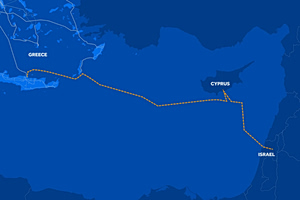
Greece, Cyprus and Israel—backed by the United States—revive their strategic “3+1” alliance, putting the Great Sea Interconnector, new gas routes and LNG corridors at the heart of a high-stakes agenda discussed by Mitsotakis, Christodoulides and Netanyahu.
Two high-level summits are expected in Washington with U.S., Greek, and European stakeholders, with Greece to be represented by AKTOR CEO, Alexandros Exarchou.
Minister Papastavrou's visit came at a moment when governments across the region are reassessing supply routes and strategic alignments in response to shifting Middle Eastern dynamics and Europe’s ongoing effort to break from Russian gas
Legislators expressed particular interest, officials said, in Greece’s recent energy agreements and in the next round of meetings under the 3+1 format with Cyprus, Israel and the United States, which is expected to reconvene in Washington in April
A meeting in Thessaloniki between US Ambassador Kimberly Guilfoyle and Deputy Minister Konstantinos Gkioulekas highlighted Northern Greece’s growing strategic role, recent energy agreements, and new opportunities for American investment
Papastavrou confirmed that American exporters have reached agreements with Greek companies — and added that “this LNG will make its way all the way to Ukraine.”
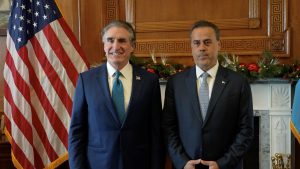
The Greek energy minister also talks with the President of the Export–Import Bank of the United States (EXIM), John Jovanovic on the Bank’s €100-billion financing program.
The meeting came shortly after the P-TEC energy conference in Athens, where the United States sent its largest delegation to date and where several agreements pointed to a more structured phase of cooperation between the two countries
Naturally, the question arises whether Greece is becoming excessively tied to the United States
November witnessed two major energy-related agreements finalized and signed in Athens, with the first foreseeing the import of American LNG to at least a couple of terminals in Greece for subsequent regasification and transport – by pipelines – to other countries in southeast and eastern Europe, including for the all-important Ukraine market
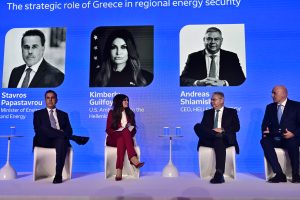
HELLENiQ Energy CEO Andreas Shiamishis says Greece is emerging as a key Southeast European hub for LNG, refined fuels and future green-power exports, as policymakers and U.S. officials highlight the country’s growing role in regional energy stability
Stretching 157 kilometers from Trikala in Imathia to an area north of Ptolemaida, the pipeline will form a critical new energy corridor.
“Our country is, in practice and on the ground, becoming an energy hub,” said the Minister of Environment and Energy, Stavros Papastavrou
Greece and Cyprus pause their flagship power-interconnection project to re-evaluate costs, hunt for investors, and navigate U.S. interest and Turkish pressure—revealing deep rifts between the two allies over strategy, risk, and the project’s viability.
During his visit to Athens, Ukrainian President Volodymyr Zelensky and Greek Prime Minister Kyriakos Mitsotakis announced a major energy cooperation deal, with both leaders highlighting security, reconstruction and Ukraine’s difficult winter ahead