
The agricultural crisis has become a European phenomenon, but in Greece it is reaching extreme levels. Farmers and livestock breeders spoke to Vima about skyrocketing production costs, blocked subsidies, and neglected infrastructure, while the pressure on the primary sector is turning into an open issue of survival.
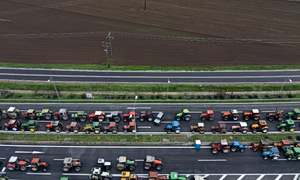
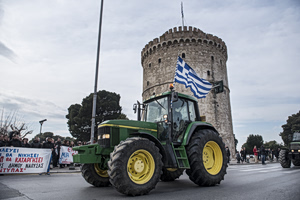
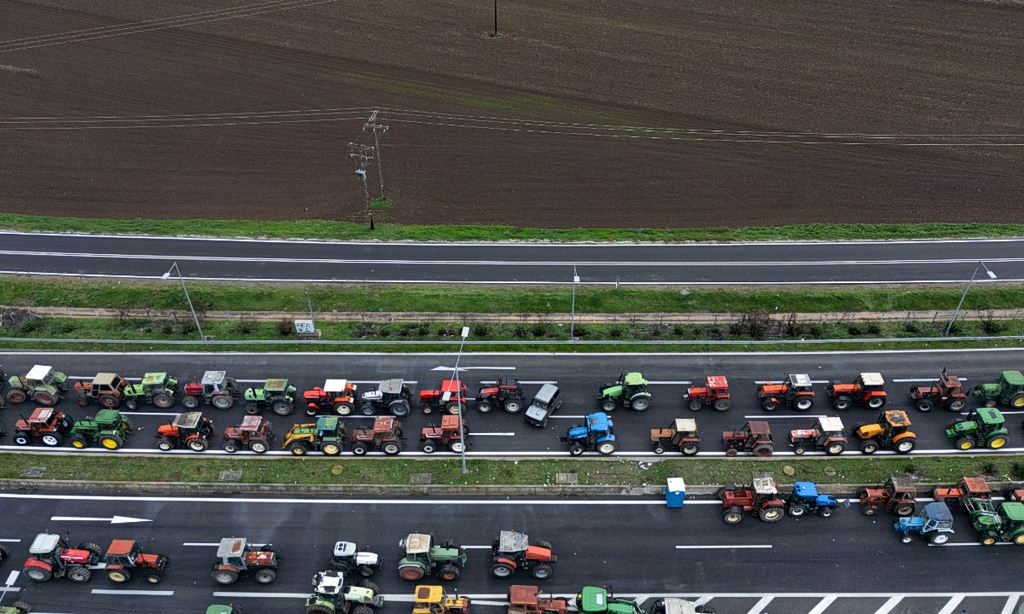
At the blockade in Nikaia, this winter is measured not in degrees Celsius but in the number of tractors. The scene has been familiar for decades – when pressure accumulates on the fields, Nikaia becomes the informal parliament of the Greek countryside.
“To see our main demands met”
Conversations among farmers between tractors are quiet and practical. They talk about water costs, fertilizers that changed price twice in a month, and animal feed that now consumes most of their income.
“We will not back down until our main demands are met,” says Vangelis Betsas, president of the Federation of Agricultural Associations of Arta, to Vima. What the farmers want, he explains, is a stable production cost price so they can know whether planting is worthwhile, and subsidies that cover what their fields need to survive. However, these remain on paper while the government avoids taking the necessary measures. As a result, production continues “in the dark,” with the risk falling entirely on the real farmers and livestock breeders.
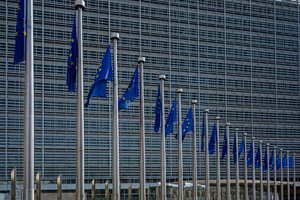
The same underlying tension has spread across the EU in recent years, as the primary sector openly questions governments’ ability to provide a stable operating framework. In the Netherlands, nitrate restrictions disrupted political balances and brought new formations into parliament. In France, tractors surrounded Paris for weeks, forcing the government to withdraw measures that had drastically raised production costs. In Germany, the abolition of the agricultural diesel subsidy triggered the largest farmer mobilization of the past decade. In Spain and Italy, pressure from imports and the dominance of large chains has severely limited producers’ survival margins.
Giorgos Beis is a young farmer in the Farsala area. He cultivates cotton, industrial tomatoes, oregano, and wheat, and says: “It’s not worth it anymore. We haven’t made a profit in the last three years. Whatever you plant, the result is the same. Subsidies aren’t enough to live on.”
Eurostat shows a common European trend. In six years, production costs have increased by about 30%, while agricultural income has remained stagnant. The green transition is advancing without financial counterbalances, while the market is flooded with products from countries with much lower costs.
In Greece, the numbers are even harsher. Energy costs have risen by around 30%, seeds by 20%, fertilizers by 35%. For crops like wheat and cotton, production costs are up to 50% higher than in 2021, while producer prices continue to fall month by month.
When the numbers no longer add up, tensions inevitably spill outside the fields. In Crete, in recent days, the deadlock turned violent, with farmers and livestock breeders closing airports in Chania and Heraklion, vandalizing police vehicles, and authorities responding with tear gas.
Giorgos Sifakis, a farmer and livestock breeder from Crete, acknowledges that the climate on the island was tense but insists on the reason. “We have exhausted every means for dialogue. They tell us they are open to discussion, and at the same time threaten us with criminal charges. Instead of calming things down, they escalate them,” he concludes. The meeting of the Minister of Rural Development and Food, Kostas Tsiaras, with Cretan farmers and livestock breeders on Thursday, December 11, ended as it began, with words, promises, and the sense that the problem has only been postponed.
“We don’t agree with what happened in Crete. Protests should be peaceful, and we must be much more careful,” counters Christos Sideropoulos, a farmers’ union representative from Larissa, who recently suffered police violence at the Nikaia blockade. “We are not in favor of such incidents; we must act peacefully,” adds Apostolos Kostopoulos, member of the United Federation of Agricultural Associations of Karditsa.
As if all that weren’t enough, an outbreak of animal plague pushed the system one step closer to the limit. More than 450,000 animals were slaughtered, hundreds of farms were removed from production, and an economic gap opened that cannot be closed with promises.
The discussion inevitably returns to OPEKEPE (the Greek Payment and Control Agency for Guidance and Guarantee Community Aid). For years it operated with gaps everyone knew about, with patchwork measures that allowed producers to live with the uncertainty that payments would continue. Revelations about irregularities in declarations, rights, and eligible land, combined with the intervention of the European Public Prosecutor, made it clear that the problem was not technical. It was institutional. For many farmers, this was the straw that broke the camel’s back.
“We were outraged by the OPEKEPE scandal; it was the cherry on top,” says Mimis Tsakanikas from the Kastro blockade. He has received his subsidy but has not been paid for “Measure 23” as it is under investigation.
“There is no tomorrow. Even if we return to our fields, we cannot continue producing. Especially for livestock breeders, many families have had zero income for a year, and the government is not standing by them,” says Sokratis Aleiftiras, spokesperson for the Agricultural Associations of Larissa.
“This struggle is no longer about subsidies”
His words are not an outburst but a cold depiction of a reality now spreading across the country, where the demand is no longer for support but for survival itself. In this climate, Vasilis Mavroskas, spokesperson for the blockade at Prasina Fanaria, notes: “There is a lot of anger at the blockades, but this struggle is no longer about subsidies; in fact, subsidies are low on our list of demands.”
“Right now, there are many colleagues who have not been paid for the ‘Daniel’ storm,” notes Giannis Koukoutsis, spokesperson of the Platykampos Cooperative. As he clarifies, this is not the main issue. “The worst part is that with the recent ‘Byron’ storm, we saw flooding again in the area, showing that no infrastructure projects have been done. The things we have been requesting for years are not being done, and in the summer we ran out of water for irrigation,” he explains.
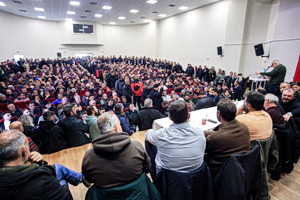
On Saturday, December 13, at the nationwide conference, farmers presented unified and clear demands: stable production costs, reliable pricing mechanisms, institutional operation of OPEKEPE, protection from unfair imports, and effective tools for the green transition. This is not merely a list of demands but a description of the conditions for the survival of an entire sector and a warning that the next crisis will not require blockades to become visible. It will have already reached the shelves, the market, the economy, and the very cohesion of the country.