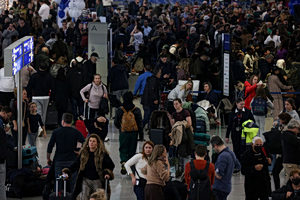

Greek authorities are continuing to investigate the recent blackout that affected the Athens Flight Information Region (FIR), an airspace zone responsible for managing aircraft traffic over much of Greece. Officials now say the incident was not caused by cyberattacks, foreign interference, or sabotage, but by a widespread technical malfunction within the telecommunications system used for air-to-ground voice communication.
The head of Greece’s National Cybersecurity Authority, Michalis Bletsas, explained that the failure stemmed from problems in the remote control of radio transmitters used by air traffic services. According to his assessment, many transmitters remained active simultaneously, with some emitting no sound and others producing continuous noise. As a result, critical radio frequencies were effectively blocked, creating what experts describe as a “denial of service” situation.
This technical overload explains why the backup system did not function as expected. When multiple transmitters continuously broadcast on the same frequency, that frequency becomes unusable. Authorities stressed that there is no parallel radio spectrum available to bypass such congestion, meaning the reserve system could not operate under those conditions.
Bletsas was categorical in dismissing claims of external interference. He stated that the disruption was caused entirely by the system’s own transmitters occupying the available spectrum, leaving no room for normal communication. Reports suggesting “blind flights” or risks to aircraft safety were also rejected. While the incident led to significant inconvenience for passengers, including flight cancellations and delays, officials confirmed that there was no danger to flight operations at any point.
The ongoing investigation is focused on understanding how the failure occurred in order to prevent similar incidents in the future. While all scenarios are still being examined, authorities indicated that the most likely cause may be human error related to technical handling of the system. The number of possible explanations has narrowed as more data is collected.
A special committee was convened to examine the incident, rather than relying on existing aviation accident bodies, in order to speed up the process and involve all relevant agencies. The complexity of the systems involved requires coordination across multiple authorities, including those responsible for cybersecurity, telecommunications, and aviation oversight.
Officials also emphasized that such failures are not unique to Greece. Comparable incidents have occurred internationally, sometimes leading to the temporary closure of even larger airspace regions. As systems become more complex, they also develop new points of failure.
“Every system will fail at some point,” Bletsas noted, adding that the real challenge is limiting the impact of such failures and ensuring resilience. The goal, he said, is not to eliminate breakdowns entirely—an impossible task—but to ensure they do not escalate into broader disruptions.