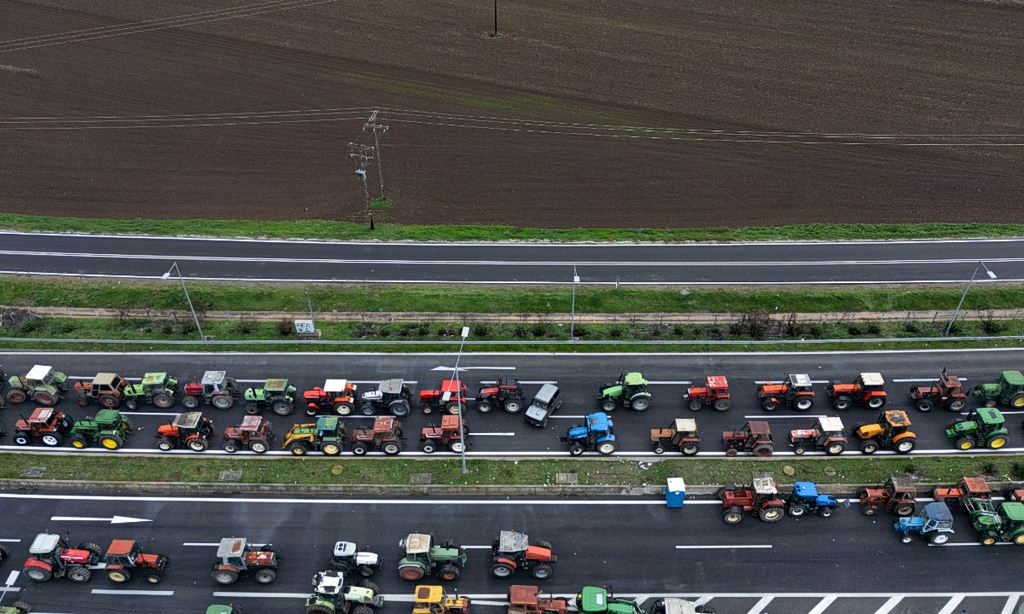
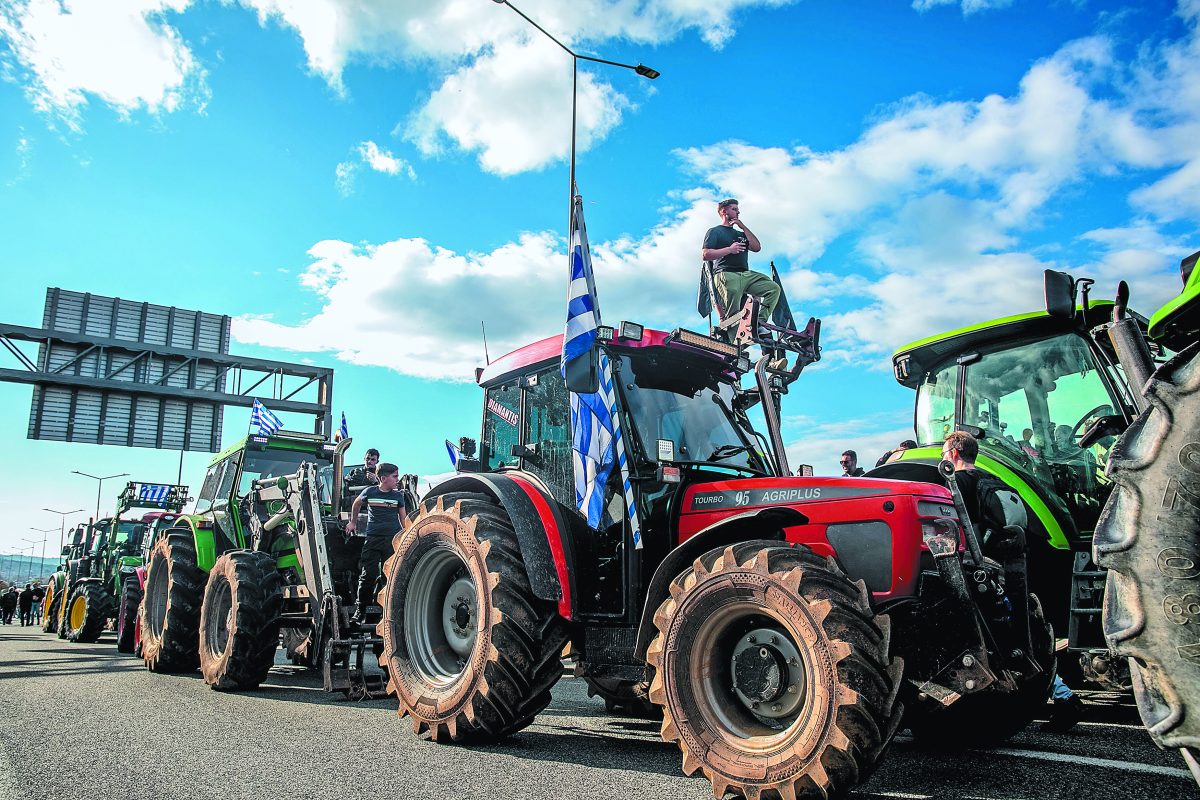
The discussion on agricultural development in the country resembles a modern-day “Tower of Babel.” The state, producers, and citizens do not speak the same language, lacking a shared “cognitive social capital,” a deficit that has led to deep and mutual distrust: farmers feel neglected and misunderstood; citizens, especially those in urban centers, fail to grasp the challenges of rural life; and the state, through its policies, is unable to bridge the gap. The result is a persistent crisis in the agricultural economy, marked by serious structural problems that continually resurface.
According to a recent report by the Centre of Planning and Economic Research (KEPE), 40% of the total cost of agri-food imports αφορά meat, dairy products, animal feed, and oilseeds.
Significant dependence on imports
This figure highlights a major dependency: approximately €4.5 billion is spent annually on importing products that could be produced domestically by utilizing Greece’s largely abandoned countryside—a sum that exceeds by €700 million the €3.8 billion in total EU and national subsidies expected to be paid this year to the primary sector. Are there, then, viable alternatives with a sustainable economic, social, and environmental footprint?
According to Vasilis Kostakis, Professor of Technological Governance and Sustainability at Tallinn University of Technology in Estonia and visiting researcher at Harvard Law School’s Berkman Klein Center, the fundamental problem behind the crisis in the primary sector is the lack of energy and technological independence among producers. This is reflected in the negative trade balance of agricultural products and food over the past five years (2020–24), which reached 36.7% in 2025 in the country’s primary sector.
“If you scratch the surface of food,” he says, “energy appears underneath. And if you dig deeper, technology emerges.”
Cooperative schemes for affordable energy
Farmers who demand cheaper energy for irrigation, cooling, and processing are essentially seeking a regulatory framework that would allow them to reduce a structural cost that is crippling them. The 2018 law on energy self-production communities, though imperfect, created opportunities for cooperative initiatives such as “Koinergia” in Ioannina and “Minoa Energy” in Crete, founded in 2021 and 2023 respectively.
In the case of Koinergia, each of the 181 participating households contributes a share of approximately €4,000–4,500 to a photovoltaic park, securing—aside from fees—zero-cost green electricity for 25 years. Minoa Energy’s first project was a 405 kWp photovoltaic installation with virtual net metering, built on land granted by the Municipality of Minoa Pediada and designed to provide energy self-sufficiency to around 100 households and businesses for 25 years.
Since July 10, 2023, the community’s second project has been in operation: a 1 MW installation built on barren land granted by the same municipality southeast of Arkalochori. At full capacity, it produces over 1,670 MWh annually, covering the needs of more than 250 households and businesses.
A shared belief in cooperation
The second level concerns technology—both tangible and intangible—as a right of access to the means of production within a post-capitalist framework. Vasilis Niaros of the Ioannina-based non-profit organization P2P Lab describes to To Vima the concrete challenges faced by small-scale farmers and livestock breeders in Epirus, who “either cannot afford the machinery produced by large industry, or that machinery is unsuitable for the mountainous terrain they work in or for the cultivation techniques they apply.”
Drawing lessons from successful French makerspaces such as l’Atelier Paysan, the “Tzoumakers” have, for over a decade, brought together farmers, researchers, craftspeople, and social innovation activists with the aim of designing and building tools tailored to farmers’ specific needs—tools they would not be able to find on the industrial market anyway.
Here, “cognitive social capital” translates into a shared language between those who know their land and those who know how to design. According to Mr. Niaros, what unites people from different backgrounds is neither the agricultural product itself nor technology as a panacea, but a shared belief in the values of cooperation, openness, transparency, and inclusion.
A new contract of trust
On the southern side of the Pindus mountain range, based in Eastern Zagori, the social cooperative enterprise “Psila Vouna” (“High Mountains”) has been active for nine years, supporting those who live and produce in mountainous areas, as well as cultural associations, communities, mountain municipalities, and individuals considering a new life in the countryside.
Inspired by the internationally widespread model of community-supported agriculture, Psila Vouna develops sustainable and socially fair mechanisms for rebuilding the relationship between producer and consumer. Speaking to To Vima, Sotiris Tsoukarelis notes that small-scale mountain production was the first to “collapse,” while emphasizing that a country that is 80% mountainous can neither be compared to nor replicate agricultural models such as that of the Netherlands.
Psila Vouna proposes a new contract of trust between producer and consumer—known in France as AMAP—emphasizing risk-sharing through a non-profit, non-competitive accounting model without intermediaries, which ensures weekly deliveries of fruit and vegetable baskets.
A graduate of political science from the University of Crete with a master’s degree in environment and mountain development from the National Technical University of Athens, Mr. Tsoukarelis chose to combine theory with practice. “I completed the Dairy School of Ioannina and later attended seminars in agritourism at the American Farm School. But the years I worked in agriculture—manual labor, I mean—felt like earning two or three more university degrees,” he says.
The crisis is not only about subsidies
Although the above initiatives for a new, place-based model of agricultural production do not fit neatly into the framework of the Common Agricultural Policy (CAP), they nonetheless serve as proof of concept for its adaptation and modernization in an extremely unstable climatic and geopolitical environment.
In any case, they make clear that the agricultural crisis is not merely a matter of subsidies or “bad” prices, but one of self-sufficiency and sovereignty over energy and technological infrastructure. And if the obstacles are political and value-based, then the solutions may require something humble yet fundamental: a shared vocabulary.