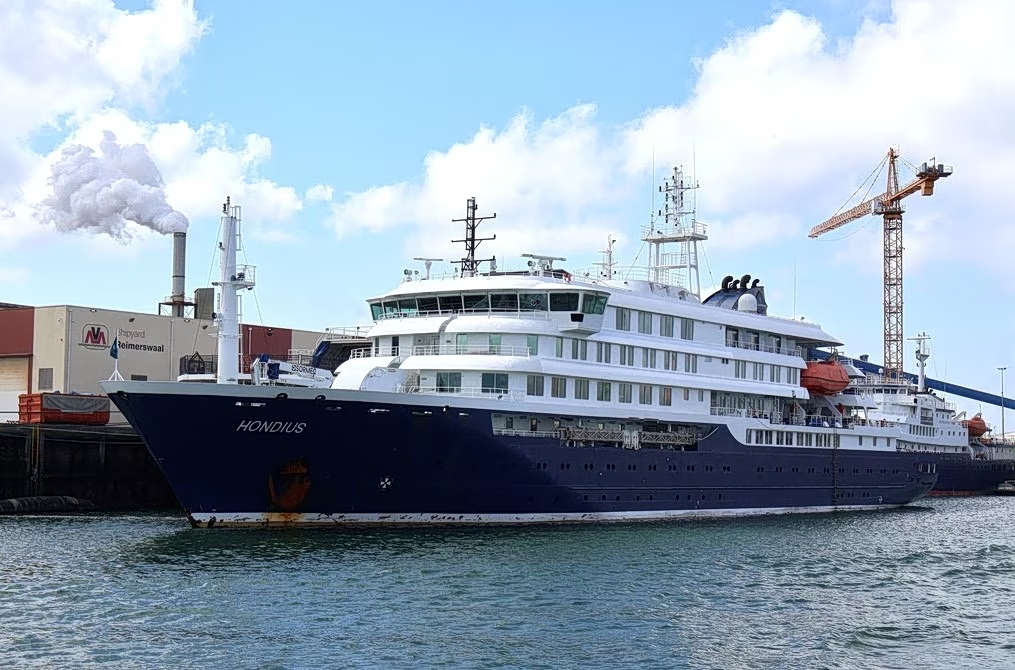
A Greek citizen who was aboard the MV Hondius, the luxury cruise ship at the center of a deadly hantavirus outbreak that has claimed three lives, is set to be repatriated to Greece on Sunday, May 10, according to an announcement by EODY, Greece’s National Public Health Organization.
The 70-year-old passenger will be transported via a Dutch aircraft to Eindhoven Airport in the Netherlands, and from there flown to the Elefsis military airbase near Athens aboard a dedicated Greek Air Force flight. Upon landing, he will be picked up by an EKAB ambulance and transferred to a specially equipped negative-pressure isolation room at Attikon University General Hospital, where he will be placed under mandatory quarantine for 45 days.
EODY confirmed that the Greek citizen is in good health and currently showing no symptoms. As a precautionary measure, the repatriation flight will be accompanied by an EKAB physician, a paramedic-nurse, and the president of EODY’s Scientific Council, Dr. Theodoros Vasilakopolous.
Spain begins evacuating passengers
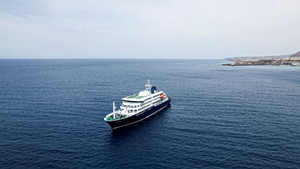
Meanwhile, according to the BBC, Spain has begun evacuating passengers from the ship, which is anchored off Tenerife in the Canary Islands. Spanish Health Minister Mónica García stated that the operation is proceeding normally and that all passengers on board the MV Hondius remain asymptomatic.
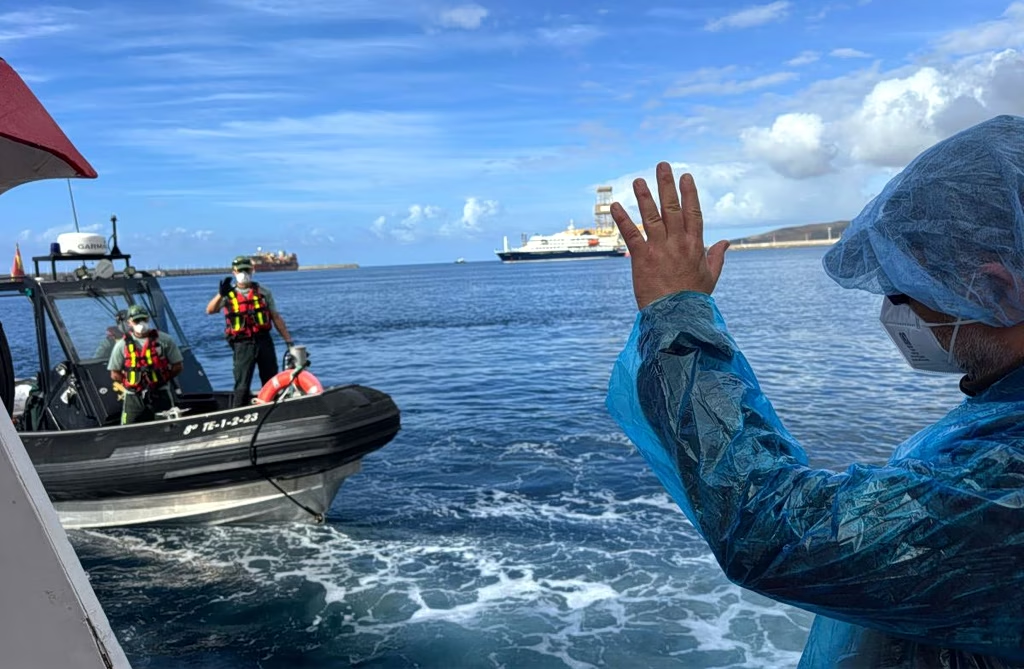
The disembarkation process is being described as a surgical operation, with passengers being transported to shore in small boats in groups of five to prevent crowding, then boarded directly onto buses bound for the airport. Images from the scene showed passengers in white medical masks moving around the ship’s deck or looking out from windows as the first evacuation boats departed. Several passengers were seen sitting at safe distances in the small evacuation vessel, filming and photographing their approach to shore, where they were received by officials in white protective suits.
“All those on board are considered high-risk contacts”
The ship departed for Spain on Wednesday from the coast of Cape Verde, after the World Health Organization and the European Union requested that Spain manage the removal of passengers following the detection of a hantavirus cluster on board. The WHO has classified all passengers aboard the luxury vessel as presumed high-risk contacts as a precautionary measure, while stressing that the risk to the broader public remains low.
Despite the fatal outcome for three passengers, a Dutch couple and a German national — the health assessment of the ship itself has been somewhat reassuring. Spanish experts who boarded the vessel found no trace of rodents, which are the primary carrier of hantavirus. This finding strengthens the working theory that transmission occurred either between people or before passengers boarded the ship, rather than through exposure to infected animals on board.
A report published by the Spanish Ministry of Health before the MV Hondius docked in Tenerife confirmed that the vessel had passed all required health checks before anchoring. According to experts who boarded the ship, hygiene and environmental conditions were deemed appropriate, further supporting the conclusion that on-board rodent exposure is unlikely to be the source.
Countries including Belgium, France, Germany, Ireland, the United States, the United Kingdom, and the Netherlands confirmed they had dispatched aircraft to evacuate their nationals, though local Canary Islands officials noted that not all planes had yet arrived. Passengers will not leave the ship before their designated aircraft is in place, Spanish officials stated.
The last flight of the operation is expected to depart from Australia, described as the most complex leg of the evacuation, scheduled to arrive the following afternoon. It will collect six people from Australia, New Zealand, and other Asia-Pacific countries. Thirty crew members will remain on board and sail the ship to the Netherlands, where the MV Hondius will undergo full decontamination.