As water shortages spread across Greece, the government is proposing emergency measures to accelerate critical infrastructure projects, with the number of areas placed under drought-related emergency status rising to 10.
The latest addition is the island of Poros, joining Tinos, Alonissos, Astypalaia, Meganisi, Karpathos, Patmos, Leros, Symi, and the Municipality of Central Corfu and Diapontia Islands, all of which have been declared in a state of emergency due to water scarcity.
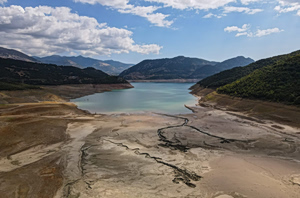
The expanding list reflects what authorities increasingly describe as a long-term water crisis, driven by years of reduced rainfall, shrinking water reserves and surging demand during the summer tourist season.
Fast-track procedures for water projects
The growing number of emergency declarations coincides with a draft law by Greece’s Ministry of Environment and Energy aimed at speeding up projects designed to address water shortages.
Currently under public consultation, the proposed legislation would introduce expedited procedures for water supply infrastructure, desalination plants and other projects once an area has been officially declared under emergency status.
The goal is to reduce delays in delivering critical works by allowing faster procurement and approval processes when communities face severe water shortages.
Under the proposal, urgent public works could be awarded through invitations to at least three contractors with proven experience in similar infrastructure. Companies would have just 10 working days to submit financial offers, with contracts awarded to the lowest bidder.
The ministry would also gain the authority to plan and implement projects that would normally fall under other public bodies, provided the area has been declared under emergency status and the government has approved the intervention. The measure is intended to reduce delays caused by overlapping responsibilities among different authorities.
Desalination approvals to be streamlined
The draft legislation also seeks to simplify approvals for desalination plants, which have become an increasingly important tool for supplying water to Greece’s islands.
It introduces fixed deadlines for environmental reviews, including assessments related to concentrated seawater discharge produced during desalination. If authorities fail to respond within the specified timeframe, responsibility would automatically pass to the relevant regional environmental licensing council to avoid lengthy delays.
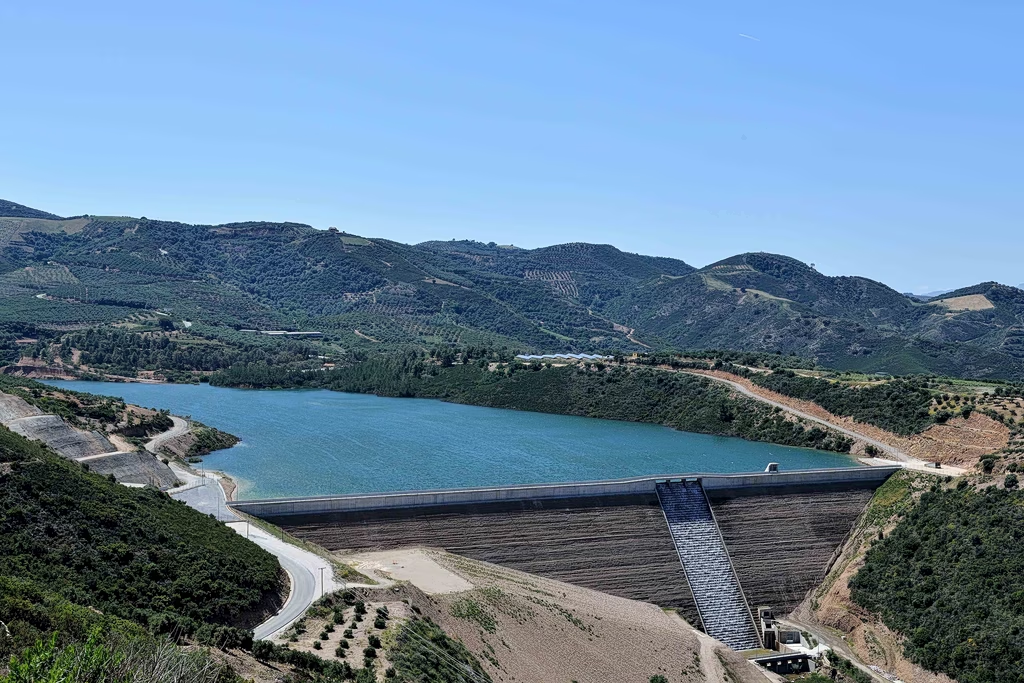
The legislation also includes provisions to strengthen water security for the wider Athens region by enabling the transfer of water from tributaries of the Acheloos River to the capital’s water supply system through the Eurytos project, a government-backed initiative with a budget of approximately €535 million.
Tourism intensifies pressure on water supplies
The seasonal surge in tourism has placed extraordinary pressure on water resources across many Greek islands.
On Mykonos, home to around 10,700 permanent residents, daily water consumption rises from between 1,600 and 2,000 cubic meters during winter to between 10,000 and 18,000 cubic meters in summer—an increase of up to nine times.
Other popular destinations also experience sharp seasonal spikes, with water consumption increasing by more than 500% on Santorini, 344% on Paros and Karpathos, and 238% on Naxos.
According to Dimitris Emmanouloudis, a professor specializing in water resource management, luxury hotels place particularly heavy demands on already stressed island water systems. While a visitor staying in standard accommodation uses around 450 liters of water per day, consumption can reach 1,000 liters per guest per day in high-end hotels.
Market officials also note that, despite the availability of funding, lengthy licensing and procurement procedures have often prevented projects from being completed quickly enough to respond to worsening water shortages.