The Perseid meteor shower returns to Greek skies this month, and stargazers are in for particularly favorable viewing conditions.
The annual event peaks on the night of August 12 into August 13, with the moon largely out of the picture this year. A new moon falls on August 12 at 8:36 p.m. Greek time, meaning the hours when the Perseids are most active will also be the darkest, free of interfering moonlight.
That does not mean anyone stepping onto a balcony will see 100 meteors an hour. That figure refers to the Zenithal Hourly Rate, a theoretical maximum based on ideal conditions and an unobstructed view of the entire sky. For 2026, the International Meteor Organization estimates that an observer in a dark, rural location can expect roughly 30 to 50 Perseids per hour at the shower’s peak.
Where the Perseids come from
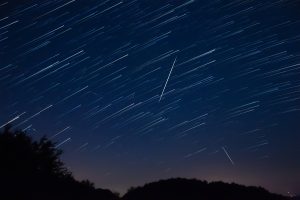
The Perseids are not falling stars but tiny fragments of dust and debris left behind by comet 109P/Swift-Tuttle during its passages through the inner solar system. Earth crosses this debris trail every year around this time. When the particles hit the atmosphere at roughly 59 to 60 kilometers per second, they heat up and ionize the surrounding gases, producing the brief streaks of light known as shooting stars.
Swift-Tuttle takes 133 years to complete one orbit of the sun. It last passed through the inner solar system in 1992 and is not due back until 2125. Its nucleus is estimated at about 26 kilometers across.
The shower takes its name from the constellation Perseus, home to the radiant point from which the meteors appear to originate. Meteors can appear anywhere in the sky, however, not just near Perseus.
When and where to watch in Greece
For Greece, the two best nights are August 12 into 13, with August 13 into 14 as a backup. Activity builds late in the evening but peaks after midnight and especially in the hours before dawn, when Perseus climbs higher in the northern sky and Earth’s position points more directly into the stream of cometary debris.
A practical window for Greek observers is to find a dark spot and stay out from 12:30 a.m. to 4:30 a.m., with the second half of the night offering the best show. There is no need to wait for Perseus to rise before starting to watch. Meteors can cross any part of the sky, so the wider the field of view, the better.
Location matters less than distance from artificial light. From central Athens or Thessaloniki, only the brightest Perseids will be visible, since light pollution washes out fainter meteors. Better options include mountainous parts of mainland Greece, remote areas of the Peloponnese, Epirus and Macedonia, and islands away from lit towns.
Ideally, the viewing spot should be far from roads, hotels and settlements. An open space with a clear horizon works better than a forest or a spot hemmed in by tall buildings. The sea can also provide a dark horizon, as long as the view avoids lights from coastal towns, harbors or ships.
No telescope or binoculars are needed. The naked eye is the best tool for watching the Perseids, since optical equipment narrows the field of view. Once at the viewing spot, allow 20 to 30 minutes for eyes to adjust to the dark. Phone screens can undo that adjustment, so it is best to avoid checking one during the shower. Anyone using a phone for a star map should keep the brightness low and switch to a red light setting if the phone has one.
A mat, lounge chair or blanket on the ground is more practical than standing, since lying down makes it easier to take in a large stretch of sky comfortably.
To find Perseus itself, look north; the constellation climbs higher as the night goes on. It sits near Cassiopeia, recognizable by its distinctive W shape, which can help with orientation. Even so, there is no need to stare only at Perseus, since the most striking meteor trails often appear well away from the radiant point. A good rule of thumb is to look roughly halfway between the horizon and the point directly overhead, covering as much sky as possible.
Perseids are known for their speed and brightness. Some leave a brief glowing trail, and occasionally a much brighter meteor, known as a fireball, streaks across the sky. Fireballs come from larger particles and produce a stronger flash. The rate is not constant. Minutes can pass with nothing visible, then two or three meteors can appear in quick succession. Patience is part of the experience.
A calendar coincidence with a solar eclipse
The new moon on August 12 coincides with a total solar eclipse visible in Iceland, Spain and Greenland. Greece will see only a partial eclipse, distinct from the total eclipse visible elsewhere, and the link between the two events is mostly a matter of timing, since the new moon is what clears the sky for Perseid viewing in the first place.
Anyone hoping to view the eclipse should follow standard safety precautions: never look directly at the sun with the naked eye or ordinary sunglasses, and use only certified solar viewing filters.
NASA livestream
The Perseids remain active from July 17 through August 24, with the peak falling on August 12 and 13. In 2026, three factors line up in observers’ favor: the summer season, the shower’s peak activity and a new moon. For Greece, the best plan is to head away from artificial light on the night of August 12 into 13 and stay out until the early morning hours.
NASA will livestream the shower on its YouTube channel, with coverage beginning at midnight Eastern time on August 13. The footage will come from cameras at the Automated Lunar and Meteor Observatory at Marshall Space Flight Center, which marks 20 years of operation this year, as well as from the International Space Station.