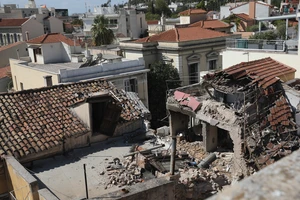
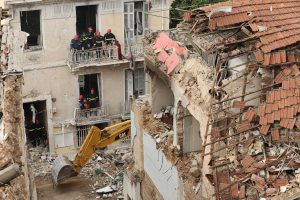
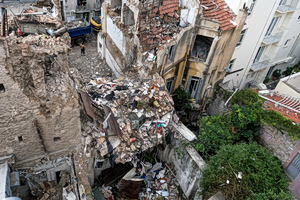
A section of corroded gas pipe has been removed from the site of the deadly Plaka explosion and sent to the Polytechnic for testing, as investigators widen their search for the source of the leak that killed six people.
According to retired fire brigadier and court-appointed expert Michalis Avgouleas, who spoke to Dimitris Kambourakis and Giorgos Choudalakis on the show “Oi Antikristoi” on Mega News 104.6, the gas distribution company EDA cut out the service pipe after it was found to show signs of corrosion. Experts will now determine whether a leak could have occurred at that point. Trenches will also be dug outside the building so the network can be inspected.
Avgouleas said the pipe appears to have lacked the external insulation required at the connection point. This insulation keeps soil from coming into contact with the pipe and protects it from corrosion, alongside the cathodic protection systems that gas networks are equipped with. He stressed that wherever there are metal components, corrosion can develop, and regular inspection and maintenance are essential.
A Possible Leak From Outside the Building
Until now, a leak in the building’s internal network had been considered the most likely scenario. However, Avgouleas said a leak from the external network cannot be ruled out.
He explained that when gas leaks underground, it can seep through the soil and through cavities and make its way into buildings. The stone walls of the building in Plaka could also have created pockets where gas could collect. Whether the leak started outside and then entered the building, he said, remains a matter for the investigation.
Were There Safety Valves?
Another open question is whether safety valves were in place. Gas networks are designed to include valves, both outside and inside buildings, that cut off the supply when pressure drops. Avgouleas said it has not yet been determined whether such valves existed at the site of the explosion, but that if they had not been installed, it would be criminal.
A Replacement That Never Happened
According to Avgouleas, the external network in Plaka is old, dating back to the era of town gas. It consists of the company’s external network, which runs up to the meter, and the internal installation beyond it.
He said an old network cannot remain in use indefinitely, since every network has a replacement timeline. The network in Plaka was scheduled to be replaced as part of the company’s five-year program for 2000 to 2005, but as far as he knows, the replacement never took place.
He added that this does not automatically mean there were no safety valves. The valves may have been in place but malfunctioned and needed replacing, something that will be checked.
Questions Over the Connection Date
Questions have also emerged over when the second-floor apartment was first connected to the gas network. While earlier reports placed the network’s construction in 2011, Vasilis Lambropoulos, crime reporter for ΤΟ ΒΗΜΑ and ΤΑ ΝΕΑ, told MEGA News that witness accounts point to 2012 or 2013, and some Fire Service findings suggest the connection may date back as far as the 1990s.
As previously reported, the fireplace and kitchen were found largely intact, and investigators are still searching for the missing water heater, which remains the focus of the Fire Service’s investigation inside the apartment.
Toxicology Tests Could Narrow the Search
The toxicology results, which will show which victims inhaled gas before they died, could also help investigators pinpoint where the leak was. According to Lambropoulos, if the foreign tourists who had rented an apartment in the building through Airbnb had not breathed in gas, that would suggest there was no leak in their apartment. All six victims, from the first and second floors, will be examined, and Fire Service officers are said to already have a rough picture of what may have happened, involving wear on the pipes.
Lambropoulos urged residents to have their own gas installations checked, since even the slightest wear can lead to a leak.
The lab results on the pipe, together with the upcoming inspections of the area’s network, are expected to shed more light on what caused the leak and the explosion.